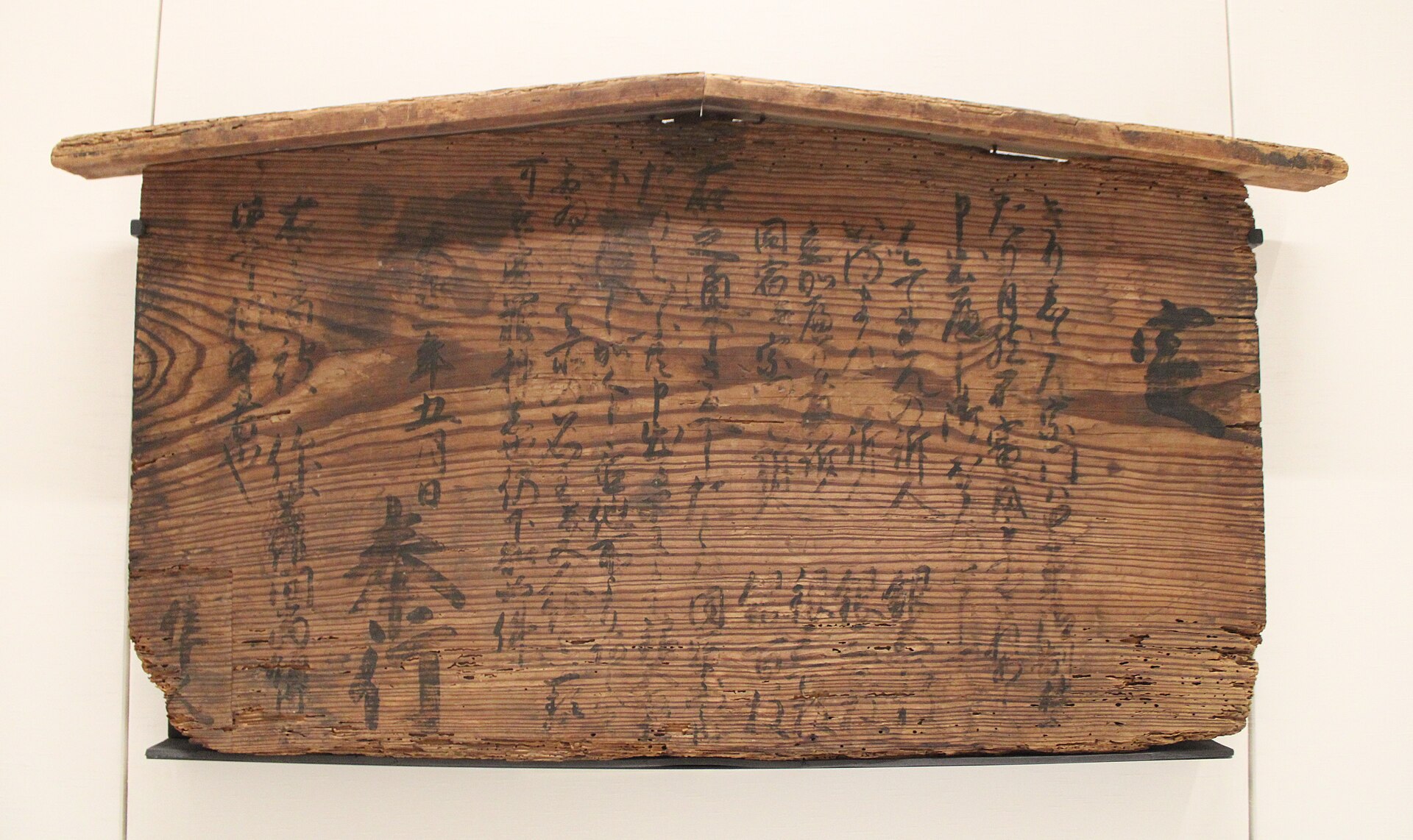
A notice about notices
The document that ended two and a half centuries of persecution does not mention Christianity.
Dajōkan Proclamation No. 68 of 24 February 1873 has a dull title: "On posting proclamations for thirty days, and removing the existing notice boards."New laws, it said, would be posted for thirty days; the old wooden notice boards, the , which had stood in towns and villages since the shogunate, would come down.Among them were the boards forbidding Christianity.
The National Archives of Japan treats this as the end of the ban: "This brought to a close the policy of prohibiting Christianity that had continued since the early Edo period."The Shimbun counts the ban at 259 years.But the government never announced that Christians were free. The ban was ended by removing a sign.
This page is about why the sign came down, and what that silence meant for the people it had been aimed at.
The boards of 1868
When the shogunate fell in 1868, many Japanese Christians hoped for change. They were wrong. The new government put up its own notice boards that year, and among them was a renewed ban on Christianity.(The 1868 board in the Nagasaki Museum of History and Culture is the one illustrated in the Japan Tourism Agency's account.)
It then did what the shogunate had not dared. In 1868 it sent 114 leaders of the Christians into exile at Hagi, and Fukuyama, and in 1870 it deported the whole village, 3,394 people, to 22 places in 20 domains.A crackdown also began in the in 1868.In the Christians' own name for it, this was the , the journey.
The ministers of Britain, the United States, France and the German states protested and asked that the exiles be allowed to go home.
What Iwakura heard
In 1871 the government sent its most senior statesmen abroad: the Iwakura Mission, led by Iwakura Tomomi, with the task of opening talks to revise the unequal treaties.It did not go as planned. Everywhere the envoys went, the Japan Tourism Agency's account says, they were sharply criticised for the treatment of the Urakami Christians and for the mass arrests then going on around and Nagasaki harbour, and pressed to allow freedom of religion.
The connection is usually drawn this way: Japan wanted to be treated as a civilised equal, and could not be while it was deporting its own Christians. That is the classic view of Otis Cary (1909) and D. C. Holtom (1947), and of later writers such as Abe Yoshiya.The historian Thomas Burkman, writing in 1974, argued that it overstates the foreign side. In his reading, domestic change set the direction and diplomacy was a catalyst.He points to the 1869 assembly, the Kōgisho, which voted, 164 of 227 members present, to keep the ban on Catholicism but rejected, by 189 votes to 22, a motion to suppress it by the death penalty. He also points to liberal voices such as Yokoi Shōnan and Nakamura Masanao, and to Finance Vice Minister Inoue Kaoru, once a hard-liner in Nagasaki, who in February 1872 petitioned for the release of some three thousand exiles.
The mission itself, Burkman shows, sent the plainest advice home. One of its recommendations read: "we should remove the regulations which forbid this from the public noticeboards. When foreigners read them, they think of us as barbarous people who have no respect for religious freedom and they therefore deny us equal rights." After a demonstration by Belgian Catholics, Itō Hirobumi telegraphed Tokyo asking for the exiles' release and the withdrawal of the edict.The government acted before the mission came home, although the leaders had agreed that no major changes would be made while it was away.Which mattered more, the pressure abroad or the change at home, remains a question of interpretation ().
Even the order itself was cautious. In Burkman's translation it said only: "The signboards which have been posted until now, because their content is common knowledge, shall be taken down." The ban stayed on the law books; what began was a policy of tacit toleration.Three weeks after the boards came down, on 14 March 1873, the government ordered the exiles returned to Urakami.Burkman gives the number released as 1,938, all home by July.
The Pope's letter
In Nagasaki, Bishop had spent the years of exile writing to Rome. Pope Pius IX had already sent him a brief in 1871 praising the exiles' courage. On 29 May 1873 he wrote again, in the brief Dum asperrimam, to share his joy at the end of the persecution."From this moment," the 's archive says, "the Japanese government showed itself disposed to tolerance," and Petitjean began organising his vicariate.
Coming home
How many came back? . The Japan Tourism Agency gives 1,930 in one text and 2,911, with 613 dead in exile, in its chronology; the Urakami parish history says about 1,900; Burkman says 1,938 were still in exile when the release was ordered, and that by British calculation seventeen percent of the deportees had died.The difference may lie in whether those who had recanted in exile are counted.
They came home to almost nothing. That September, 736 of the returnees had no house., one of the exiles, remembered buying the cheapest food there was, three-year-old dried sweet potato, full of worms. With no pot, the family soaked the slices in water and "ate the worms too." They dug their fields with broken pottery. But it was not hard, she said: they could work freely, and "we could say our prayers out loud."
In July 1874 dysentery broke out on Iōjima and spread to Urakami, then smallpox. Father nursed the sick, helped by young returnees such as Iwanaga Maki; the community they formed raised orphans and became the Urakami Jūjikai.
Churches in the villages
The ban's end changed the landscape of western Kyushu. Encouraged by the French missionaries, the communities that rejoined the Catholic Church began building churches in the very hamlets where they had hidden, simple at first and then grander, as priest-builders such as de Rotz in Sotome and Urakami and Father Pelu in Gotō trained Japanese craftsmen. One of those, , went on to design and build more than thirty churches.
Not everyone came back to the Church. Some communities kept the forms their ancestors had used in hiding; they are the people now called .
Freedom in law, 1889
The silence of 1873 was filled only sixteen years later. of the Constitution of the Empire of Japan, promulgated in 1889, said that Japanese subjects "shall, within limits not prejudicial to peace and order, and not antagonistic to their duties as subjects, enjoy freedom of religious belief."(Translation by the author of this draft.) The Japan Tourism Agency calls this the moment religious freedom was guaranteed by the state.The conditions in that sentence would matter in the 1930s.
The thread
The had been proclaimed on every village board. Its end in 1873 was announced by taking the boards away. For the Christians of Urakami, the difference was that they could go home, pray aloud, and start building.
