A port and its lords
Hirado (平戸) is an island port in the north-western part of Kyūshū (九州).Matsura Takanobu (松浦隆信), of the family that ruled the island, inherited the domain as a boy in 1541.His poor fief of four small islands pushed him into trade and privateering with the mainland.The Chinese corsair chief Wang Chih, based on the island since about 1542, piloted in the first Portuguese ship in 1550, and a Japanese chronicle records: "Hirado was at that time called the Miyako of the West."Portuguese ships came almost every year from 1550, and in 1553 the port became their preferred call.They stayed about three months each year, so the priest at Hakata (博多) would come to live there while the ships were in.Takanobu favoured the missionaries while the trade lasted, but turned to persecution once the Portuguese ships went elsewhere.
Francis Xavier's visit
Francis Xavier (ザビエル) first came to the port from Kagoshima (鹿児島) in the summer of 1550, to minister to the Portuguese of Francisco Pereira de Miranda's ship.When he returned with his companions that autumn, the Portuguese ships greeted the missionaries with an artillery salute and escorted them to the lord, who gave them leave to preach.About a hundred people became Christians within a few days, thanks to Br Juan Fernández's preaching and a translated book.Xavier stayed only briefly before setting out for Kyoto (京都), leaving Fr Cosme de Torres (トーレス) in charge of the new Christians.In the four months that followed, the priest baptised about forty more, among them his host Taniguchi Thomé with his wife, children and servants.The converts kept an image of Mary and a scourge that Xavier had left them for healing, and many people came to them hoping for help.
The first community and its first martyr
The Christian community of the port grew quickly in the 1550s, from about 200 in 1553 to some 500 by 1555.In 1553 the first nobles of the domain were baptised, among them Koteda Yasutsune Antonio (籠手田安経) and his brother.The brothers later led mass baptisms on the island, and their family stayed at the head of its Christians until 1599.Early in 1557 Fr Cosme de Torres sent Fr Baltasar Gago, Br Juan Fernández and Paul, a former Buddhist monk, to the port, and up to 300 people were baptised in one day.That September, with two Portuguese ships in harbour, the missionaries led a solemn procession with cross, music and a guard of arquebuses to a cross on a hill in the field the lord had granted as a Christian cemetery.Two churches were built in the town, and children learning doctrine sat boys on one side and girls on the other.Tension with the Buddhist clergy grew: after losing public debates, bonzes had a cross cut down at night, and some Christians in reply burned a Buddhist house and threw temple images into the sea.About 1558 the lord asked Fr Gaspar Vilela (ヴィレラ) to leave.In these years a Christian maidservant was killed by her pagan master for praying at a cross outside the town.She had told him she had not become a Christian to fear death, and he beheaded her as she knelt.Local legend names her O-Sen, and she is remembered as the first martyr of Japan.
Ships, quarrels and poison
The mission's fortunes rose and fell with the Portuguese trade.In 1560 Fr Torres asked for a viceroy's order banning Portuguese trade at the port, because Christians there were being forced to renounce their faith.In August 1561 a quarrel over the price of silk ended in a fight before the Shichirō shrine in which fourteen Portuguese, including the captain-major Fernão de Sousa, were killed.The clash became known as the Miyanomae Incident, and the Portuguese and the Jesuits looked for another port, first at Yokoseura (横瀬浦).In 1564 the ship Santa Cruz anchored outside the harbour and would not enter until the lord readmitted the priests, and a church was rebuilt.In August 1566 a new church of Our Lady of the Assumption was dedicated amid huge crowds.That year, however, men of the island seized the Christians' ship returning from India with church furnishings, and the lord's son disfigured a painting of the Virgin.By 1583 the islands of the domain had about 5,000 Christians, though the lord had once expelled the Jesuits, closed the church and cut down the crosses.After the edict of Hideyoshi (豊臣秀吉) in 1587 the daimyo destroyed several churches, yet the Jesuits gathered at the port and agreed unanimously to stay with their converts.Not daring to expel the missionaries outright, the lord of the domain had Jesuits poisoned: Fr Francisco Carrión died in 1590, and Fr Theodore Mantels died at Malacca three years later.Takanobu's son Matsura Shigenobu (松浦鎮信) was the only non-Christian daimyo to fight in Korea under the banner of Konishi Yukinaga (小西行長).
The exile of 1599
When the old lord Takanobu died in 1599, his son and heir ordered every Christian in the domain to abandon the faith for his father's funeral.His daughter-in-law Doña Mancia, a daughter of Ōmura Sumitada (大村純忠), refused and offered to leave her husband, who then gave way.The Christians answered that they would obey their lord in all else, but would die rather than give up a faith held from father to son.At a night signal more than 600 people of all ages, led by Koteda Jerónimo and the other Christian lords, embarked secretly for Nagasaki (長崎), most with only the clothes they wore.The angry lord had their houses burned and cannon fired, saying: "So much for the new law that I have driven from my lands" (translated).The exiles were lodged at the site of the old Jesuit college and fed by the Jesuits, and their number grew to about 800.Konishi Yukinaga later sheltered them, and some settled in Higo (肥後).Fearing the loss of so many subjects, Shigenobu stopped the persecution and promised the exiles they need not recant if they came back, but the Koteda and their followers refused.
Martyrs of the 1620s
By 1612 the Dutch, and from 1613 the English, had trading stations at the port, and in 1616 English ships were restricted to it.The persecution of Christians meanwhile grew fiercer.Br Augustine Ota, a Japanese Jesuit, was beheaded at Hirado on August 10, 1622.His host, Gabriel Ichinose, was beheaded at Ikitsuki (生月) in 1622, preaching on the way that the Christian religion would rise again in its time and spread through all Japan.On March 3, 1624 his whole family, including his grandmother Maria, over ninety and one of the first Christians of the island, was beheaded at Kōchi-domari, the domain's execution ground.In that year alone the lord had 38 Christians killed in two and a half months, sparing not even servants, babies or apostates.Among them were Michael Yamada Hiemon, his wife Ursula and their three children; after watching her husband and two children die, Ursula offered her own life and that of her last child, Madeleine, aged two.It was said that in 1624 this domain alone shed more blood for the faith than all the other kingdoms from Kyoto to the Gotō islands together.The killings went on into the 1630s: John Macouza was drowned at Hirado on February 12, 1632.
The return of the Christians
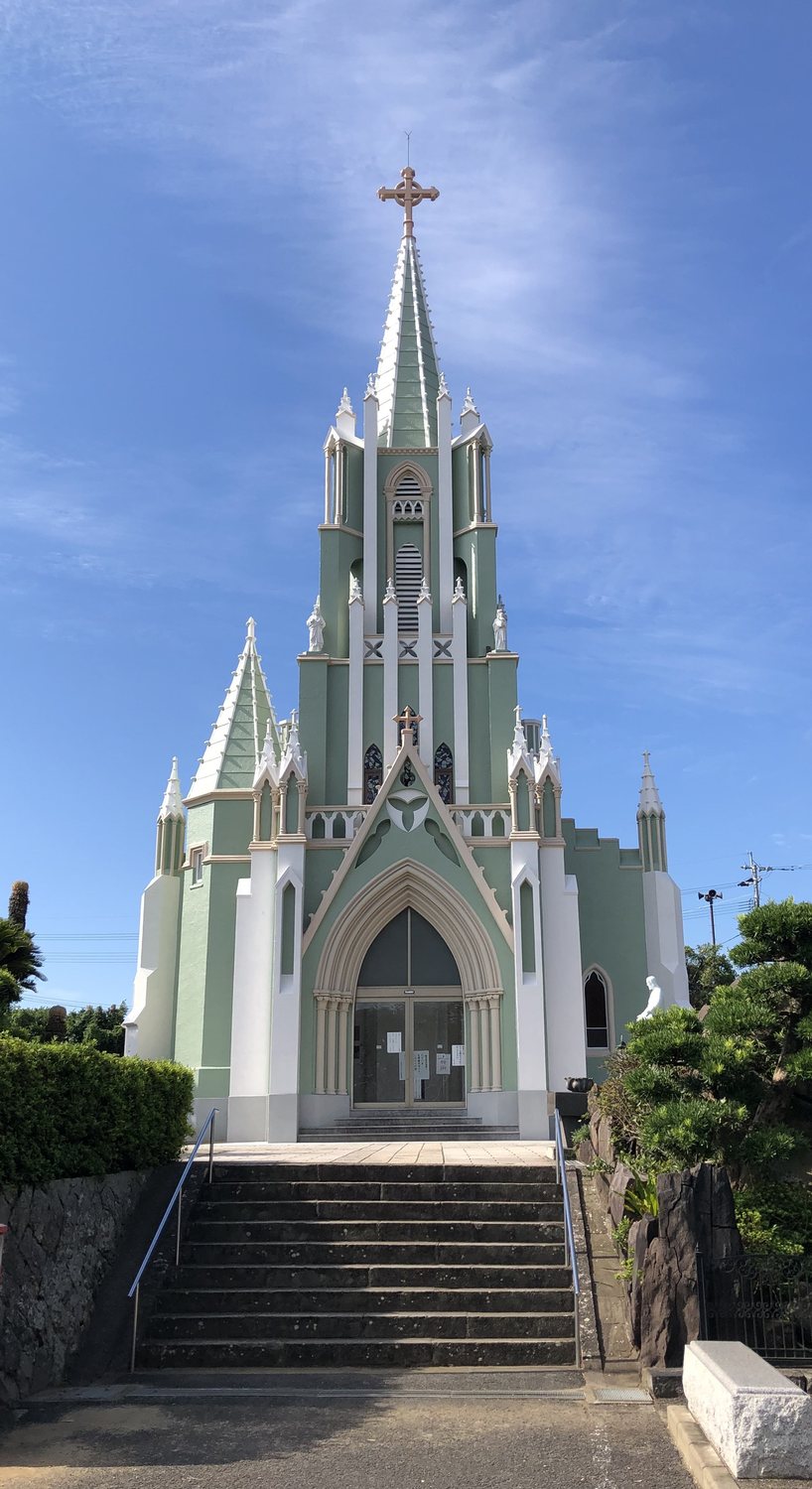
Christian families survived in the villages around the port into the nineteenth century.In 1867 a Christian known as Michael of the Discipline went to the island and its neighbours, where about a thousand Christian families were said to live, and brought some of them to the missionaries.When persecution returned, Christians from the Gotō (五島) islands under the domain were shipped to the town in November 1869, and early in 1870 its hundred-odd Christian prisoners were plunged into icy water until they apostatised.By about 1883 there were five or six thousand Catholics in and around the town, and that year they built a large church at its centre, on the spot where the Cross and holy images had once been trodden underfoot.The local authorities sided with Christians who refused to pay for temple festivals, and ordered Buddhists to return property taken from them ten years before.In the twentieth century a large church stood at Hōki (宝亀) on the island, among many old Kirishitan villages.
What is uncertain
Where the sources disagree
- The date of the maidservant's martyrdom. Profillet gives 1557; Anesaki and Omata Rappo give 1559, and the name O-Sen comes from local legend.
- The size of the 1599 exile. over 600 at first, then 200 more (Profillet, Pagès); 700 (Valignano, Cerqueira's letter); about 800 (Solier, Oliveira e Costa); Profillet's entry for Tomás Koteda speaks of 900 of the family and household.
- Xavier's host in 1550 was Francisco Pereira de Miranda, not Duarte da Gama as often stated (Schurhammer).
- The length of Xavier's stay. ten days (Cary, Murdoch) or twenty days (Bartoli-Maffei).
- The number of Christians in 1557. about 400 (Torres) or about 500 (the editor's collation).
- Gabriel Ichinose's death. Pagès gives July 26, 1622 at Ikitsuki; the martyrology also lists a July 26, 1621 death at Nakazaki, which Anesaki treats as a duplicate; his personal name is spelled Shinshirō, Kinshiro or Jinshiro.
- Fr Francisco Carrión's death is dated May 1590 (Profillet) or August 1590 (Boero).
- Charlevoix says four later Jesuits, including Fr Giuseppe Fornaletti, were poisoned too; Boero's catalogue places Fornaletti's death at Arima in 1593.
- When the English left. Pagès places their final withdrawal after 1623, but elsewhere says they had already left by 1621.
