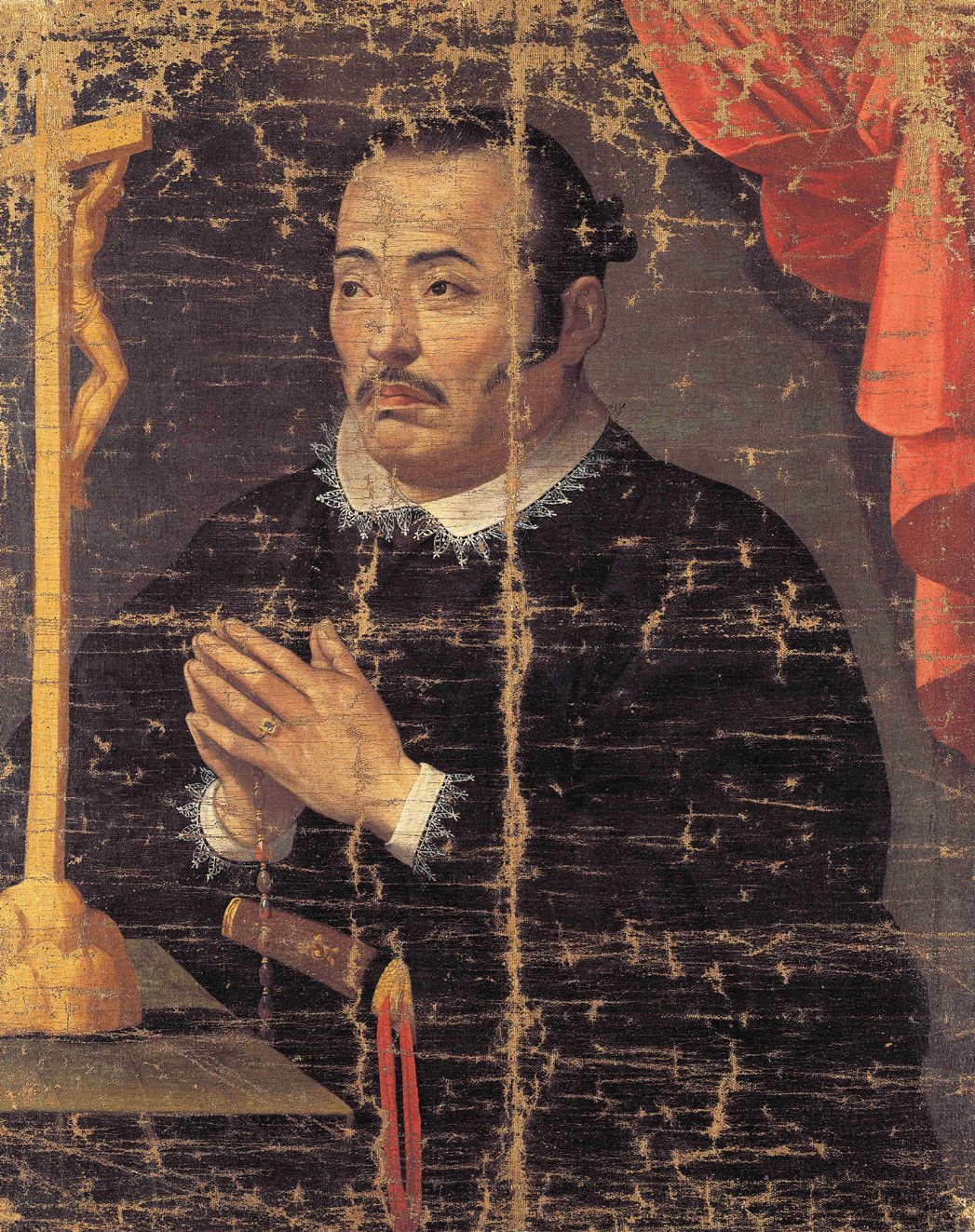
Why the embassy was sent
The Keichō Embassy was a mission sent in 1613 by Date Masamune (伊達政宗), lord of Ōshū (奥州), to the king of Spain and to Pope Paul V (パウルス5世).As his envoys the daimyo chose the Franciscan friar Luis Sotelo (ルイス・ソテロ) and one of his own retainers, Hasekura Rokuemon (支倉六右衛門), also known as Hasekura Tsunenaga (支倉常長).The friar had proposed the embassy in a letter, and Masamune promised to supply the men and money it needed.The daimyo wanted two things: to show his favour to the Christian faith, and to make a political and commercial treaty with Spain.
His letter to the Pope, dated at Sendai (仙台) on October 6, 1613, asked for Observant Franciscan friars and for a great prelate to lead the conversion of his lands, and promised to build monasteries at his own expense.He explained why he did not become a Christian himself: he "would not hesitate to profess them openly if certain affairs had not hindered and invincible reasons prevented my doing so".He also asked the Pope to help him win the friendship of the king of Spain, since New Spain was not far from his realm and lay on the friars' necessary route.Draft articles for the Spanish king offered free trade, help for the Manila galleons, and wood, iron and carpenters for Spanish shipbuilding.A letter to the city of Seville, dated October 26, 1613, came with a sword and dagger and asked for pilots to show whether ships could sail each year between his seas and Spain.
The plan was known to Tokugawa Ieyasu (徳川家康), whose own admiral, Mukai Shōgen (向井将監), oversaw the fitting out of Masamune's ship.
Across the Pacific to Mexico
The embassy sailed in October 1613 from Tsukinoura (月浦), a small port about forty miles from Sendai.On board were the friar, two other Franciscans, the ambassador, and a large company of samurai and merchants.The merchants filled the ship with folding screens, chests of drawers and other goods to sell in Mexico.
The ship reached Acapulco in late January 1614.The viceroy received the envoys with honour, and they had an audience in Mexico City on March 24, 1614.During Holy Week, sixty-eight members of the ambassador's suite, fully instructed in the faith, were solemnly baptized in the church of San Francisco and confirmed by the archbishop.Hasekura wished to be baptized too, but on the advice of the archbishop and the commissary general he waited until he reached Spain.
Many of the party stayed behind in New Spain while the ambassador went on with a smaller group.He left Mexico City on Ascension Day, sailed from San Juan de Ulúa on June 10, 1614, and reached Havana on July 23.
Spain: an audience and a royal baptism
The embassy landed at Sanlúcar de Barrameda on October 5, 1614, where the Duke of Medina Sidonia lodged the envoys in a palace.Seville, the friar's birthplace, welcomed them with great enthusiasm.The cathedral chapter offered to hold the ambassador's baptism there, but it was judged better to leave that honour to the king.The party left Seville in late November and entered Madrid on December 20, 1614, lodging at the Franciscan convent at the king's expense.
On January 30, 1615, Philip III (フェリペ3世) received the embassy in solemn audience.Hasekura presented his lord's wishes and asked the king to send friars to preach and give the sacraments.He then asked for one personal reward: to be made a Christian "by his royal hands" (translated).The king agreed that the ceremony would take place in his presence.
In February 1615 the ambassador was baptized at a convent of the Discalced Franciscans in Madrid.Philip III, the queen-elect of France and the two infantas were present.The king's chief chaplain, Diego de Guzmán, performed the rite in place of the sick cardinal-archbishop of Toledo, and the Duke of Lerma stood as godfather.The new Christian took the name Felipe Francisco.He said he counted himself the happiest knight in all Japan, not only for becoming a Christian but for the honour of the king's presence.
While in Madrid the ambassador took Dr Scipione Amati of Rome as interpreter and agent for the embassy.The interpreter travelled with the envoys and wrote the embassy's history, printed at Rome in 1615.
Rome and Pope Paul V
After about eight more months in Spain, the embassy set out for Rome.At Alcalá de Henares three of the ambassador's companions, Don Thomas, Don Pietro and Don Francesco, were so moved by the friars that they resolved to become Franciscans, and had to be held back.The envoys went on by way of Zaragoza, Montserrat and Barcelona, then sailed to Savona and on to Genoa, where the Doge and Senate received them warmly, before landing at Civitavecchia.
The embassy made its solemn entry into Rome on October 29, 1615.Hasekura rode at the right hand of the Pope's nephew, Marc'Antonio Vittori, in a white robe worked with animals, birds and flowers in silk, gold and silver.Watching him ride up the Capitol, the interpreter wrote that he "seemed one of those ancient triumphant ones" (translated).
The public audience with Paul V took place on November 3, 1615.The envoys handed the Pope a silk purse holding Masamune's letter in Japanese and in Latin.Fr Gregorio Petrocchi spoke for the daimyo and his envoys, presenting him as a Christian in intention, and Pietro Strozzi replied for the Pope.At the end, the twenty-five members of the retinue kissed the Pope's feet one after another.
On November 15, Sotelo presented three Japanese Christians sent by the Christians of Japan to report on their church.They gave the Pope a crucifix in a casket made from a piece of the wood on which a Japanese religious had been martyred.One modern study treats the embassy as part of the beatification process of the twenty-six martyrs.On November 20, 1615, Rome made Hasekura a Roman citizen, and the envoys left the city about that time.A brief of Paul V to the faithful of Japan promised a seminary in Ōshū once a bishop was established there.Sotelo was designated bishop of the territory, but he was never consecrated.
The long road home
In the end the embassy won little: the Spanish court declined most of its requests, and the results fell short of its splendid reception.Spanish law allowed only Manila, among the colonies, to trade with Japan, so direct trade with Mexico threatened Manila's privileges.The Franciscans in Japan, who had come from the Philippines, opposed Sotelo because of their ties to the Manila merchants, and Cerqueira (セルケイラ) feared that a large Franciscan mission in Masamune's lands would make Ieyasu suspect a Spanish alliance.Japan itself had turned against the faith, with a ban on Christianity in 1614 and a rule in 1616 limiting foreign trade to Nagasaki (長崎) and Hirado (平戸).
The envoys sailed back toward New Spain from Sanlúcar, and in 1617 Hasekura and the friar reached Acapulco, where they found one of Masamune's ships.A new governor of the Philippines chartered the ship to Manila, which they reached in June 1618.There the friar stayed, and the ambassador went on ahead.
Hasekura reached Sendai in August 1620, after seven years away, with a suite now numbering only eleven people.By then his lord was anything but a patron of Christianity.Masamune had waited for his envoy's return before moving against the Christians of his domain.
Hasekura Tsunenaga before and after the embassy
Hasekura Tsunenaga, born in 1571, was a retainer of Date Masamune.The interpreter Amati described him as a knight of an old family whose ancestors had come into Ōshū from Kyoto (京都), and as a captain of the arquebusiers of the daimyo's guard.The Jesuit Jerónimo de Angelis called him the son of a man once beheaded for theft, and another account says that the beheading he himself owed for his father's crime was changed into the dangers of the voyage.When he was named ambassador, his lord moved his wife and children and gave them a villa and two villages, and many at court envied his good fortune.
On his return in 1620, Masamune sent word that the envoy was not to appear before him except as an apostate.Reports differ on how the ambassador answered this demand.He died not long afterward, and a letter of 1622 spoke of him as recently dead.A martyrology records that his son Tsuneyori was executed at Sendai in 1640.
What the embassy left behind
Some members of the embassy never went home.Luís de Encío, born in 1595 at Fukuchi in Sendai, probably came with the embassy and became a shopkeeper in Guadalajara, where he died in 1666.Another Japanese, Don Tomás Felipe, stayed in Spain, was held as a slave at Zafra, and in 1622 won leave to return to New Spain as a free Christian.
In Japan, the objects the ambassador brought back from Rome were later held by the Date family.A Japanese collection compiled in 1812, the Kinjō hiun (金城秘韞), described them, including forty-two small gilt metal plaques that may be medals.A box of nineteen books, apparently his own notes in kana, still existed in the Bunka era but was lost early in the Meiji era.In the 1870s a missionary of the Paris Foreign Missions found at Sendai the parchment of November 20, 1615, that made him a Roman citizen.The story was later retold in a 1980 novel, Samurai, which gives the envoy an invented death at the stake.
What is uncertain
Where the sources disagree
- Departure date. Cary and Murdoch give October 21, 1613; Delplace, Amati, Anesaki and Sousa give October 28; Fujita gives October 29.Profillet reads October 28 as the arrival in New Spain, which the standard account treats as the departure.
- Arrival at Acapulco. January 24, 1614 (Cary, Murdoch) or January 25 (Sousa, Profillet); Fujita has them reach Mexico on January 25.
- Size of the party. Sousa gives 150 to 180 Japanese, Amati 150 Japanese servants, Cary some seventy members plus merchants, Delplace 60 samurai, and Murdoch "more than sixty" in Spain.
- Baptism date. most sources give February 17, 1615; Marnas gives February 16. Sources also differ on the place: the chapel of the Discalced Franciscan nuns (Descalzas Reales) in Amati, or the Discalced Franciscan friars' convent in Profillet and Murdoch.
- Departure from Seville. the Italian Amati gives November 25, 1614 (St Catherine's day); the German translation's November 28 is a slip.
- Arrival at Zaragoza. September 20, 1615 in the German Amati, September 30 in the Italian.
- Who planned the embassy and why. Amati presents it as Masamune's response to Sotelo's teaching; the Jesuit Jerónimo de Angelis wrote in 1619 that "This embassy is an invention of Luis Sotelo" (translated), and Fujita reports him saying it served Sotelo's wish to be a bishop; Cerqueira called it inopportune and ill-founded.
- Real aims. Bartoli, Charlevoix and Sotelo's own later confession to Gonroku stress trade with New Spain; a Venetian dispatch reports a claim in Rome that Date would try to supplant the shogun; Murdoch thinks the Tokugawa probably sanctioned the embassy.
- Ieyasu's part. the Italian Amati says Ieyasu had a ship built in 1612 to carry Sotelo as his own envoy and that Masamune first asked to send servants with it; Pagès says Sotelo claimed in Europe to represent the shogun, which Cary doubts.
- What was asked of Philip III. Pagès quotes Hasekura placing Date's person and kingdom "under Your Majesty's wings"; Meriwether, following Berchet, reduces this to a request for perpetual friendship.
- Seville's welcome. Lee argues the festivities mainly celebrated Sotelo's homecoming rather than the Japanese visitors.
- Sotelo and a bishopric. Charlevoix says Paul V wished to send Sotelo back as bishop but the king of Spain opposed it; Delplace says Sotelo briefly hoped to be named cardinal legate; Murdoch says he sought an archbishopric.
- France. Morris says the embassy went by way of Spain, France and Italy; the facts give no details of a French stop.
- The return from Europe. Sousa has the embassy leave Sanlúcar in June 1616, while Cary and Charlevoix put Hasekura and Sotelo at Acapulco in 1617; Pagès says Masamune's ship reached Uraga in August 1616 with Hasekura aboard.
- Arrival home. Cary and Meriwether give Sendai in August 1620; Sousa gives Nagasaki on September 22, 1620; Bartoli gives Ōshū toward the end of September.
- Hasekura's faith after his return. Bartoli says he declared himself an apostate, at least outwardly, within ten days; Bishop Valente's relation of April 14, 1621 lists him among the apostates; the Macao annual letter of 1622 says it was unknown, though rumour said he behaved shamefully; Pagès and Murdoch report that he called Christianity an empty show; a letter by his grandson in 1677 says he was never a Christian at heart. On the other side, a memorial attributed to Sotelo says he made his wife, children, household and many vassals Christians and died piously, and Jennes has him die still a Christian.
- Date of death. Sotelo's memorial says less than a year after his return; Jennes gives January 7, 1622; Morris gives 1622; Fujita says two years after his return.
- His family background. Amati claims an old noble lineage, and the embassy's writings call him "of royal blood" (translated), which Japanese sources do not support; De Angelis says he was the son of a man beheaded for theft.
- Amati says that Hasekura, as captain of the guard, carried out Masamune's order to burn a temple whose bonzes refused to destroy it; no Japanese source supports this.
- The citizenship patent. Delplace cites a report of 1875 for its discovery, Marnas gives 1876; Delplace calls the title Roman patrician, Marnas citizen and senator.
- The sons executed in 1640. the martyrology names Tsuneyori; a Sendai tradition cited by Anesaki names Tsuneyori and Tsunenao, beheaded on April 9, 1640.
- Murdoch suggests a Japanese envoy to Europe shared responsibility for the expulsion decrees; Delplace calls this claim puerile.
