A Christian community in the north
Yonezawa (米沢) was the chief city of Dewa (出羽).Its lord, Uesugi Kagekatsu (上杉景勝), esteemed Christianity and never persecuted, so his lands enjoyed peace while neighbouring states persecuted.Until his death in 1628 he reported to the shogun's council that there was not a single Christian in his domains, though there were thousands.He is said to have told the shogun that there were no Christians in his states.
The mainstay of this northern church was Louis Amakasu Uemon (甘糟右衛門), a noble captain who had won three battles.Retired to his lands, he preached to his vassals so fervently that his sermons became a proverb.He was head of the Jesuits' Congregation of Our Lady at Yonezawa and the universal father of its Christians.Once, to rouse a lukewarm Christian, he thrust his hand into burning coals and asked how the man could bear the fire of hell if he shrank at this.He sheltered Jesuits in his house and gathered the faithful there for the sacraments.His elder son Michael had brought a young nobleman, Paul Nishihori Shikibu, to the faith.Every year, after the snow melted, a Jesuit came to Yonezawa.
The order of December 1628
Kagekatsu's son and successor, Uesugi Sadakatsu (上杉定勝), called Danjō, had been raised in hatred of the Christian God.Needing to court the shogunate, he ordered his chief minister Shida Shuri to list the Christians and force them to abjure.The minister was a moderate man and a close friend of Amakasu.He asked whether the prince would lose in one day more than three thousand subjects, many of them the flower of his nobility.He even wrote out the maxims of the Christian law and asked whether people of such pure morals could be killed.The second governor, Izumo, a mortal enemy of the faith, pressed the other way.
The lord returned to Yonezawa on November 30, 1628, and spoke bitterly against Amakasu and his two sons.On December 22, 1628, he gave a written order to kill all who followed "the law of Yémoné" (translated).In the end he resolved to kill the leaders of the Christian community and those who followed them.
The night before
On the evening of January 11, 1629, two samurai sent by the minister told Louis Amakasu and his sons that they would die the next day.Michael, the elder son, lay sick, but on hearing the news it was said he rose cured and rode to his father with the good news.The father had long before had coffins made for himself and his sons, and now had more made.The whole family gathered at his house, the two young wives each carrying a baby daughter.Michael's wife Dominica was 23; Tecla, wife of the younger son Vincent Kurogane Ichibyoe, was 17 and had been a Christian for only one year.She refused the last kisses of her own pagan mother.
That evening Amakasu and his sons sent their swords and daggers to the governor, a Japanese sign of submission by the condemned.His servants refused to be dismissed, even boys of twelve and fourteen, and he declared them all Christians.Timothy Obasawa and his wife Lucia, Christians driven out of Edo whom he had taken in, gave themselves up as members of the household.The family spent the night in prayer.
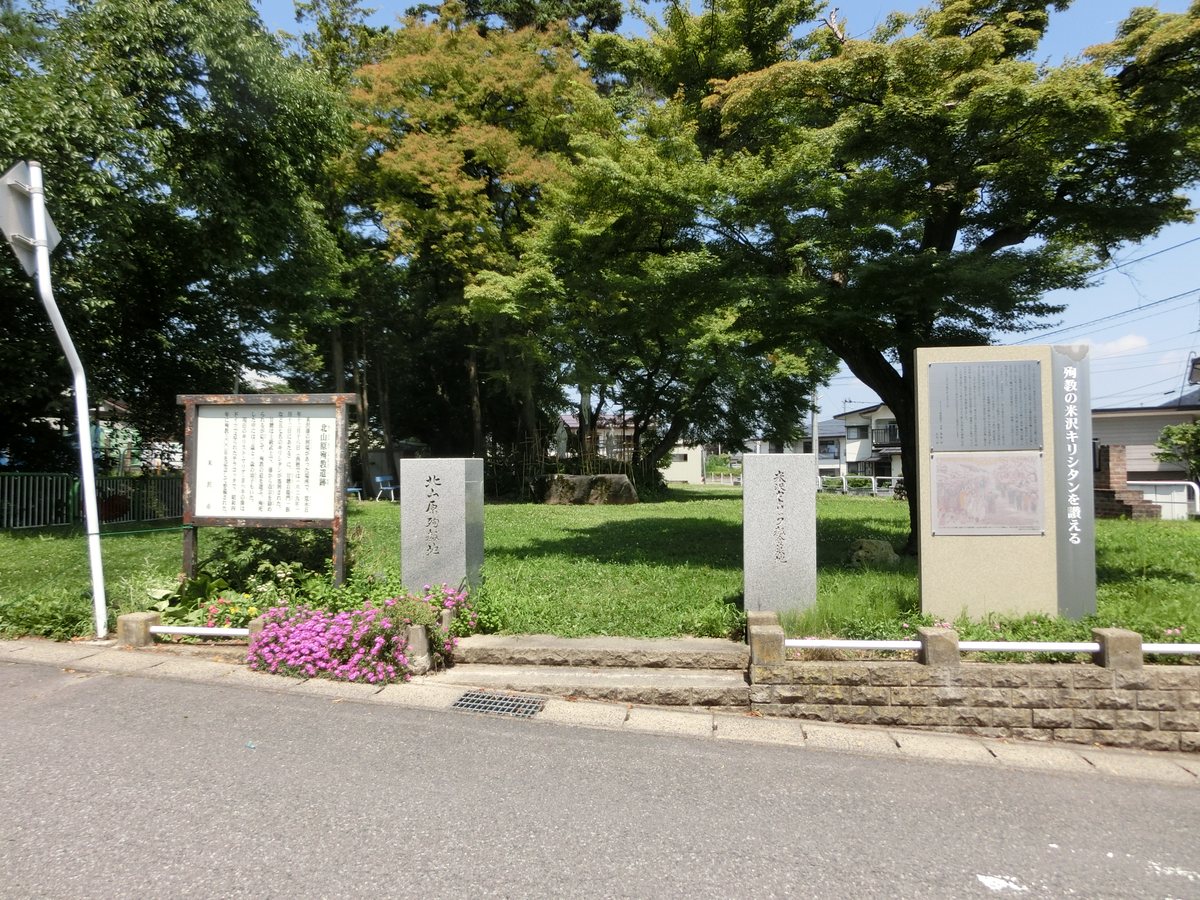
January 12 at Hokusanbara
None of the nobles was imprisoned; officials fetched each from his own house.They reached the Amakasu house two hours before dawn and found the family already bound, with ropes round their necks.The procession went out to Hokusanbara (北山原), a short way from the city.A boy carried a lit torch, and a twelve-year-old page carried an image of Our Lady on a pole.The women went next with the babies, then the men, the servants and old John Gorobyoe, Louis Amakasu last, all richly dressed with rosaries round their necks.Passing the house of Paul Nishihori, the old captain sent word that he would wait for him at Hokusanbara or in heaven.A rich farmer named Joachim, a recent convert, ran to join them.
The snow lay deep and was cleared for the execution.Seeing pagan spectators standing while the gentlemen prayed, the presiding officer made them kneel in the snow.A layman gave each of the condemned an image of the Blessed Sacrament to kiss, in place of Communion.Three times they said: "Praised be the Most Holy Sacrament" (translated).The women and the two babies died first, then the men, and Louis last: fifteen in all.Two boys and other servants who begged to die were sent home by force.The young wives were laid in their coffins with their beheaded babies in their arms.
The other households
More groups followed through the day.John Banzai Kasuemon had written a long memorial offering himself as the victim for all.He died with his wife Aurea, his son Antony, his son-in-law Paul Sanjuro, his daughter Rufina and their children Paul, aged five, and Martha, aged one.Simon Takahashi Chuzaemon, a gentleman of the lord's guard, was followed by his daughter Tecla, aged thirteen, who escaped from those holding her back and was beheaded beside him.
Paul Nishihori Shikibu was 31, tall and much loved at court, and had been a Christian for six years.Three weeks earlier he had kept Christmas in the hall of his house with an altar and images, and in his last eighteen days he converted four idolaters.His wife Magdalena begged to die with him, but she was spared at her father's request.He asked that the martyrs' bodies be given to Fr Giovanni Battista Porro or the first Jesuit to return after the snow.Feeling unworthy of ground soaked with the others' blood, he had a new space cleared nearby, venerated the heads of those already dead, and was beheaded.
Last came the old couple Louis Jinemon and Anne, then Mancio Yoshino Saemon and his wife Julia.The old man, over 80, ran ahead so as not to keep their companions waiting, and his wife held the trailing end of his rope to keep up.Pagans asked whether, as a young bride, she had gone so happily to her wedding.Mancio had once wavered, but recovered and sent his weapons to the governor.With them the number killed in the town reached twenty-nine.
The villages and Hoyo
Thirty-one more were killed from four nearby villages, Nukayama (糠山), Shidogadai, Hanazawa and Hoyo, most of them at Hokusanbara.The first was a village of the lord's retainers, baptized only that year after instruction by Antony Anazawa Hayemon.He died with his sons, among them Mancio, aged 14, and Michael, aged 11.At Hanazawa, Candido, aged 14, a Christian for less than a year, laughed at an offer of life and died smiling.On January 13 a baby of one year, Ignatius, was beheaded.
On January 16, Joachim Minagawa, over 80, lame and nearly blind, was led out at night in a snowstorm.On the icy road the young soldiers kept falling while he walked without stumbling.That day, at Hoyo, John Mino, aged 80, head of the Christians of a nearby village, was crucified with his family and others.On the road he had kissed the displayed head of Louis Amakasu, who had baptized him.
By one account, sixty were killed in Yonezawa and its lands.The heads were set on busy roads, twenty-five of them at Hokusanbara, each place with a placard.It read: "All these were Christians, and because they were so against the law that forbids it" (translated), and gave the date as the 18th of the 12th moon.
Afterwards
Pagans at Yonezawa, who had never seen Christians die, said that baptism must give a new soul that despised life.Of more than three thousand faithful, only these few courtiers were killed in the town.Yet the lord persisted, and his land became one of those where the blood of martyrs flowed most abundantly.In 1654 more Christians were beheaded at Yonezawa.In 1929 a missionary there marked the three hundredth anniversary with a book on the martyrs.
What is uncertain
Where the sources disagree
- How many died. Profillet, Bartoli, Charlevoix and Pagès give twenty-nine in the town on January 12;Bartoli adds thirty-one from the villages and sixty in all;Pagès, as listed by Anesaki, gives about twenty more from January 13 to 17.The martyrs beatified in 2008 are given as 53, and a Japanese bishops' source gives 30 men and 23 women, nine of them aged five or under, though this count is uncertain.
- The village deaths. Bartoli dates most of them to January 12;Profillet and Pagès spread them from January 12 to 16, including the crucifixions at Hoyo.
- Joachim the farmer. baptized three months before in Profillet, thirteen months in Charlevoix.
- John Banzai's name. given as Gansuemon, Kasuemon, Gasuemon and Kazue.
- Michael Amakasu's age. 23 in Charlevoix, 35 in Bartoli.
- The size of Louis Amakasu's party. 17 in Profillet, 20 in Bartoli;Charlevoix says fourteen were named in the sentence.
- Names of the old man with Anne. Louis Inemon in Profillet,Louis Jinemon in Pagès as listed by Anesaki.Anne had been baptized a year before, or only five months.
- Timothy's family name and wife. written Obasawa Hirobyoe or Obasama Jirobyoe; Lucia may have been his wife or his daughter.
- Candido's family. Profillet calls Alexis Shoemon his relative;Bartoli calls Alexis his elder brother.
- Dates outside January 12. Profillet gives January 17 for the blind catechist Joachim Shoichi, and prints some years wrongly (1621, 1622, 1625, 1529) for 1629.
- Paul Nishihori's wife. Bartoli says the prince let her live openly as a Christian;Charlevoix says she was later ordered to prepare for death and received it with joy.
- The surname Inda may be Iida, and Anazawa may be Akazawa, according to Anesaki.
