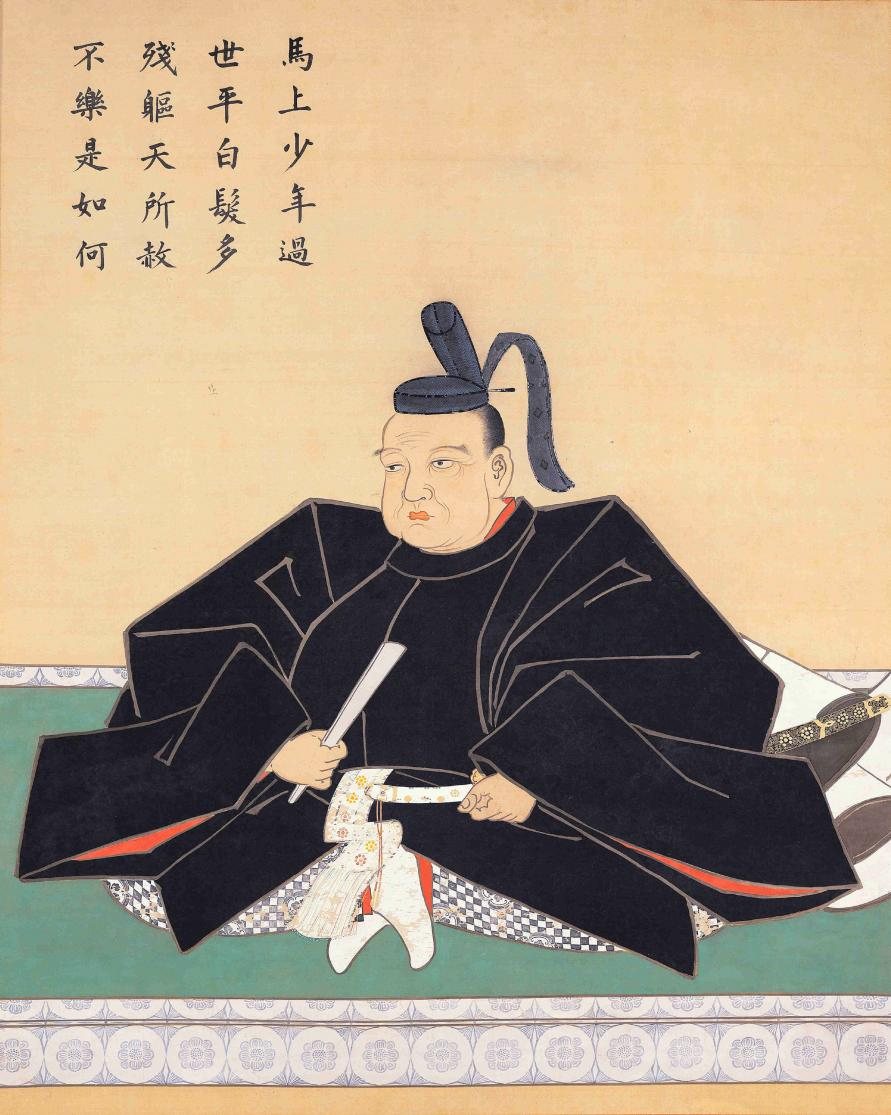
A great lord of the north
Date Masamune (伊達政宗) was the daimyo of Sendai (仙台) in northern Japan, a lord who welcomed Christian missionaries for some years but did not become a Christian himself.He was born in 1567.In 1590, aged 22, the young lord was summoned to the camp of Toyotomi Hideyoshi (豊臣秀吉) before Odawara (小田原), where he was soundly rated and ordered to surrender his recent conquests, which were then restored to him.In August 1595 he was suspected of involvement with Hidetsugu (豊臣秀次), and his leading retainers had to swear allegiance to the ruler and promise to report any treachery by their own master.
The next year the lord of Sendai showed off his wealth.In the procession of gilded barges that escorted the Chinese envoys back to Sakai (堺), the finest entry of all was his, paid for by extra taxes squeezed from his retainers at home.Another account says that after the Chinese embassy the great lords built ornate pleasure ships, and that his surpassed them all, with all its cables and cordage of crimson silk.
He was one of the most enterprising men of his day, promoting trade, farming and forestry and planning canals.As his statue at Matsushima (松島) shows, he had only one good eye, but it was commonly said that "he could see more with this one than most persons could with two."
Ally and suspect of the Tokugawa
In the Aizu (会津) campaign of 1600, Masamune attacked Uesugi (上杉) from the north-east on the orders of Tokugawa Ieyasu (徳川家康), kept up a vigorous offensive and relieved Mogami (最上) at Yamagata (山形).He and that ally bore the brunt of the fighting.Under the Tokugawa his fief was returned at 605,000 koku, his loyalty having added only 25,000 koku to it.
Marriages tied his house to the new rulers.His daughter Iroha married Matsudaira Tadateru (松平忠輝), a son of Ieyasu, and his heir Date Tadamune married Furihime, an adopted daughter of Tokugawa Hidetada (徳川秀忠).
In the winter campaign of 1614 the daimyo left Edo (江戸) for Osaka (大坂) with 10,000 men on November 22, ahead of the main army.On June 1, 1615, his troops in the Tokugawa van fought a stubborn and indecisive action at Domyoji (道明寺), and two days later he led the Tokugawa left column next to the sea.
The family ties also brought danger.Tadateru was suspected of plotting to replace his brother as shogun, and his father-in-law may have been involved.In a diary entry of August 18, 1616, the diarist Cocks noted that Ieyasu's son had been attainted of treason for wanting to set up Hideyori, and wrote: "It is thought it will goe hard with Masamone Dono".Tadateru lost nearly all his lands and was banished.The lord of Sendai, by contrast, kept his own domain intact through a pliant and adroit policy.
Friend of the Franciscans
In 1611 the daimyo invited the first Franciscans to the Sendai domain.That year, on St John's day, he met the Spanish ambassador on his way to mass, dismounted and asked the soldiers to fire their guns, and many horses in his train bolted and threw their riders.
The friar Luis Sotelo (ルイス・ソテロ) entered Ōshū (奥州) and founded several Christian communities there, and the daimyo wanted private conversations with him.According to accounts from the embassy's own party, the friendship began when a Franciscan healed a sick woman of the lord's household.The same source says Masamune was delighted that Sotelo spoke Japanese so well, asked him about Europe and its religion, and later asked to be taught the law of one God.
That account also says that on November 23, 1611, the lord posted an edict at his palace gate and in his own hall: the law of God was to be preached in his lands, and whoever wished might freely be baptized.He is reported to have told the friar that he would gladly become a Christian, but for the hatred of his kinsmen and because it would make it impossible for him to attain the empire in his time.Meanwhile, he said, he would worship the one God and have his subjects become Christians in his place.When Sotelo was later held prisoner in Edo, a Franciscan relation says the friar was spared through the daimyo's intervention.
The embassy to Spain and Rome
In 1613 Masamune named Sotelo and Hasekura Rokuemon (支倉六右衛門) as his ambassadors to the Pope.In his letter to Pope Paul V, dated at Sendai on October 6, 1613, he said he would profess the faith were he not hindered by certain affairs, asked for Observant Franciscans and promised to help build their monasteries.He also asked the pontiff "to institute and create a great prelate" (translated) for his realm, whose costs he would pay himself.He signed as Idate Masamune, a form said to be a special mark of honour to the person addressed.
A second letter, to the city of Seville, was dated at Sendai on October 26, 1613.In it the daimyo said he knew the faith through Sotelo and wished to be baptized, but could not yet do so for grave causes; he wanted all his vassals to embrace it.He asked for pilots so that his ships might sail every year to Seville's ports, and sent a sword and dagger as a pledge of goodwill.
In Rome the embassy's speakers praised him as the greatest favourer of the faith among the kings of Japan, unbaptized only because of the danger to the new planting of the Church.The Pope's reply hoped he would very soon put on the white garment of baptism.
Tolerance without baptism, 1614 to 1619
After the shogunate's anti-Christian law of 1614, Masamune did not put it into effect in his domain, and persecution there did not begin until 1620.His goodwill had limits, however.On June 5, 1615, Fr Porro, fleeing Osaka, asked him for safe passage to Muro and Nagasaki (長崎).The daimyo answered through a page that he would have granted the request at once, had the priest not been a Christian.This came at the very time his envoy Hasekura was presenting him in Europe as a protector of the Christians.
In 1618 Fr Diego de San Francisco sent the Franciscan Francisco Gálvez to him with a letter and gifts on Sotelo's behalf.The lord received the friar well and allowed him to preach and baptize in his capital.Gálvez also passed on to him the official answers that Sotelo had obtained in Europe.
Fr de Angelis, a missionary who also worked in his lands, wrote in 1619 that the daimyo was far from being a catechumen.The lord did give his vassals licence to become Christians, and the priest found about two hundred Christians there.
Turning persecutor, 1620 to 1624
In 1620, under pressure from Edo and suspected because of his embassy, Masamune turned against the Christians.A letter written from Macao in 1622 and a later history say he feared the shogun would see the embassy as a bid for an alliance with the King of Spain, and that he persecuted to prove his loyalty.As soon as he learned that Hasekura had reached Nagasaki, he issued three edicts within a few days.Converts made against the shogun's will had to abjure, the rich on pain of losing their goods and the poor on pain of death; informers would be rewarded; and preachers would be banished unless they renounced the faith.An anti-Christian decree was dated September 4, 1620.
The first martyrs of this persecution died at Mizusawa (水沢) on Friday, November 6, 1620, when six Christians were beheaded, among them Joachim, aged 66, and his wife Anna, aged 60.One account says: "More than five hundred Christians accompanied them to the place of death" (translated).
Even so, for several years the edicts were not strictly enforced, and the daimyo turned a blind eye to missionaries living in Sendai.According to Sotelo's own memorial, the lord secretly provided for the friars at his court, and in 1621 he sent a ship to Manila to fetch Sotelo, who was seized as he embarked.Yet Solier's chapter for 1621 describes persecution throughout his lands.One boy of twelve, told to choose between his inheritance and the faith, gave up the inheritance.
The decisive turn came in the winter of 1623 to 1624.At Edo, after the shogun's mass execution of Christians, Masamune sent orders to his governor at Sendai to seek out the Christians and force them to apostatize on pain of death, making an exception only for Juan Goto.Twenty-three were killed, but only the death of the Jesuit Fr Diogo de Carvalho was documented in the processes.In this way the daimyo became one of the leading persecutors, and he still appears as a persecutor in 1624.
Last years and memory
Masamune died peacefully in 1636, aged 70.Through all the changes of the period he kept his great domain intact.Traces of the Christians of his lands survived him.In 1922, at the village of Date in Hokkaido, a manuscript of nine leaves on the mysteries of the rosary, the seven capital sins and the ten commandments was found among the relics of the Tamura family, descendants of one of his vassals.
What is uncertain
Where the sources disagree
- How the friendship with the Franciscans began. the German edition of Scipione Amati's embassy account has Sotelo called to treat a favourite concubine, a foreigner, who fell ill in Edo, while Delplace's summary of Amati says the Franciscan Pedro de Burgillos cured Masamune's wife.
- Amati's account of the edict of November 23, 1611, and of the destruction of the great temple at Matsushima is doubted: Delplace treats it as improbable in several details, and Masamune in fact rebuilt Zuiganji at Matsushima, with no Japanese source recording a destruction.Further claims from the embassy party, that he abolished idolatry and had a bonze killed, are unverified.
- His sincerity is judged very differently. The embassy speeches called him the greatest favourer of the faith; De Angelis wrote that he believed only in the present life; Bartoli called him an idolater and an epicurean; Charlevoix judged the embassy aimed more at European trade than at religion.
- Why he turned persecutor. Cary suggests his hostility was partly meant to turn away the suspicion raised by his letter to the Pope and the speeches in Rome.
- The year of the three edicts. Pagès dates them to 1620, while Solier tells of them in his chapter for 1621.
- The timing of his order to search for Christians. Boero places it during the Edo executions of December 1623, while Profillet and Cieslik date it to January 1624, Cieslik placing it after an audience with Iemitsu.The number executed at Edo is given as fifty by Boero and seventy-four by Bartoli.
- How great his realm was. the embassy presented him as the most powerful king in Japan, but Bartoli says Ōshū was not ruled by one prince, and Solier counts five princes there in 1621.
- Whether he was involved in the suspected plot of his son-in-law Tadateru is unknown.
- His revenue is given by Murdoch as 605,000 koku under Ieyasu and 615,000 koku in a later passage.
- A boy of his family who wished to become a Christian is called the son of the king's eldest brother in the German edition of Amati, but his nephew in the Italian edition.
