Five hours
On 18 October 1633, at , a group of prisoners were led out to the pits.Among them were the leader of the Dominicans in Japan, Antonio de Souza, and the Japanese Jesuit , who as a boy had travelled to Rome with the .And there was the most important prisoner of all: Cristóvão Ferreira, acting head of the Society of Jesus in Japan.
The torture was new that year. It was called ana-tsurushi, "hanging in the pit." The victim was bound, hung upside down by the feet, and lowered head first into a hole, sometimes as far as the waist. Boards closed the mouth of the pit around him.
The officials hoped that breaking such men would break the hidden Church across Japan. "After hanging in the pit for five painful hours," the Jesuit historian Hubert Cieslik writes, "Christovão Ferreira gave in."No record says how he signalled that he would give up.They pulled him out and cut his bonds. Nakaura, hanging nearby, held out, and died on 21 October.Ferreira was 53 and had been a Jesuit for 37 years.
This page follows one question: how does the leader of a mission become its persecutor's tool? The answer is not a single moment in a pit. It is the seventeen years that came after.
A boy from Torres Vedras
Ferreira was born about 1580 at Torres Vedras, north of Lisbon, the son of Domingos Ferreira and Maria .He entered the Society of Jesus at Coimbra at Christmas 1596.On 4 April 1600 he sailed from Lisbon on the São Valentim. He studied at Macao, where one of his classmates in 1603 was a young Japanese, Martinho Shikimi.Remember that name. It comes back.
He was ordained in 1608 and landed at Nagasaki on 29 June 1609.He learned Japanese well. A 1614 catalogue says he understood the language well and that his sermons in it were fairly good.Bándy notes a curious limit: he could speak and read Japanese but never learned to write it.
Barefoot in Kyoto
When the shogunate expelled the missionaries in 1614, Ferreira stayed behind. Hidden in with one companion, he served as superior of the whole capital region, caring for Christians in Kyoto, Fushimi, Tamba and the hills of Settsu. A fellow Jesuit wrote that he travelled by night, barefoot, his clothes tied up at his belt. He was hidden by noblewomen, among them the widow of the Christian lord .
In 1617 he was called to Nagasaki as secretary to the superior, Mateus de Couros, and on 1 October 1617 he made his final four vows.He wrote the annual letters and kept the mission's money. In 1623 he compiled the record of the , and later reports on the martyrdoms at the hot springs of .He knew exactly what the persecutors could do. He had written it down himself.
When Couros died in July 1632 and his successor was arrested, Ferreira became acting head of the Jesuits in Japan. Rome named him Vice-Provincial in December 1632, but the news never reached him.Ten months later, he was in the pit.
"What good can a man do if he is separated from God?"
The news reached Macao slowly and in pieces. Some reports said he had died a martyr. Others said he had denied the faith and then taken it back. A rumour even spread that he had been offered a cure for leprosy.Palmeiro, the Visitor, was so shaken that he fasted and scourged himself, and died on 14 April 1635.
Then came the plain facts. Ferreira was living in a house in Nagasaki, made to live with the Japanese widow of an executed Chinese merchant. He had taken the name Sawano Chūan.A report of 1635 said he translated the letters that came from Macao, betrayed no one, and twice came to the Jesuits' door and turned back.A Jesuit in Macao wrote the line that sums up the shock: "What good can a man do if he is separated from God?"On 1 to 2 November 1636 the Jesuits at Macao formally dismissed him from the Society.
The useful man
The shogunate did not simply let him go. It used him.
He was registered at the Zen temple Kōtaiji (晧台寺) in Nagasaki.He worked as an interpreter. A letter of 1726 says he and another apostate were made shūmon no metsuke, inspectors of religion.In 1636 he had also put his name to Kengiroku, "Deceit Disclosed," an attack on Christianity that, with the earlier book of the ex-Jesuit Fabian Fucan, gave a doctrinal base to later anti-Christian writing.Read without its purpose, Bándy observes, its six sections on God, the soul, the commandments, the Church, the sacraments and the Last Judgment would look almost like a short catechism. Oddly, the shogunate never put it to use.
In 1643 a second group landed, Jesuits who had come partly to win Ferreira back. They were brought before "the inquisitor Chūan," and later faced him in Edo with Ferreira as interpreter. They failed, and all gave up their faith under torture.Their story is on our page.
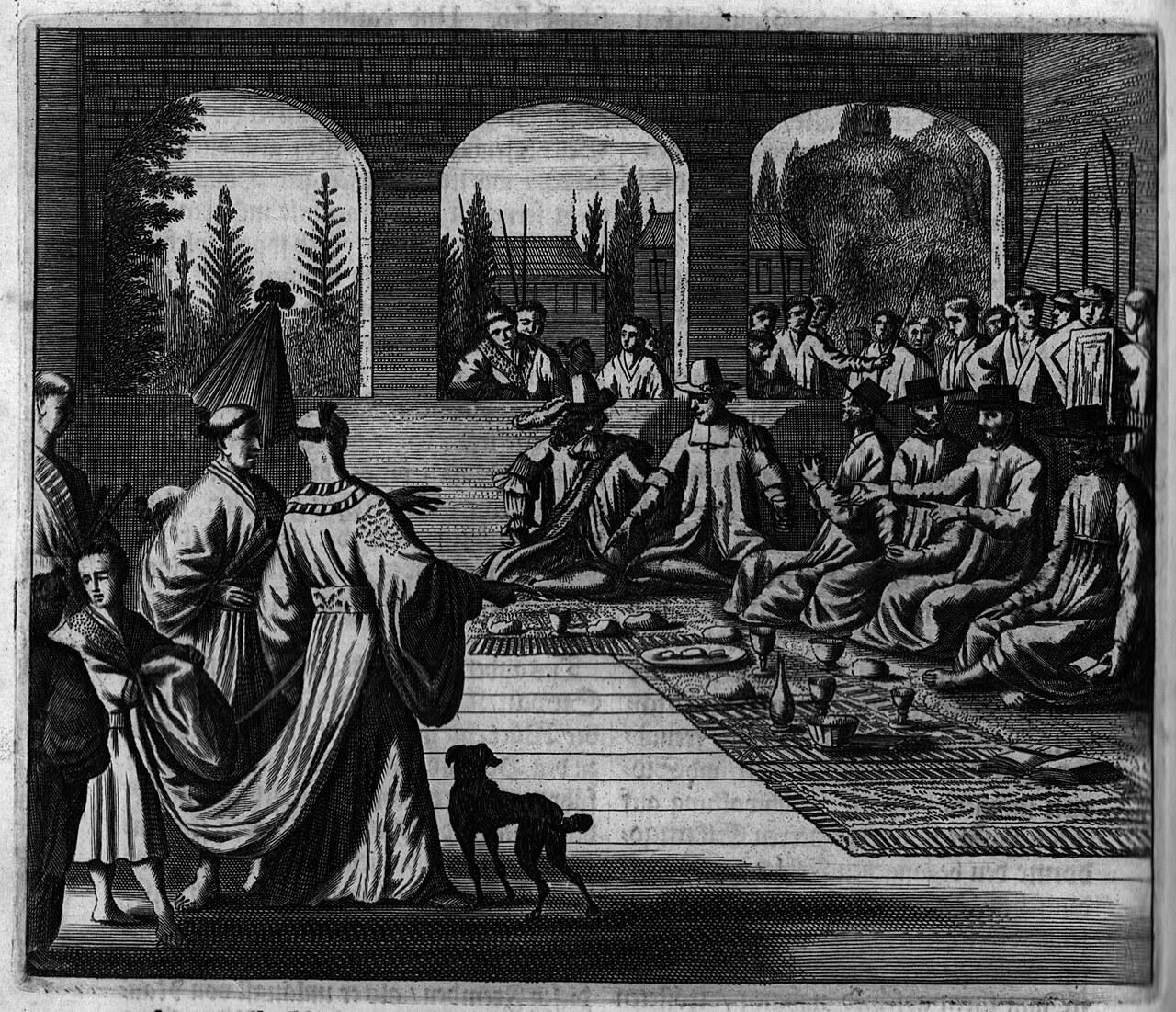
That same year he was in Edo again when the crew of the Dutch ship Breskens were questioned. Ferreira showed the Dutch a map with Hokkaido drawn as part of North America and tried to persuade the captain that there was no sea north of it. The Jesuits had known since the journeys of Girolamo de Angelis that Ezo was an island, so he may have been trying to mislead them.
The Dutch did not like him. In 1643 their diary said he asked for the bones of the Fathers buried in Nagasaki to be dug up and thrown into the sea. In 1646 a Dutch officer wrote that "his heart is black."
The last question
He died in Nagasaki. Japanese records give 4 November 1650 (Keian 3.10.11).The Nagasaki historian Koga Jūjirō found him under that day in the death register of Kōtaiji, by his Buddhist name, and the Deshima diary for 6 November says he had died "yesterday," so Cieslik calls 4 or 5 November 1650 "quite certain."The other date sometimes given, 13 September 1651, belongs to his son Chūjirō, who died a year after him.A Dutch entry quoted by François Valentyn for 6 November 1650 notes the death of "the apostate Jesuit Father Juan."
Did the leader of the mission find his way back at the end? Three stories say so.
: the nineteenth-century writer Léon Pagès claimed he returned to the faith and died a martyr.
: in 1653 a Japanese Christian exile in Tonkin, Paulo de Bada, told the Jesuits there how Ferreira had died. The annual letter for 1655 records that "old and ill, he repented his sins and asked aloud for God's forgiveness."This is second-hand, from an exile, twenty years and an ocean away. But it is a real Jesuit document, not a later legend. Cieslik gives the fuller version pieced together by the Jesuit historian J. F. Schütte: the old man, long bedridden, voiced his sorrow aloud, his neighbours reported him, and the governor had him hung in the pit in secret, where he died.Cieslik's own verdict is that the Japanese sources tell us only the date of his death, and that "there will probably always remain a veil of mystery."
So the question has no clean answer. The Jesuits dismissed him. The shogunate used him. The Dutch despised him. And somewhere in Nagasaki an old man may, or may not, have asked aloud for forgiveness.

