Two silver coins
On 27 June 1643 islanders on Kajime Ōshima, a small island off the coast of Chikuzen in northern Kyushu, saw ten men come ashore. They wore Japanese clothes, carried swords and had shaved heads like any traveller. But something was wrong. The strangers begged the islanders not to tell anyone they had come, and pressed two silver coins into their hands. The islanders took the coins and went straight to the coastguard post.
Among the ten was a Sicilian Jesuit of about forty, Giuseppe Chiara. He had come to Japan for a reason that sounds like the plot of a novel, and later became one. He had come to rescue a fallen man: the former Jesuit leader , who had given up the faith in the pit ten years before.This page asks what happened to the rescuer. The answer is that he became, almost exactly, the man he came to save.
Eight letters
Chiara was born at Chiusa Sclafani, a hill town near Palermo, in 1602 or 1603 ().He wanted the missions badly. From January 1623 he wrote eight letters to his superiors begging to be sent to the Indies, and he entered the Jesuits at Naples on 2 September 1623.
On 13 April 1635 he sailed from Lisbon with the young Neapolitan Jesuit Marcello Mastrilli.Their voyage went badly. Dutch ships forced them off course to , where they arrived on 31 July 1636. Mastrilli went on to Japan and was killed there in 1637.Chiara was shipwrecked off the Philippines on the way to and only reached Macao in 1639. There he studied Japanese.
By then the news from Japan was all of torture and apostasy. Ferreira's fall in 1633 had shaken the Jesuits of Asia, and some resolved to go to Japan to make up for it.Chiara was one of them.
The first Rubino group
The plan was organized by Antonio Rubino, an Italian named Visitor of Japan and China in 1639.He decided to go himself after the Portuguese embassy from Macao was executed in Japan in 1640.
Rubino, Antonio Capece, Diego de Morales, Francisco Marques and the Polish Jesuit Alberto Mecinski, with four servants, left Manila in July 1642 and were found on Koshiki island off Satsuma in August.: one study gives 6 August 1642 (Kan'ei 19.7.11), Japanese Wikipedia 11 August (Kan'ei 19.7.16).Taken to , they were questioned, paraded, and hung in the pit early in 1643. All but one servant died as martyrs. Rubino died on 22 March 1643.
Three months after Rubino died, the second group stepped ashore on Kajime Ōshima with their two silver coins.
The second Rubino group
They were Pedro Marques, an old Japan hand born in 1575; Alonso de Arroyo from Andalusia; the Lombard mathematician and astronomer Francesco Cassola; Giuseppe Chiara; Pinto, born in Nagasaki to a Chinese father and a Luso-Japanese mother; the Japanese Brother André Vieira; and four others.
They were not judged in Nagasaki. That summer a Dutch ship, the Breskens, had appeared off Nanbu in the north, and the shogun suspected a link. So the prisoners were sent to Edo, leaving on 27 August 1643.There they were questioned at the residence of the chief inquisitor , and also at the houses of the great lords Sakai Tadakatsu and Hotta Masamori. Iemitsu himself attended.
And there they finally met Ferreira, the man they had come for. He was not waiting to be rescued. He was the interpreter.
The pit
The prisoners were hung in the pit. Japanese Wikipedia, citing a Chōfu city pamphlet, says Chiara gave up after three days.Inoue recorded that every member of the group renounced the faith.Their confession was copied and sent round to the .Chiara and Cassola also told the inquisitor the route they had planned, by way of "Riyanhou," the Chinese port of Ningbo; Inoue passed this on to the Sō family of Tsushima in a letter of 1644.
The Dutch prisoners of the Breskens were brought face to face with them on 20 October 1643, to test whether the two groups were connected.Bándy adds a strange coda: after that, two of the apostate former Jesuits took back their apostasy and refused to join a Buddhist sect. He does not name them.
Okamoto San'emon
The shogunate kept him, and gave him a whole borrowed life. He received the name, the sword and even the widow of a condemned samurai, Okamoto San'emon, plus a stipend of ten rations and silver, and two servants.The same thing had been done to Ferreira, who was made to live with an executed merchant's widow.
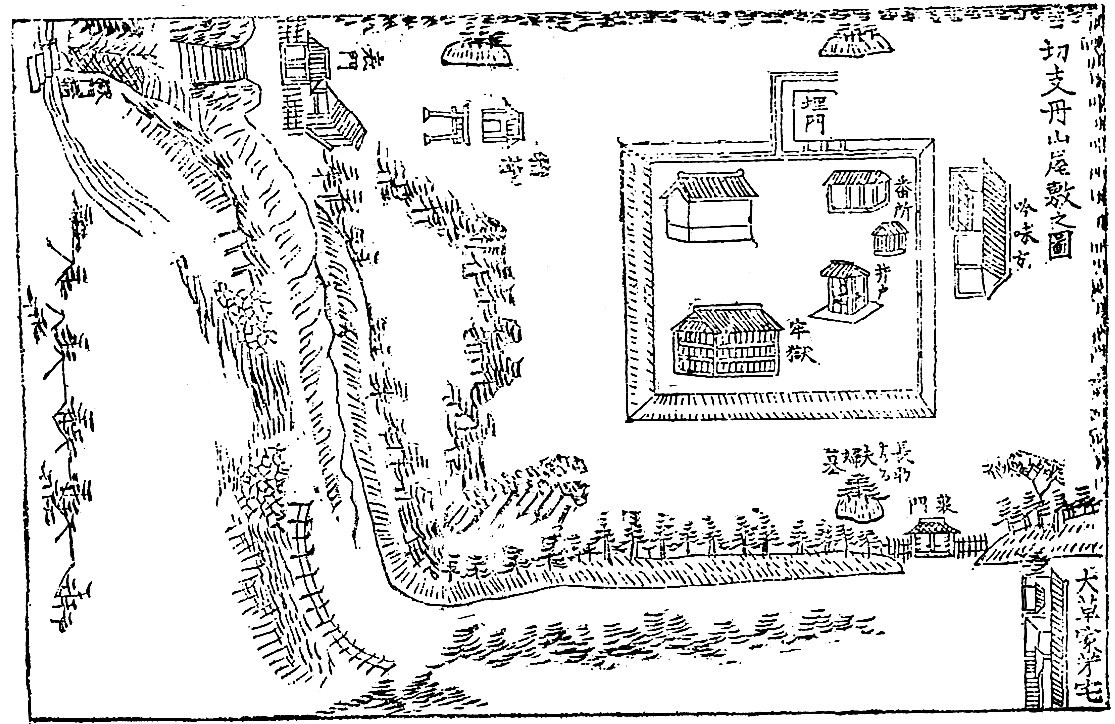
He was held first at Tenmachō, then at Iidamachi. From 1646 he lived in the , the "Christian mansion" prison built in Inoue's lower residence at Koishikawa, in today's Kohinata, Bunkyō ward.He would never leave it.
On 12 June 1658 he signed a declaration. In 1674 he was ordered to write an account of Christianity, which ran to three volumes; Japanese Wikipedia calls it Tenshukyō taii. In November 1675 he was questioned on whether he had written it sincerely, and in 1677 an inventory was made of his books.Japanese Wikipedia adds that he refused to register as a temple parishioner, a quiet refusal in a country where every non-Christian had to be attached to a temple.
He died in Edo on 24 August 1685 (Jōkyō 2.7.25), aged about 82, after 42 years as a prisoner. He was cremated and buried at Muryōin in Koishikawa under the Buddhist name Nyūsen Jōshin Shinji. "Nyūsen" may echo "Giuseppe."His Japanese "wife" outlived him by ten years and died on 27 February 1695, aged 74.
A stone that travelled
His gravestone did not stay put. Moved to Zōshigaya in 1909, it was pulled by handcart on 3 June 1943 by the Salesian Father Clodoveo Tassinari to the Salesian seminary in Nerima, and taken in 1950 to the Salesian seminary in Chōfu.The stone is Izu andesite, 160.7 cm tall.The top is shaped like a priest's hat.Chōfu city made it a cultural property on 29 January 2016, and a memorial stele to "Father Joseph Okamoto San'emon" was set up at Denzūin in 1977.
So the rescuer ended as the rescued had: a renamed, married, watched man who wrote what the shogunate asked him to write. The difference is that his stone, at least, now stands among priests.
Fact check: Chiara, Sidotti and Sawano Chūan
These three names are often tangled. Here is what the sources say.
- Sawano Chūan was Cristóvão Ferreira, the Portuguese Jesuit who apostatized in 1633. Not Chiara.
- Giuseppe Chiara came with the second Rubino group in 1643, apostatized, became Okamoto San'emon, and died in 1685.
- Giovanni Battista Sidotti was a Sicilian secular priest who landed alone on Yakushima in 1708, never apostatized, and died in the same yashiki in 1714.
- The Edo-period writer Honda Toshiaki confused Chiara and Sidotti.
- freely modeled the hero of Silence on Chiara. It is a novel.
- Excavators in 2014 judged that a skeleton buried full length in a coffin was Sidotti; Chiara was cremated at Muryōin.
