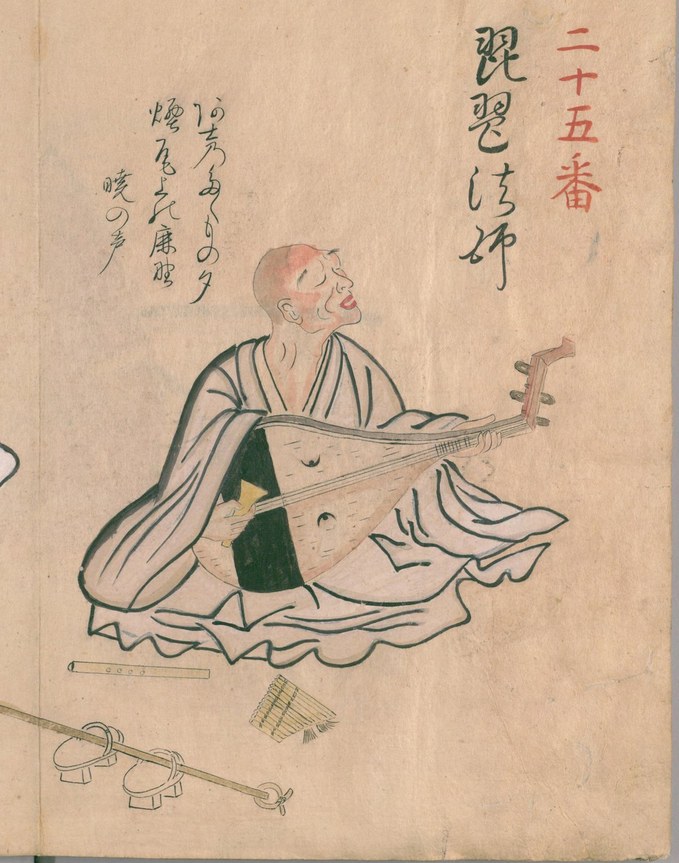
The man they laughed at
Years afterwards, a Christian lord named Sanga Yoriteru, baptized Sancho, stood in his own church in Kawachi before a priest, a brother and a group of Christian soldiers, and told them how it had all begun. The Jesuit historian wrote his words down.
The man who had brought them the faith, Sanga said, was blind in one eye and could see almost nothing with the other. Before he became a Christian he had been a beggar who went from house to house with a staff in his hand and a biwa lute on his back, playing and telling witty stories for his food. He was not even from the capital region, but from Hizen, a backwater, and of humble birth.When he first came to them, Sanga recalled, they laughed at him. His own children ran away from the shabby, ugly stranger.
And yet that stranger had stood before the proud samurai of the Miyoshi house and told them, to their faces, that their gods were demons and their way of life was sin. In the end they knelt and asked for baptism.
His name was Lourenço.
A singer with a biwa
He was born in 1526 at Shiraishi, a hamlet of about ten houses on the north coast of island, where the bridge to now crosses.He could not see from one eye and only dimly from the other.
For a poor blind boy in sixteenth-century Japan there was one road open: to become a biwa hōshi, a blind musician who wandered from house to house playing the lute and chanting old war tales such as the Tale of the Heike. Takada suggests his father was probably a fisherman and that the boy was placed in a local temple, where he learned his music and the teachings of the Buddhist schools. Both are reasonable guesses, not records.
Fróis, who knew him, paints him without flattery. He was very ugly, one eye blind and the other almost useless, poor and shabbily dressed, feeling his way with a staff. He could neither read nor write. But, Fróis says, God made up for it with a lively wit, great judgment, an excellent memory, and a flood of words so pleasant, clear and wise that everyone who heard him was amazed.
The meeting at Yamaguchi
In 1551 he was in , the rich city of the Ōuchi lords, earning his keep by playing and singing in noble houses.He heard that foreigners were preaching a new religion there. Xavier and Brother were preaching on street corners and taking questions day and night at the old temple the lord had lent them, the Daidōji.
The blind singer went to see the priest. He put his doubts to him, was satisfied with the answers, came back again and again, and at last Master Francis baptized him and named him Lourenço.Takada dates the baptism to between about May and 10 September 1551.
He gave up singing for a living and stayed with the missionaries.Within months Xavier had left Japan. Lourenço stayed with his successor, , and found out what his gift was for.
The voice of the mission
Torres spoke Japanese poorly, and Lourenço became his voice. A Brother who left Japan in 1553 wrote that Torres used him at once whenever there was a serious debate, because he knew the things of God so well.Father Gago wrote in 1555 that Lourenço corrected the wording of the Brothers' texts so that Japanese readers could understand them.He knew the Buddhist vocabulary from the inside. The missionaries did not.
In the winter of 1554 to 1555 Torres sent him alone to Miyano, a farming village near Yamaguchi where illiterate peasants had become Christians and met on their own. He came back through the cold with twelve people asking for baptism, some of them toothless old women who knew the Pater Noster in Latin as if they had learned it in childhood.
In June 1555 the Christians of Yamaguchi finished a new church, and Lourenço preached at the first Mass on 28 June.
A test of obedience
In 1553 Lourenço asked to go home and win his parents for the faith. Torres let him go, but only on foot, begging along the way. At Funai Father Gago kept him to preach instead, and Lourenço obeyed. He did not see his parents baptized until 1557, at Hirado.
There, too, he showed what kind of debater he was. A Jōdo monk had been attacking Christianity. Lourenço questioned him after a sermon and the monk could not answer. By Japanese custom the winner could strip the loser's robe. Lourenço said he would be content if everyone simply knew the monk had lost, "because those who spread God's law wish to shame no one."
Then the road turned toward the capital.
Toward Kyoto
Two Buddhist monks from Tōnomine in Yamato had become Christians at Yamaguchi, and one of them, , was a famous doctor known on Mount Hiei. Torres sent Lourenço to Hiei with Paulo's letters, and the former monk Barnabé went with him. Lourenço sold his summer robe and sash for the boat fare and survived a robber's sword. On Hiei the old monks listened, but nothing came of it.(See our page on the Tōnomine monks.)
In 1559 he went again, this time with Father , a young catechist named Damião and a guide from Sakamoto.Vilela wrote that he took Lourenço "to be my interpreter in disputes and conversations."They obtained an audience with the shogun Ashikaga Yoshiteru and a licence to preach, and met Miyoshi Nagayoshi, the real power in the capital.
The lords kneel
In 1563 the court astronomer Yūki Tadamasa and the scholar Kiyohara Edakata, who had been asked to investigate the Christians, invited Lourenço to Nara. Vilela feared a trap and sent Lourenço instead.His preaching turned the investigators into converts. Yūki, Kiyohara and Takayama Tomoteru, lord of Sawa castle, were baptized. The next year Sanga, Ikeda Tango-no-kami and Tomoteru's son, the future , followed.
At the Miyoshi castle of Iimori, Lourenço preached for days to the samurai who had laughed at him. Seventy-three of them asked for baptism.Among the names recorded is a Miki Handayū, whose son became the Jesuit martyr .(See our page on Paul Miki; the identification is .)
On 20 April 1569, at the Myōkakuji temple in , had Lourenço and Father Luís Fróis debate the Nichiren monk Asayama Nichijō in front of him. The argument ran to God and the invisible, immortal soul.Nichijō lost, and became the missionaries' bitter enemy. Nobunaga went on protecting them.
Fróis's own account of that day has a sharper scene. When Fróis said the soul lives on after death, Nichijō leapt up, seized Nobunaga's two-handed sword from a corner of the room and began to draw it, shouting that he would kill "your disciple Lourenço" with it, and then they could show him the soul. Nobunaga and other lords grabbed him from behind and took the sword away, and Nobunaga told him that monks should defend their law with reasons, not weapons. Fróis notes that he and Lourenço never moved from their places. When Nichijō kept demanding that the priest be thrown out, Lourenço answered calmly that the house belonged to neither of them, and Nobunaga said: "Lourenço is right in what he says, and Nichijō has lost face."Charlevoix, writing in 1715, tells the same scene but says the monk was disarmed by Wada and "an officer who later became the famous Taikosama", that is . Fróis does not say this. Unverified.
Islands and old age
In 1566 he went with to the . Almeida described a three-hour sermon in the lord's hall before about 400 men: Lourenço argued for a Creator, then took the pagan side himself and answered his own objections so clearly that the hall agreed God alone was to be worshipped.When Almeida fell ill, Lourenço stayed on alone for months.
After Hideyoshi's he went west to Hirado, then to .In 1590 the Visitor called him to a consultation of the Jesuits, where his name heads the list of brothers.The story goes that he asked Valignano a sharp question: why, when the priests were few and spoke poor Japanese, had so many converted, and now, with many fluent priests, so few? His own answer was that the first missionaries had spoken to people directly about God.
Past 65, sick and weak, he still preached two or three times a day when needed.
He died at Nagasaki on 3 February 1592, aged 66. He had asked God that no one be in the room at the end, no visitors and no brothers loudly coaching him. That day, after his meal, he sent the visitors out, asked his servant boy to help him sit up, said the name of Jesus, and died so quietly that the boy did not notice.
The beggar the samurai laughed at had become, in Fróis's word, a foundation stone of the Church in the capital.
