A bucket of bones
"My wife, whom I had asked to look after the children after I was gone, had to be picked up from the burnt ruins of our house as light bones in a bucket. She had died in the kitchen."
Nagai Takashi wrote that sentence in Kono ko o nokoshite (Leaving These Children), three years after he did it. On 11 August 1945, two days after the bomb, he went to the site of his house in , gathered Midori's bones from the ashes, and buried them.
He was thirty-seven, a senior lecturer in radiology at Medical College. On 9 August he had been in the radium room on the second floor of the college hospital's main building, about 700 metres from the hypocentre, preparing a lecture.Glass cut the right side of his body and severed an artery near his right ear. He tied the wound with a triangular bandage and went on treating the injured for three days, collapsing again and again from loss of blood.Only then did he go home.
He was already dying. In June 1945 he had been diagnosed with leukaemia, the result of years of exposure to radium in his work, and given about three years to live. His white cell count was 108,000, against a normal 7,000.
What he did with the time he had left is the subject of this page. Its thread is the motto he chose for his last home: nyoko aijin, "love others as yourself."
From Shimane to Urakami
Nagai was born on 3 February 1908 in Omachi, Matsue, Shimane Prefecture, the eldest son of a doctor, Nagai Noboru, and his wife Tsune, and grew up from the next year in the hill country at Iishi (now Mitoya, Unnan).His family followed the Izumo Taisha faith; as a young man he called himself a materialist.
He entered Nagasaki Medical College in 1928 and played basketball there.He lodged with the Moriyama family of Urakami. According to the scholar Miwa Chishio, the Moriyamas were descendants of the hidden Christian leaders of the village: Midori, the only daughter of the house, was a great-granddaughter of Kichizō, the seventh and last (keeper of the calendar), who died in prison in the crackdown of 1856.The family next door, Miwa adds, had held the office of for generations, and it was there that the student heard stories of the martyrs.Today a stone in front of the Nagai Takashi Memorial Museum marks the site of the old chōkata house.
Two things turned him. The first was Pascal, a physicist he admired, who believed in the soul.The second came in 1933, when he was called up as an officer cadet and sent to Manchuria. In a comfort parcel he found a Catholic catechism, the Kōkyō yōri, and was deeply moved by it.Back in Nagasaki, in June 1934 he was baptised, taking the name Paul, after of the , and in August he married Midori.
An ear infection in his final year had ended his hopes of general medicine, so he had joined the department of physical therapy and specialised in radiology.He served again as an army doctor in China from 1937, returned in 1940 as assistant professor and head of the department, and received his doctorate in 1944.By 1945 he and Midori had two surviving children, Makoto and Kayano.
Under the atomic cloud
On 9 August the children were safe. With their grandmother, Moriyama Tsumo, they had been sent out to Mitsuyama, in the hills outside the city.Midori was at home.
On 12 August Nagai went to Koba in Mitsuyama-machi and organised the college's "11th Medical Relief Team." In 58 days, until 8 October, it treated 125 people.He went from house to house until the radiation sickness caught up with him. On 20 September, losing consciousness, he composed a haiku, hikaritsutsu / akigumo takaku / kie ni keri ("shining, the autumn cloud rose high and vanished"), and fell into a coma. A week later, the museum says, he woke "miraculously."On 15 October he went back to the ruins of his house in Ueno-machi.
On 23 November 1945, at the requiem for the Urakami dead in front of the ruined cathedral, he read a eulogy as the representative of the Catholic laity. About six hundred surviving parishioners attended, Konishi writes, and it is said that the cross-shaped memorial tablets they carried for their dead outnumbered the people.It became the most argued-over thing he ever wrote (see below). At Christmas the cathedral's surviving bell was dug out of the rubble and rung again, and he took the title of his first book from its sound.
The Bells of Nagasaki
In January 1946 he was made professor.That summer he wrote a manuscript called "The Opening of the Atomic Age," later Nagasaki no kane (The Bells of Nagasaki). On 17 November 1946, after a lecture on atomic-bomb sickness to the Nagasaki Medical Association, he took to his bed for good.
The book could not be published at once. It was the first account of the bombing written for the general public, and the occupation authorities' censors held it for more than two years.When they released it, it was on a condition: it had to be bound with The Tragedy of , a record of Japanese army atrocities in Manila in February 1945 compiled by the occupation's intelligence section.The first edition, published by Hibiya Shuppan in January 1949, runs to 319 pages, about half of them the Manila appendix.It became a best-seller in a year of paper shortages, and a popular song of the same name came out that July.A film followed in 1950.An English translation by William Johnston was published by Kodansha International in 1984.
Nyokodō
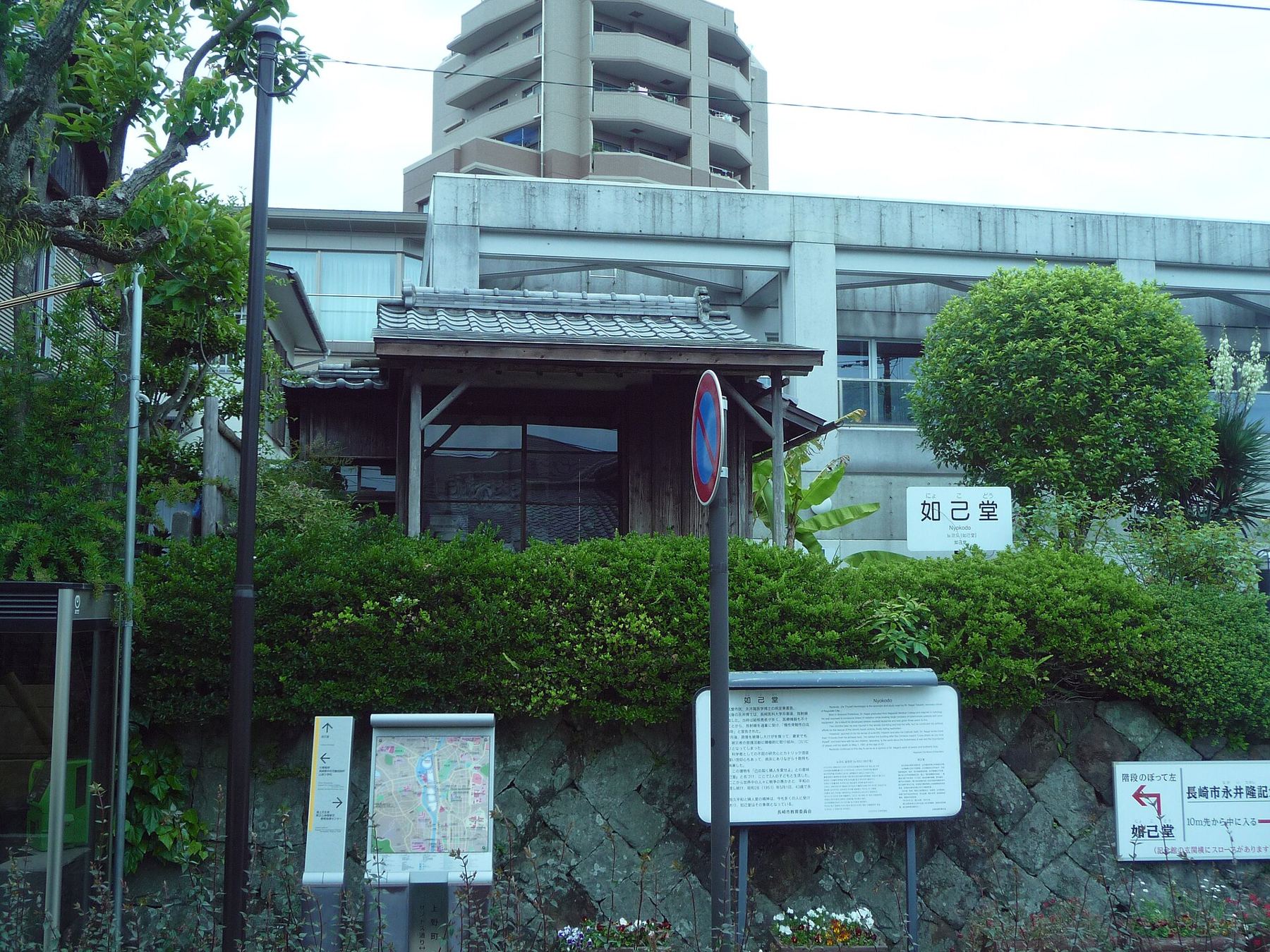
In the spring of 1948, as barley grew where the houses had been, the people of Urakami and his Catholic friends built him a new home.It was a hut of two tatami mats, put together, the museum's director told an interviewer, from timber that had survived the fire.Nagai named it , "the hall of as-yourself," from the commandment to love one's neighbour as oneself.
"The Nyokodō where I lie is a house of one room, two mats," he wrote. "Beside my bed one more mat is laid, and that is where Makoto and Kayano live." He said he took the name because the people of Urakami loved him as themselves, a stranger who had fallen sick far from home.
From that bed he wrote. His leukaemia had swollen his spleen so badly that pressure on it could cause internal bleeding, so he could not let his children come close.The museum lists The Chain of the Rosary, Leaving These Children, Horobinu mono o and The River of Life in 1948, The Bells of Nagasaki and Hana saku oka in 1949, and Otome-tōge, about the Urakami , finished in April 1951 and published after his death.He also edited Genshigumo no shita ni ikite, the testimonies of children who had survived the bomb, and translated two books.How many books he wrote depends on how you count: the parish says fourteen, the museum's director seventeen.
The books paid. With the money, he had a monument raised at Yamazato primary school, where about 1,300 children and staff had died; it was unveiled on 3 November 1949.With a literary prize he bought cherry saplings, "a thousand" in the museum's chronology and about 1,200 in its longer account, and had them planted at schools, churches and along roads in Urakami.In 1950 he paid for a small library for the children of Urakami, Uchira no hondana, "our bookcase."
Visitors came to the hut. Helen Keller visited in October 1948 (the museum gives the 18th; an interview gives the 8th).In 1949 he was received by the Emperor, visited by the papal legate Cardinal Gilroy, and made the first honorary citizen of Nagasaki.
Death
On 22 April 1951 he finished his last book, Otome-tōge.Three days later bleeding in his right shoulder stopped him writing. On 1 May he was taken to the university hospital, his old workplace, and after a strong prayer, the museum says, he died quietly at 9:50 that evening, aged forty-three. His younger brother Hajime was with him.(The parish history says he died at Nyokodō: ; the museum is more specific.)
A church funeral was held at Urakami on 3 May, and on 14 May the city gave him a public funeral; about 20,000 people attended.He was buried in a corner at the entrance to the Sakamoto international cemetery.
The argument about the eulogy
Nagai's reputation is not settled. The argument is about his eulogy of 23 November 1945, printed in The Bells of Nagasaki. In it he called the bomb an act of divine providence, said that Urakami, "the one holy place in Japan," had been chosen as a sacrificial lamb for the sins of the war, and called the dead a great hansai, a burnt offering.
For Urakami's Catholics, who were hearing it whispered in the old town that the bomb was heaven's punishment, the words were meant as comfort, and critics accept that.But in 1966 his former student and fellow survivor, the doctor Akizuki Tatsuichirō, wrote that he could not follow the idea that God dropped the bomb on Urakami because he loved it. In 1972 the poet Yamada Kan began a fuller critique, and in 1994 the philosopher Takahashi Shinji named Nagai's view "the Urakami burnt-offering theory," arguing that under the occupation it absolved both the Japanese state and the United States.In 1996 Kataoka Chizuko replied that the eulogy was spoken by a believer to believers, and that outside that setting it is misread.This page records the debate as ; it does not decide it.
A song for Nagasaki
Outside Japan, Nagai is best known through A Song for Nagasaki (1988) by Paul Glynn, an Australian Marist priest who had worked in Japan for some twenty-five years and saw the book as part of reconciling Australians and Japanese after the war.A later edition carries a foreword by the novelist .The museum lists its Japanese translation among the books about him.
The museum itself grew from the children's bookcase. In 1950 a Japanese visitor from Brazil took up Nagai's idea of a proper children's library; 471 Japanese residents of Brazil sent 1,747,188 yen, the city added about 400,000, and the Nagasaki City Nagai Library opened in December 1952. It became the Nagai Memorial Hall in 1969 and, rebuilt, the Nagasaki City Nagai Takashi Memorial Museum in April 2000.
The thread
Nagai is remembered in Nagasaki as a doctor who kept working when he could have stopped, and as a writer who made Urakami's catastrophe known, under censorship, to a country that had heard little of it. Some of his words are still argued over. His own summary was two words written on a hut that his neighbours built: love others as yourself.
