The highest pulpit
On the morning of 5 February 1597 a column of prisoners climbed the hill of , just outside , above the busy harbour. Waiting for them on the ground lay twenty-six crosses. When the prisoners saw how they were to die, they sang the Te Deum, the Church's hymn of thanksgiving.Then they let the executioners tie them to the crosses and fit iron bands around their necks to hold their heads upright. One by one the crosses were raised and dropped into their holes.
Among them was a Japanese Jesuit of about thirty-three, Paulo Miki. He had spent years preaching to crowds. Now, says a contemporary account read every year in the Church's prayer, he found himself "raised up before everyone on a pulpit such as he had never had."He used it.
This page follows the preacher. Paul Miki never became a priest. He was a few months short of ordination when he was arrested.But his whole life was a sermon in preparation, and it began with a sermon someone else preached to his father.
A father who heard Lourenço
Paul Miki's Japanese name is unknown.He was born in 1564 or 1569 (: the first fits his age of 33 at death, the second a report that he was 12 in 1581). The Portuguese liturgical calendar says between 1564 and 1566.One account places his birth in Arima district of Settsu, today in Hyōgo Prefecture; others say Tajima or Awa ().The Jesuit curia says simply that he came from a well-off family near Osaka.
His father, Miki Handayū, was a warrior who served the Miyoshi and, it is said, . He was baptized in 1564 as Paulo, and his son was baptized at four or five with the same name.
Who converted the father? Around 1563 and 1564 the half-blind Jesuit brother , a former street singer, preached for days to the samurai of the Miyoshi at their castle of Iimori. They laughed at his ugly face at first. Then they listened, and seventy-three of them asked for baptism. Among the names recorded is a Miki Handayū.
So the boy grew up a Christian from early childhood, in a samurai household of the capital region, in the years when Nobunaga protected the missionaries.
The first seminary
In 1581 the Jesuits opened their first seminary in Japan at Azuchi, at the foot of Nobunaga's great new castle on Lake Biwa. Paulo Miki was in its first class.: the Jesuit curia says he entered at twenty, which would fit an earlier birth.
After Nobunaga's death in 1582 the seminary moved to Takatsuki, the domain of the Christian lord .In August 1586 Paulo was admitted to the Society of Jesus.
The preacher
He found his gift in the pulpit. Japanese Wikipedia calls him a celebrated preacher who drew large crowds.The Jesuit curia says he was an eloquent speaker, very successful in drawing Buddhists to the faith.He had been well educated even before he entered the Society, and on the road to his death he preached to his companions every day.
He was preaching in a dangerous time. had ordered the foreign missionaries out of Japan in 1587. The order was not strictly enforced, and the Jesuits kept working quietly.For nearly ten years the uneasy truce held. Then a ship ran aground.
The San Felipe
In 1596 the Spanish ship San Felipe was wrecked on the coast of Shikoku.Remarks made by its crew, as reported to Hideyoshi, suggested that missionaries prepared the way for Spanish conquest. Hideyoshi ordered the arrest of the Franciscans who had come from the Philippines.
The Jesuits were not the main target. But on 9 December the officers came to the Jesuit house in Osaka and took three men they found there: Paulo Miki; James Kisai, the house porter, a former Buddhist whose wife had left him; and John de Goto, a young catechist from the islands.All three were taken to and imprisoned with six Franciscans and fifteen Japanese laymen.
The ear
The twenty-four prisoners were brought into a public square and condemned to crucifixion. As a mark of shame, the lobe of each man's left ear was cut off.They were paraded through Kyoto, Osaka and Sakai.
Among them were three boys. Louis Ibaraki, aged twelve, kept on singing while his ear was being cut.Thomas Kozaki, thirteen, was there with his father Michael.
A month of winter roads
The next day the prisoners set out on foot for Nagasaki, hundreds of miles away, in midwinter, short of food and clothing.A memorial in Kyoto marks where the march began.People mocked them along the road. Paulo and a Franciscan priest preached to the crowds anyway, and the prisoners sang.Two more Christians joined them on the way, making twenty-six.
On the road young Thomas Kozaki wrote to his mother: "You should not worry about me and my father Michael. I hope to see you both very soon, there in paradise." He asked her to be patient with whatever was done to her and to show charity to everyone.
Just before Nagasaki, two Jesuit priests were allowed to reach them. Father Francesco Pasio took the three Jesuits aside into a chapel. There Paulo Miki renewed his vows, and John de Goto and James Kisai made their first vows as Jesuits.Then came the hill.
The sermon from the cross
When the crosses had been raised, "it was wonderful to see the constancy of all," says the contemporary account, as Father Pasio and Father Rodrigues called out encouragement to them.The Franciscan commissary stood motionless with his eyes on heaven. Brother Martinho sang psalms. Brother Gonçalo recited the Our Father and the Hail Mary.
Then Paulo Miki spoke. He told the crowd that he was Japanese and a member of the Society of Jesus, that he was dying for having preached the Gospel, and that he thanked God for so great a gift. Then:
"Now that I have come to this final point of my life, none of you will believe that I want to hide the truth. I declare to you, therefore, that there is no other way of salvation than the one the Christians hold. And since this way teaches me to forgive my enemies and all who have offended me, I freely forgive the ruler and all the authors of my death, and I ask all of you to be baptized." (our translation from the Portuguese text)
He turned to his companions and encouraged them.John de Goto's father was in the crowd and heard him.Little Louis, when a Christian called out that he would soon be in paradise, made a gesture of such joy with his hands and body that every eye turned to him. Antonio, beside him, sang the psalm "Praise the Lord, you servants of the Lord," which he had learned at catechism in Nagasaki.
Then the executioners came forward with their lances, the crowd cried out "Jesus, Maria," and in a short time all were dead.
After
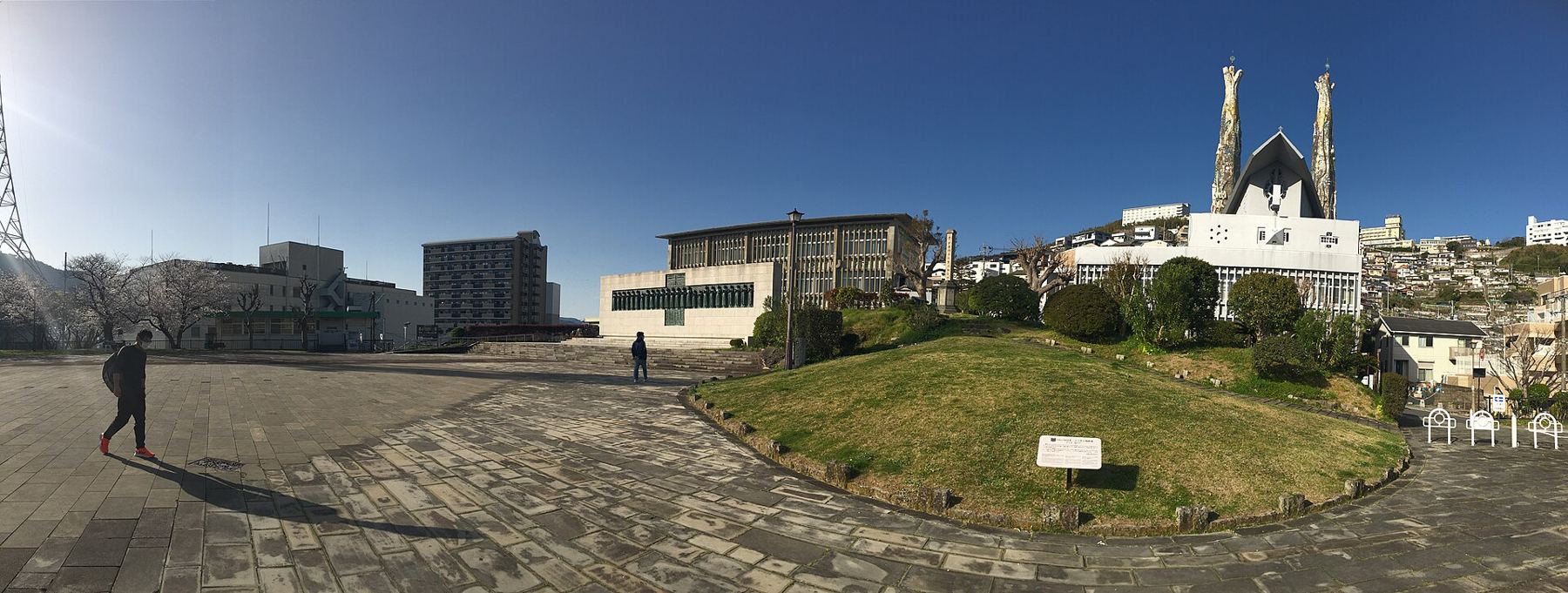
The bodies were left on the crosses for days as a warning.The hill became known as Martyrs' Hill.Paul Miki was beatified in 1627 and canonized with his companions by Pius IX on 8 June 1862.Today a museum and monument stand at Nishizaka, and the Museum keeps a wood carving of Paul Miki by S. Sawada (1962).
He never said Mass. He never heard a confession. But the sermon he preached from that cross has been read aloud in the Church's prayer, in many languages, for centuries. It began, perhaps, with a half-blind brother talking to a roomful of laughing samurai at Iimori.
