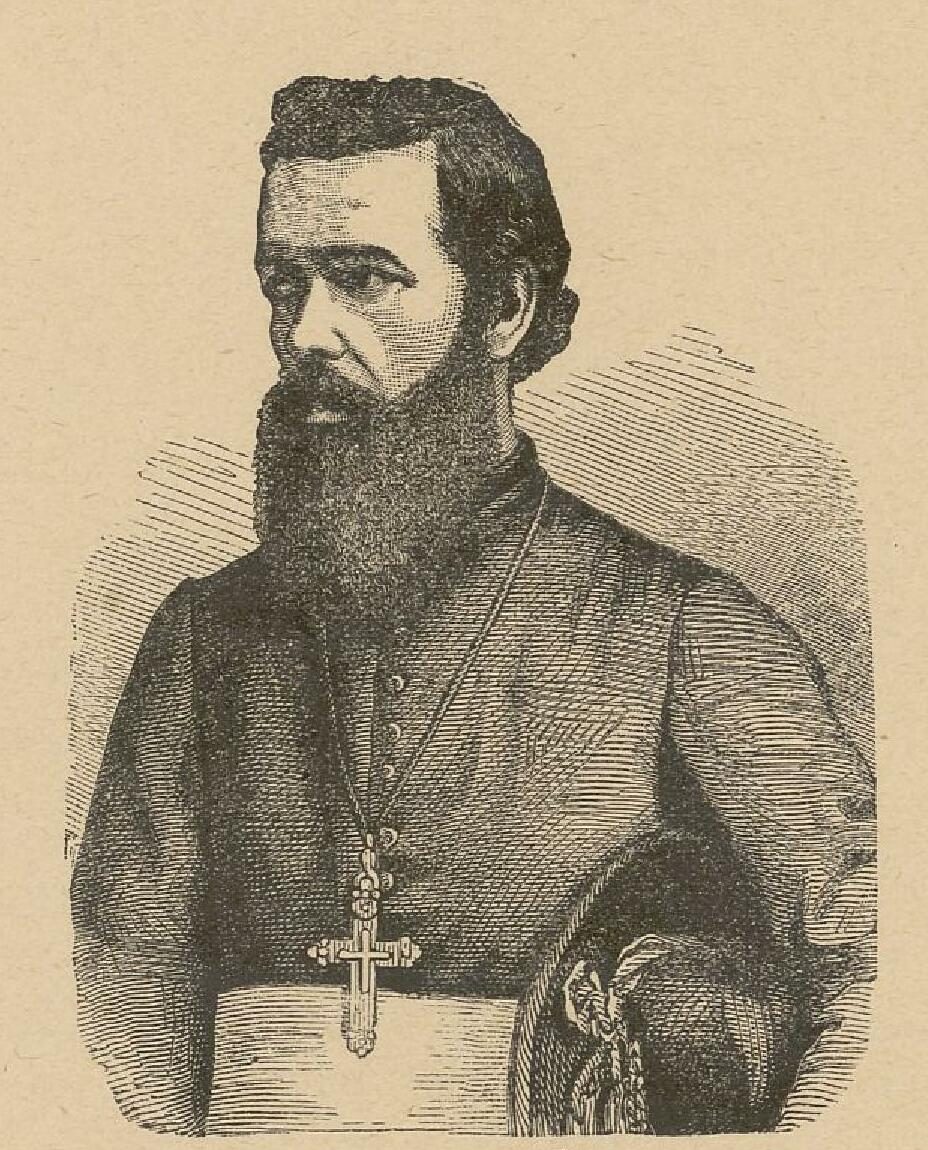
Out the window
One night in 1859, a young priest let himself down from a window of the presbytery at Chauffailles, in Burgundy, and slipped away without being seen.
Bernard Petitjean was thirty. He was chaplain to a community of sisters and a mission preacher in his diocese, and he was afraid that if he asked openly to leave, someone would stop him. His old parishioners still told the story when he died, and his bishop at Autun compared it to St Paul, lowered over the wall of Damascus in a basket.He was heading for the seminary of the , the MEP.
He had no idea yet where he would be sent. He would end up in Japan, standing in an empty church, praying for words, when the people he had come to find walked in and found him.
Petitjean went out a window to look for a mission. In Nagasaki he waited in a church built for foreigners, hoping. The Christians he hoped for found him. The rest of his life was spent keeping faith with them: through raids, exile and a long illness, until he was buried beneath the spot where they had first knelt.
A Burgundy priest
Petitjean was born on 14 June 1829 at Blanzy-sur-Bourbince, in the diocese of Autun, and studied at the junior and senior seminaries there.Ordained on 21 May 1853, he taught, served as a curate at Verdun-sur-le-Doubs, became a diocesan mission preacher, and from December 1858 was chaplain to the Sisters of the Holy Child Jesus at Chauffailles.
He entered the MEP seminary in 1859 (11 June in the biographical notice, 10 July in the obituary: ).After eight months, chance fixed his destination. A young missionary bound for Japan, Father Berther, died suddenly at Bordeaux while waiting to sail, and Petitjean was sent in haste to take his place on board.He left on 13 March 1860.
Waiting in the Ryukyus
Japan was not yet open to missionaries. From Hong Kong Petitjean was sent to the Ryukyu Islands, to join Father Louis Furet, who had been left there alone. For two years the priests could do nothing but study and pray; Petitjean still remembered those islands fondly.
In 1863 he reached Yokohama and then , arriving there on 5 August 1863 by the Church Trust's chronology.The treaties of 1858 let foreigners build places of worship in the settlements, but Japanese were still forbidden to become Christians. Petitjean taught French and helped Furet put up a church on the hill at , to plans by Furet and Father Prudence Girard.
The church was dedicated on 19 February 1865 to the of Japan, and faced the hill at where they had died.The townspeople called it the "French temple" and came in crowds to look.
17 March 1865
About a month later, on 17 March, a group from came in. Petitjean knelt and asked God to put words on his lips that would touch their hearts. Three women knelt beside him, and one said quietly that their hearts were the same as his. Then she asked: "Where is the image of Holy Mary?"
"At that name," he wrote, he had no more doubt. He was standing before the descendants of the old Christians of Japan.The speaker, later identified as the midwife Isabelina , was not named in his letter.
He set to work at once. Within weeks he was meeting the village leaders in secret, checking their baptismal formula, and learning how they had kept the faith. By 8 June he knew of twenty-five Christian groups, and seven of their baptisers were in touch with him.At the end of 1865 he quietly began training Japanese boys in Latin in the attic of the priests' house, the start of the seminary.
Bishop of a hidden flock
When Pope Pius IX heard the news, the MEP obituary says, he wept for joy.On 11 May 1866 he named Petitjean bishop (titular bishop of Myriophite) and vicar apostolic of Japan. Petitjean was consecrated at Hong Kong on 21 October 1866.His coat of arms showed the crowned Virgin holding the Child, and his motto ran: Ipse conteret caput. Sancta Maria, ora pro nobis, "She shall crush his head. Holy Mary, pray for us."
The joy did not last. In July 1867 the Urakami were raided. The new Meiji government issued edicts against Christianity in April and June 1868, and between October 1869 and January 1870 some 4,500 Christians of Urakami and the were taken away, the obituary says; hundreds died.When the mass exile began in January 1870, Petitjean was in Europe for the Vatican Council.While there, he had a Latin-Japanese dictionary printed in Rome, a revision of the Jesuits' Amakusa dictionary of 1595.
Pius IX wrote to him twice: the brief Licet perjucunde of 28 September 1871, praising the exiles' courage, and Dum asperrimam of 29 May 1873, rejoicing at the end of the persecution.
Building
From 1873 the government tolerated the Church, and Petitjean set about organising it. On 22 February 1874 he consecrated Father Jules-Alphonse as his auxiliary bishop. He placed priests in towns, sent others inland as teachers, and brought sisters from France: the Dames de Saint-Maur and the Sisters of the Holy Child Jesus of Chauffailles, the community he had once served.
In 1876 Rome divided Japan in two. Petitjean became vicar apostolic of Southern Japan, and Bishop Osouf took the north.He lived for a time in Osaka and built a church there, then returned to Nagasaki.He left Osaka early in 1880, leaving his pro-vicar Cousin in charge, and wrote on 1 March 1880 that in Osaka he had been able to build "our church of the Immaculate Conception" and start some works.Ōura was enlarged into the church that stands today, and he blessed it in 1879.On 17 December 1881 he blessed a great cross in the garden at Ōura to mark the ordination of three Japanese seminarians as deacons.Before he died, the obituary records, he had "the great consolation" of ordaining the first priests of the revived Church in Japan.The three had been made subdeacons and deacons in 1881. At midnight Mass that Christmas the eldest deacon preached, and Petitjean wrote on 29 January 1882 that it was the first time in more than two hundred years that a Japanese had spoken at a public service. He ordained all three priests on 31 December 1882, before two bishops and seventeen missionaries; one was a son of Dominique Zen'emon.
The little pilgrimage
He had long suffered from liver disease. Hoping to see the Ryukyus once more and to found a mission there, he walked across part of Kyushu to to take ship, and collapsed. Brought back to Nagasaki, he received the last rites, rallied, and then slowly declined.On 21 August 1884 a crisis left him paralysed.
Bishop Laucaigne, who nursed him for more than forty days, described what came next. One afternoon Petitjean asked to be carried onto the veranda "to greet the holy images." Facing the great cross he had set up in the garden, with the white statue of Our Lady he had placed at the church door on his right, he followed a Pater and an Ave and some invocations, and asked to be taken in. "There," he said, "our little pilgrimage is over."
He died on Tuesday 7 October 1884, two days after the feast of the Holy Rosary.He was buried in the sanctuary of Ōura, at the foot of the altar where, nineteen years before, the old Christians of Japan had made themselves known to him.There were then 30,230 Catholics in Japan, with three Japanese priests.
