The last to die
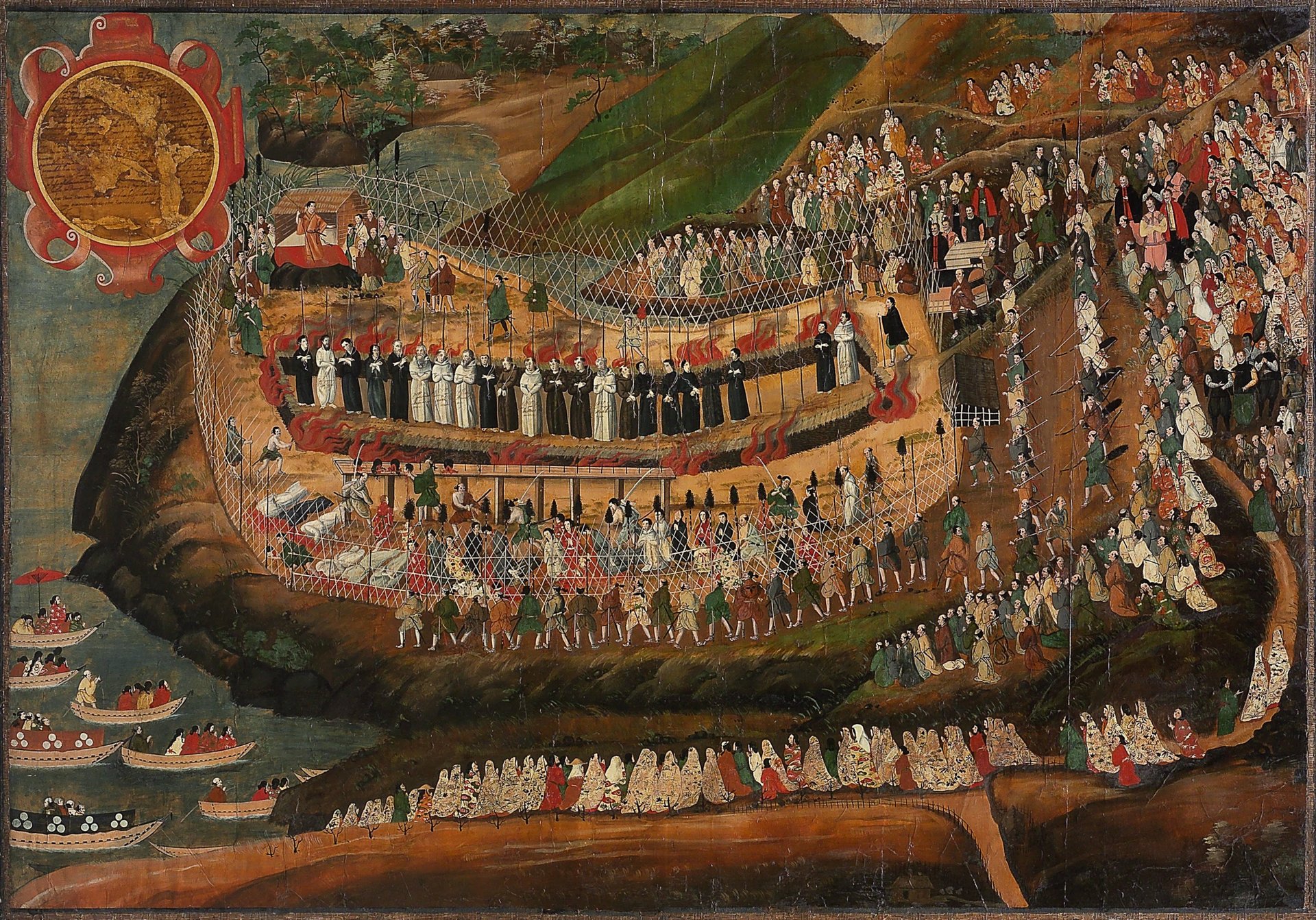
On 10 September 1622, on the hill of above harbour, a long row of stakes stood waiting. A huge crowd had gathered. The wood had been piled at a distance from each stake, so that the prisoners would roast slowly in the heat rather than burn quickly in the flames.
Charles , the Italian Jesuit, was led to the fifth stake. A few places further on, after three Dominican friars, stood a Japanese Jesuit priest in a white surplice: Sebastião Kimura.When the fires were lit, Spinola began the psalm Laudate Dominum omnes gentes, "Praise the Lord, all you nations," and the others took it up.Spinola, worn out by four years in prison, died within half an hour. Kimura lasted three hours. He was the last to die, and through it all, a Jesuit account says, he stood still with his arms stretched out in the shape of a cross.
He was about 57.He was the first Japanese ever ordained a priest. And the story of how he came to that stake begins seventy-two years earlier, at the door of his grandfather's house.
A door opened in Hirado
In the autumn of 1550 Francis Xavier came to , the trading port in northwest Kyushu where Portuguese ships called. He stayed in the house of a samurai named Kimura. Kimura asked for baptism with his whole family, and he became, Cieslik writes, the first person Xavier baptized at Hirado.
The family kept the faith through every change of lord and law. It would give the Church more than one martyr. Sebastião's cousin Leonard Kimura, a Jesuit lay brother, was burned at Nagasaki in 1619. "It hardly burns," Leonard is said to have told the crowd, motioning for the fire to be pushed closer.Another relative, Anthony Kimura, was beheaded that same year.
The boy in the seminary
Sebastião was born at Hirado, about 1565 or 1566 (; the Portuguese Virtual Encyclopedia says 1563).He was helping the missionaries as a dōjuku, a lay assistant, by the age of twelve.
In 1580 the Jesuit Visitor opened a small to train Japanese boys. Sebastião was one of its first twenty pupils.Two years later, in 1582, he was one of five seminary boys admitted to the Society of Jesus, and began his novitiate at Usuki in Bungo.
He worked in , then, after 's , in Hirado, Arima and Mie near Shimabara.He learned Latin well enough to teach it at the Amakusa college.In 1595 or 1596 he went to for theology, and in 1598 he was made subdeacon there with two other Japanese, Julian Yamada and Luis Niabara.
The three sailed home together and reached Nagasaki on 13 August 1600. Bishop Luís de Cerqueira ordained them deacons that September.Then the long preparation was nearly over. It had taken twenty years.
The first Japanese priests
On 22 September 1601, in the church of Our Lady of the Assumption in Nagasaki, Kimura and Niabara were ordained priests, the first Japanese ever.: the French Wikipedia gives 21 September.Yamada did not live to see it. He had died of tuberculosis that July.
For the next thirteen years Kimura was an ordinary missionary priest. He served at Amakusa, Bungo, Kazusa and Fudōyama.The French Wikipedia sums it up well: he left no great works behind, only the memory of a zealous, faithful priest.Then, in 1614, the shogunate expelled every missionary from Japan.
A man of many disguises
Kimura stayed. With the foreign priests in hiding or gone, he was the only Japanese priest left in Nagasaki, and more of the work fell on him.He took his final vows on 9 February 1620.
Being Japanese gave him one great advantage: he could pass. He moved through the city at different times dressed as a soldier, a merchant, a labourer or a physician, slipping into Christian homes and even into prisons to bring the sacraments.The magistrate's men wanted him badly. His Provincial told him to leave Nagasaki until the danger passed.
He did not get out in time. In late June 1621 a servant in the house where he was staying, a Korean, betrayed him.He was arrested with his catechist Thomas Akaboshi and Louis Kawara, an assistant at the Jesuit house.
The bird cage at Suzuta
He was taken to the prison at Suzuta, near Ōmura, on a hilltop exposed to every wind.There he found Charles Spinola, who had been held there since 1618, with Dominicans, Franciscans and many Christians.Thirty-two of them shared a narrow enclosure. They had one blanket each, rice and two sardines to eat, and no way to wash or dry their clothes.An English Jesuit account calls the place a bird cage.
They made the cage into a religious house. Spinola ran a novitiate inside it. Kimura's catechist Akaboshi, who had once been a brilliant officer, and Kawara asked to join.They prayed, did penance and gave each other spiritual talks.
In September 1622 the order came from Edo: all the Christians in the prisons of Ōmura and Nagasaki were to die.Before leaving Suzuta, Spinola received the first vows of his seven novices.He had two white surplices made, one for himself and one for Kimura, so that they could go to their deaths as priests.
Back to the hill
On 9 September the prisoners from Suzuta, ropes round their necks, the Jesuits in cassocks, were marched toward Nagasaki under an escort of some 400 soldiers.The next morning, at Nishizaka, they met thirty-three more prisoners brought from the city, and the two groups embraced.It was the same hill where the had been crucified twenty-five years earlier.
Thirty were beheaded that day and twenty-five burned, Kimura among them.It is remembered as the Great Martyrdom of Genna. The boy who had grown up in the house that welcomed Xavier was the last to die.
Remembered
Pope Pius IX beatified Kimura on 7 July 1867 with 204 other martyrs of Japan.: the Singapore Jesuits' page gives 7 May 1867.In December 2024 the Church in Japan renamed the group's shared feast day (10 September) "Blessed Sebastião Kimura, Priest, and 204 Martyrs."A bronze relief by Andō Maki was unveiled at the Japan Catholic Seminary in Nerima on 8 May 2025, and a second at Nishizaka Park on 26 October 2025.
The first Japanese priest now gives his name to the whole company. The door his grandfather opened in Hirado stayed open a long time.
