"I would not mind being killed"
Before she went down to the French church, the story goes, Sugimoto Yuri said that if she could only make sure the Pater had really come back, she would not mind being killed.
That is the remark her family's descendants still repeat. It was not an exaggeration. She was about fifty-one by Western reckoning; the historian Kataoka Yakichi gives her age as fifty-two.She had grown up in a village where the faith was passed on in whispers, where her neighbours had been jailed and tortured for it in 1856, and where every New Year the whole village was made to tread on an image of Christ.What she was about to do was, under the law of the time, a confession of a capital crime.
She did it anyway, and with a sentence that has been quoted ever since.
A midwife of Urakami
Yuri was born in 1813 (Bunka 10) in , the farming village just north of whose people had kept the Christian faith in secret since the ban.She was a midwife.The Nagasaki prefectural tourism feature places her home in Hamaguchi-machi.Her baptismal name, given to her secretly by a village baptiser, is written Isabelina by most sources (Isaberuna in a Hiroshima diocesan leaflet).
A midwife was a useful person in a hidden Christian village. In Urakami the baptisers, the , baptised newborn children in secret.Whether Yuri herself played any part in that is not recorded (), but she would have been present at more births than anyone.
She had a younger sister, Moriuchi Teru, whose baptismal name was Clara.Kataoka describes the two women as opposites: Yuri quiet and retiring, Teru lively and strong-willed.
17 March 1865
In February 1865 the French missionaries had opened their new church on the hill at , built for the foreign residents of Nagasaki. The townspeople called it the "French temple" and came to stare.
In Urakami, Kataoka writes, word spread that Santa Maria was in the French temple, and Yuri said she wanted to go and meet the priest. The elders hesitated. The third crackdown, nine years before, had sent men to prison and to death, and they feared a trap. Yuri insisted. The elders gave way, but they did not want to send the quiet midwife alone, so Teru, then forty-nine, went with her. Teru's husband Tajū and Yuri's son-in-law Kōtarō said they would go too, and children came along, until the party numbered twelve to fifteen.
On the afternoon of 17 March they reached the church.Inside, Father was praying. Three women came and knelt beside him. One put her hand on her breast and said, very quietly, that their hearts were the same as his.
Japanese sources render her words in katakana, the way they have come down. The versions differ slightly:
- "Ware-ra no mune, anata no mune to onaji" ("Our hearts, the same as your heart"), in the prefectural tourism feature and the Nagasaki Shimbun.
- "Watashi no mune, anata no mune to onaji" ("My heart, the same as your heart"), in the Urakami parish history.
- "Ware-ra no mune anata to onaji," in Nihon jinmei daijiten.
Petitjean's own account, as printed by Marnas in French, has "The heart of all of us here is the same as yours."The exact words are therefore in detail; the meaning is not.
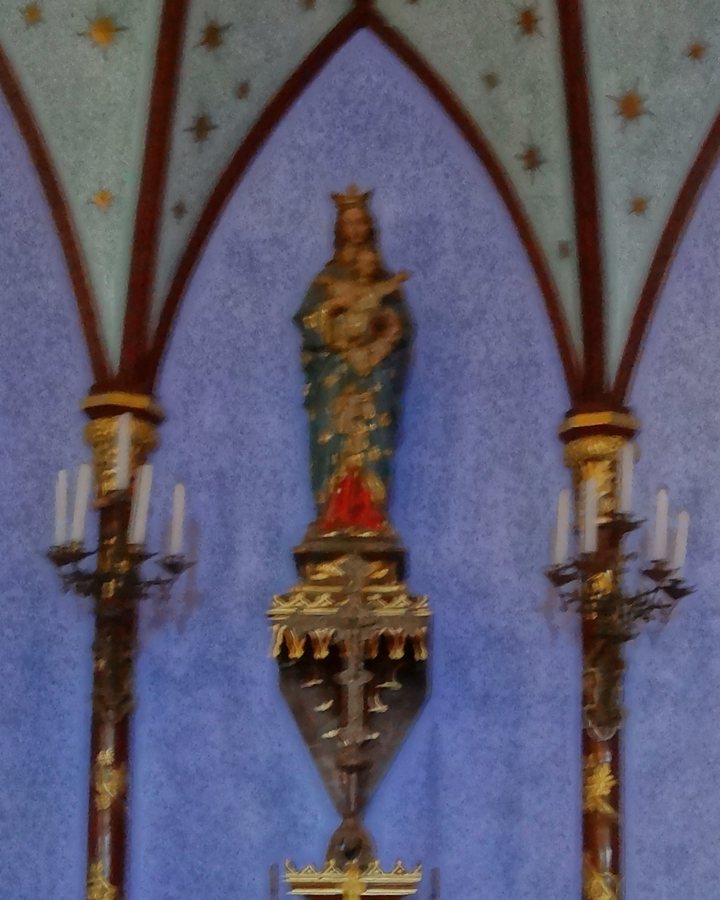
Then, the Nagasaki Shimbun's version continues, she told him that in Urakami almost everyone had the same heart, and asked, "Where is the statue of Santa Maria?"Petitjean led them to the statue of the Virgin at the side altar on the right, where the Urakami visitors knelt.
How we know her name
Here is a surprise. Petitjean, who wrote the famous account the next day, did not record the woman's name.For a long time many people credited the words to her sister, Clara Teru, the bolder of the two.
The name was saved by another missionary, and later than is often said. Father Jules Alfred Renaut was born in Paris in 1852, so in 1865 he was a boy of twelve or thirteen in France. He served in Nagasaki from 1875 to 1880, and became the first head of the seminary for Japanese priests.According to the Nagasaki prefectural feature, the "Renaut diaries," preserved at the Sulpician major seminary in Fukuoka, record that the speaker was "Yuri Isabelina Sugimoto, a midwife living in Hamaguchi-machi."Kataoka Yakichi, in his history of the Japanese martyrs, says it was through Renaut's diary, kept after he came to Nagasaki in Meiji 8 (1875), that it became clear the first words were Yuri's.Nihon jinmei daijiten also credits Kataoka with the identification.
So the record is not an eyewitness note made on the day. It was written about ten years later, presumably from the people who had been there; the diary does not say so in any source we have seen (). The chain runs: Renaut's diary (1875 to 1880), read by Kataoka, reported by reference works and the prefecture (Unverified). No source we have found names anyone else as the speaker except the older attribution to Teru, which Kataoka sets aside.
Exile
The meeting at Ōura changed Urakami's life. Within two years the village had ; in July 1867 they were raided, and the new Meiji government decided to break the community by scattering it.
Yuri was sent to Fukuyama, in what is now Hiroshima Prefecture. Teru was , where, the family remembers, she was tortured.The Hiroshima diocese's pilgrimage notice for Fukuyama says the domain received 20 people in the first exile and 76 in the second, "Isaberuna Yuri" among them, 96 in all, held at four sites in the castle town.That would put her among the mass exile of early 1870.Nihon jinmei daijiten dates her exile to Meiji 4 (1871) ().
Home, and after
When the ban was lifted in 1873, both sisters returned to Urakami.Yuri lived another twenty years. She died on 4 October 1893, aged 81 by the Japanese count.
She is buried in a cemetery in Sakamoto 3-chōme, Nagasaki. Teru lies in the Moriuchi family plot in the Hakusan cemetery at Motohara.A descendant of Teru in the fifth generation, interviewed in 2018, still went every year to the Mass at Ōura that marks the day.
Why she matters
The Nagasaki Shimbun's columnist put it plainly: the two sisters' single-minded faith helped bring the ban to an end, and so "opened the door to human rights in Japan."That is an editorial judgement, not a finding. But the plain facts are remarkable enough. A village midwife, in her fifties, walked into a foreign building with her sister and said aloud what her family had hidden for two hundred and fifty years. She went into exile for it. She came home. And for a long time, almost nobody knew her name.
What is uncertain
Where the sources disagree
- Her role as midwife in secret baptisms: not stated by any source (Unverified; do not claim).
