Christmas on the beach
The first Christmas Mass in Gotō after the ban was lifted was not said in a church. There was none. It was said on the beach at Dozaki, a small cape in Okuura Bay on Fukue Island, by Father of the Paris Foreign Missions, who had come to the islands after 1873. The two missionaries sent to Gotō, Fraineau and , were there to take part in the revival of the islands' Christians.
The faithful who gathered on the shore had grown up in secret. Okuura, on the north-east of Fukue, is held to be the place where Christians from Sotome, crossing the sea in the Edo period, first settled. In 1868 the persecution that began with the prison on had reached Okuura too, with harassment, detentions and imprisonment. The missionary historian Francisque Marnas gives the day: on 16 December fifty-nine Christians were seized at Okuura and shut up in the village of Uragashira, while Bishop Petitjean in Nagasaki wrote that the news from Gotō "tears our souls".
Sources: christmas on the beach
The Christmas Mass, the 1877 permanent priest and the dates of the church come from the Goto City guide to its churches. The Visit GOTO page and the prefecture's おらしょ site add the names and the museum details. None of these gives the year of the beach Mass.
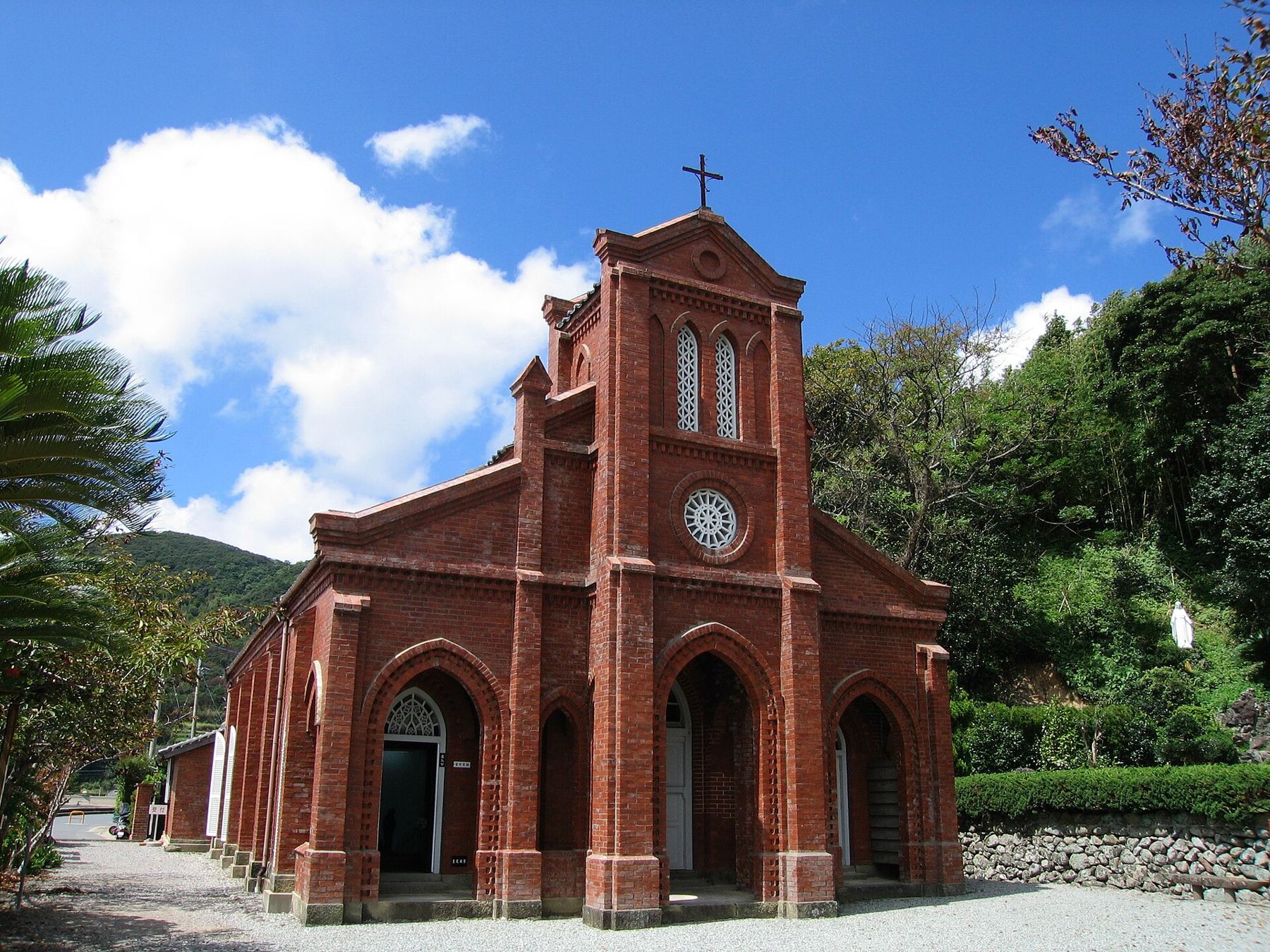
A red brick church on the cape
In 1877 a priest came to live on the island, and real parish work began. Until parishes had been set up all over the island, Dozaki was the centre. Father Marmand built the first church, a temporary wooden one. the Goto City guide gives 1880; Visit GOTO gives 1879.
Joseph-Ferdinand Marmand, born at Simandre in the Ain in 1849, had been a lieutenant in the war of 1870 before he became a priest. Ordained on 23 September 1876, he left for Japan that November and began in the south of the Gotō islands. His society's obituary says he cared for three thousand Christians there and built ten churches in barely ten years, about one a year. He later served the islands at the mouth of Nagasaki harbour, the Amami islands and Kuroshima, where he died in August 1912.
His successor, Father , rebuilt it in red brick. Albert Pélu, from Fresnay-sur-Sarthe, had come to Japan in 1872 and was later made superior of all the Gotō missions. His obituary tells how the little Christian villages each wanted a chapel of their own, which wind and termites soon destroyed, and how he persuaded them to pool their collections and part of what they earned from fishing, for years, to build larger and stronger churches in central places. "Armed with ruler and compass" he drew the plans himself, and gave Gotō several fine brick churches. At Dozaki, the prefecture's column says, Pelu designed the church himself, and an island carpenter, Nohara Yokichi, was head builder, helped by Tetsukawa Yosuke, then still an apprentice. Some of the materials came all the way from Italy. It is a Gothic church of red brick, with a wooden interior, stained glass and a ribbed vault ceiling. completed in 1907 and consecrated in 1908 (Goto City guide), rebuilt in 1907 (prefecture), or rebuilt in 1908 (Visit GOTO). This guide uses 1907 for the building and 1908 for the consecration.
The women of Okuura
Dozaki was more than a church. Under the missionaries, rooms for teaching the catechism to children grew up here, together with the , an organisation of women who taught the faith. The prefecture describes a children's home where women of Gotō took in children whose families were too poor to raise them, and says that spirit is still carried on today.
The church becomes a museum
On 9 April 1974 the church was named a tangible cultural property of Nagasaki Prefecture. In 1977 it was turned into a museum of Christian history, with exhibits from the first mission through the persecution to the revival.
The museum shows the , the church calendar handed down by the hidden Christians' calendar keepers, woodblock prints that Father used in teaching, and other objects from the ban to the Meiji era. Relics of , one of the Twenty-Six Martyrs and a son of these islands, are kept in the church. the prefecture's museum page says they came home from Macau, while a column title on the same site says Manila. In the garden are a relief of Luis de preaching in Gotō and a statue of St John of Gotō.
