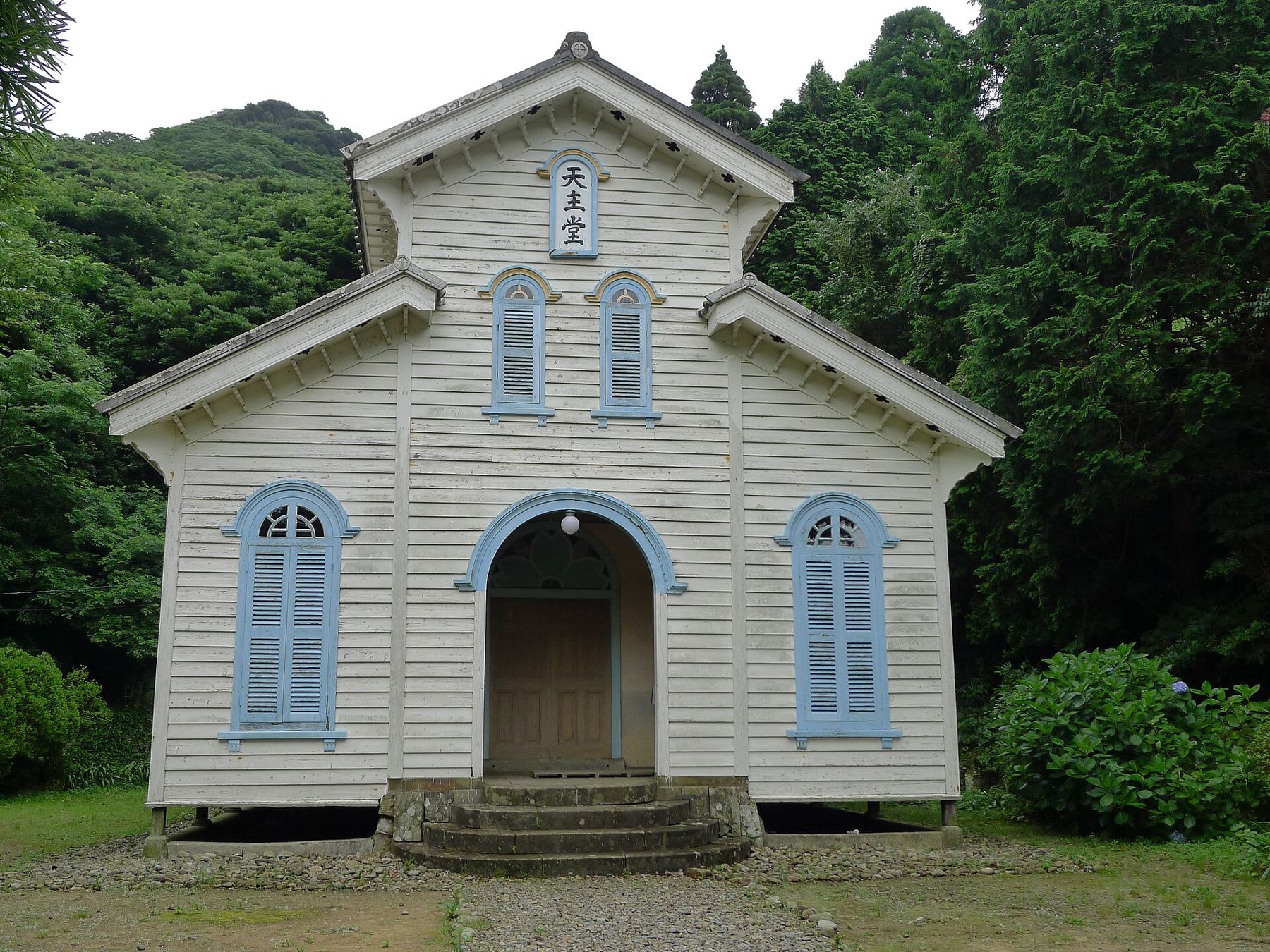
Four families and a valley
Egami lies in a valley near the sea on , in the middle of the Gotō chain, well away from the villages where Buddhists and Shinto believers lived. The school guide says four hidden Christian families began life there, building houses and tilling the little flat land. The prefecture's heritage site says they came from in the middle of the 19th century.
Egami is the last of the five World Heritage villages chosen to show where hidden Christians moved, and the prefecture calls it the representative example of villages formed in remote valleys by the sea. They chose the place, the panel says, adapting to the lie of the land, and kept their community together around their leaders.
A church on stilts
The families were baptised in 1881, and Egami grew into a Catholic village. At first they went to other churches by boat. In 1906 they built a first wooden church in a spot blessed with a spring and good shelter from the wind.
In 1918 they built the present church, paid for by selling , a small silver sardine. The builder was the Gotō master carpenter . He designed the site for its weather. The valley was windy and damp, with a stream in front, so he raised the floor on , short Japanese-style floor posts, instead of brick footings, and cut ventilation holes under the eaves in the shape of flowered crosses, . Traces of shells still cling to the foundation stones.
Tetsukawa himself was a Buddhist. The prefecture says he came to understand the Christian spirit through his friendship with the priests and left messages all through his churches.
Sources: a church on stilts
The World Heritage panel and the Gotō school guide give the official account; the prefecture's heritage site gives the building data; a prefecture column describes the details of the building.
Wood made to look like more
Inside, the church follows the Japanese custom of taking off shoes. The believers painted wood grain and flowers by hand on the pillars and the window glass. The flowing grain on the pillars is said to have been drawn with a comb, the way European builders painted marble onto stone columns, and the same grain appears at Shitsu church in Sotome; look at the windows and you will find hand-painted cherry blossoms. Overhead is a , made of wood. The prefecture calls Egami one of the most complete wooden churches built in Nagasaki since the 19th century.
In front of the church grow large tabu trees, which shield it from the strong north wind in winter, and a prefecture column credits them with saving the building from typhoons. The stone-lined channel and stone walls built with the church still survive around it.
A village church on a quiet island
Naru is losing people, and the church is normally locked. A guidance centre for the island's World Heritage site opened in 2021.
