Crosses from bullets
Among the bones in the castle's broken stone walls, the excavators found small crosses. They had been made inside the castle, quickly, from the lead of gun bullets. With them were medals that had been handed down in families since the first missionaries gave them out.
The people who made them were besieged. In 1637, after years of harsh rule and famine, peasants of the southern Shimabara peninsula and the Amakusa islands rose up, and, it is said, more than 20,000 of them shut themselves into the abandoned castle at Hara under a young leader, . They took with them the banner of a Christian confraternity and used it as their battle flag, and they prayed in Latin written out in Japanese script. Shogunate records suggest they built a chapel inside the walls and preached there. Among the finds are flower-cross roof tiles of the kind dug up at Nagasaki's church sites, and , medals bearing the figures of St Ignatius Loyola and St Francis Xavier; their war cry, the Dutch recorded, was "Santiago!" The city's excavation report says the crosses, medals and rosary beads show plainly the faith of the Christians who held the castle.
Sources: crosses from bullets
The castle's building dates come from Jesuit reports sent to Europe. The siege comes from shogunate records and from excavations that are still going on, which have found the bones, the devotional objects and the houses of the defenders. The banner and the prayer survive because samurai of the shogunate's army took them home as trophies.
The Arima castle
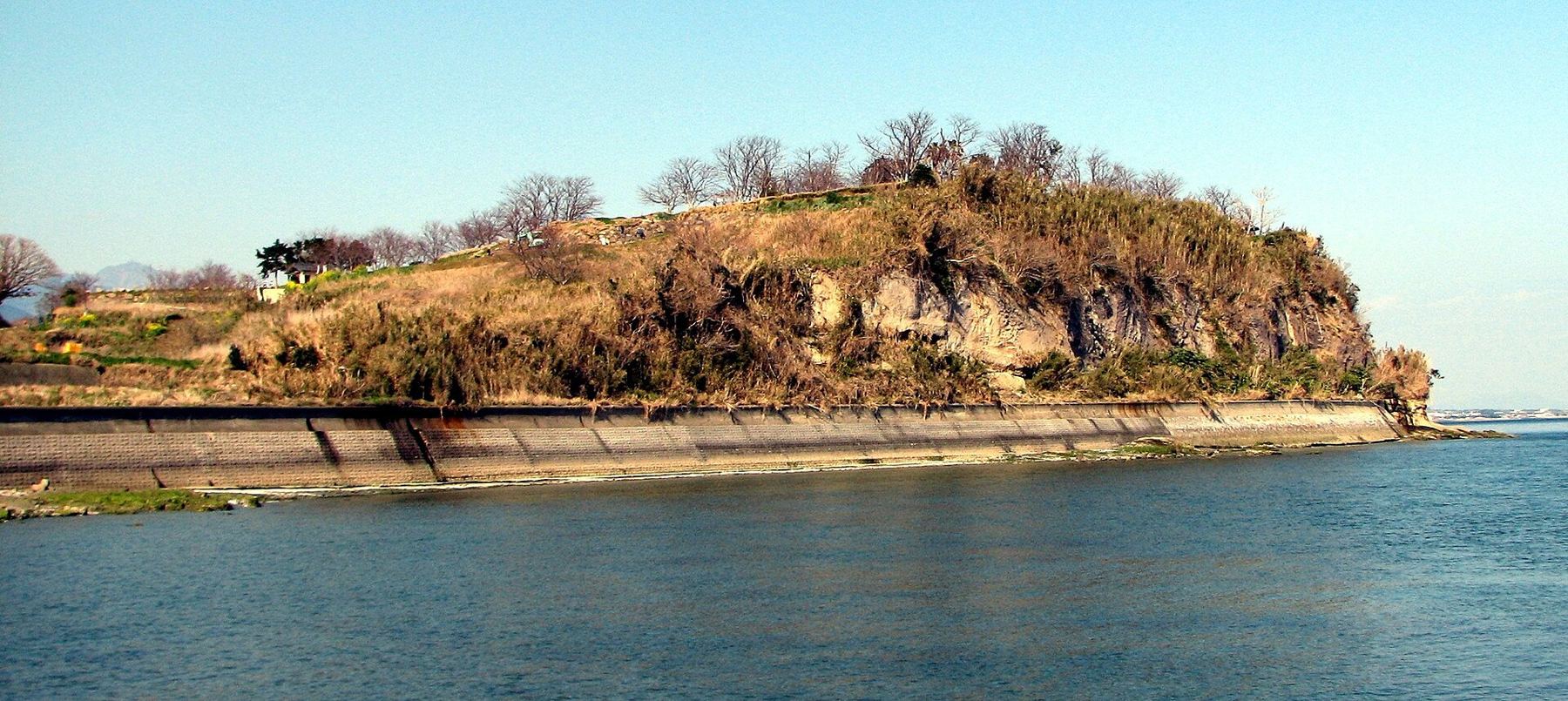
The castle was built between 1598 and 1604 by , a Christian daimyo, and the Jesuits reported its building to Europe. It stands on a hill that juts into the sea, with water on the north, east and south and low marsh to the west, and was laid out in a main enclosure, second and third enclosures, an Amakusa enclosure and outworks. Its early stone walls show the techniques in fashion under Oda and Toyotomi.
The Arima left the region, and the family who replaced them built a new castle. In 1618 Hara was given up.
The rising
The shogunate sent an army of more than 120,000 against the castle. The defenders fought back hard, and the attackers suffered more than 8,000 dead and wounded. After a siege of four months almost everyone inside, men and women, young and old, was killed. the official component page gives "about 20,000 and several thousand" defenders; a column on the prefecture's site puts the dead at about 26,000.
The Catholic historian Léon Pagès, writing from the account of Duarte Correa, a Portuguese captain then held for the faith in the jail at Ōmura, insisted that religion was not the true cause. The lord had added tax upon tax: half of every tobacco plant's leaves, a share of every eggplant, a levy on every house. Farmers who could not pay were beaten, and their wives taken as hostages; some pregnant women were plunged into icy water and died. When the daughter of a leading farmer was stripped and burned with brands, her father and his friends killed the local official and his men, on 17 December 1637, and the whole district rose. In Japanese the rising is called an . Correa himself was burned at a slow fire at Ōmura in 1639.
Former retainers of the Christian daimyo Arima Harunobu and took the lead. They are said to have been the leaders of the , the units of the Christian community. West of the main enclosure, excavation has found rows of half-underground huts, built regularly, which show that the defenders still acted together as families and villages.
A castle destroyed
The castle fell on the 28th day of the second month of Kan'ei 15, which is 12 April 1638. The very next day Hosokawa Tadatoshi ordered parties of good walkers with guns into the hills to hunt down the Christians who had escaped, and told his elders to have 500 men ready, for the stone walls of the main enclosure were to be pulled down from the following day. Pagès found no living soul left in the fort; he counts 35,000 dead, "others have said 37,000". Pagès dates the end of the siege 15 April 1638, three days after the Japanese date; we use 12 April. To break the walls the shogunate's commander had even called on a Dutch ship, the De Ryp, which fired on the castle from the sea between 21 February and 12 March 1638. Hosokawa Tadatoshi protested that asking foreigners for help was a disgrace to Japan.
The bones, crosses and huts were found buried inside the broken stone walls. The shogunate, afraid that the castle could be used for another rising, had destroyed it completely.
The rising shocked the shogunate. It banned the Portuguese ships that might carry missionaries in, and the country was closed for more than two centuries. With no priests left in Japan, the Christians who survived had to go into hiding and keep the faith by themselves. The memory of the rising was handed down for generations in hidden Christian villages, in and in among them.
