A room of twelve mats
After the Discovery at in 1865, Hisaka's leaders went to the church to meet the priests. In 1868, the first year of Meiji, the hidden Christians of Hisaka told the authorities what they believed. They were arrested, and more than two hundred were pushed into a prison of about twelve tatami mats. Torture and hunger killed thirty-nine there, and three more died just after they were let out. The school guide puts it simply: about two hundred people in a narrow cell, and forty-two dead, many of them old people and children.
The prefecture says the "Gotō ", the persecution of the Gotō Christians, began here. When Father reported it to Europe, foreign governments protested, and the government later came to accept Christianity. the prefecture's memorial page and the school guide give 42 deaths; a prefecture column says 43 names are on the memorial.
Settlers invited
Hisaka is one of five World Heritage villages chosen to show where hidden Christians moved. From the late 18th century the Gotō domain welcomed settlers to open up the island. Hidden Christians from heard of it and chose Hisaka as a place where they could live beside the existing villages.
They did more than live beside them. At Ōkai, in the middle of the island, they settled on the edge of a Buddhist village and cleared rice fields while working with their neighbours; the prefecture says such mutual help was found all over the island. At the port of Tanoura, at the fishing ground of Hosoguryū and in the fields of Nagaeri, the prefecture's monitoring list names places where Buddhists and hidden Christians worked together.
was different. It was a small hamlet cut off from the rest of the island, where hidden Christians lived far from Buddhist and Shinto neighbours. Its graveyard holds graves from both before and after the ban.
A church that moved by sea
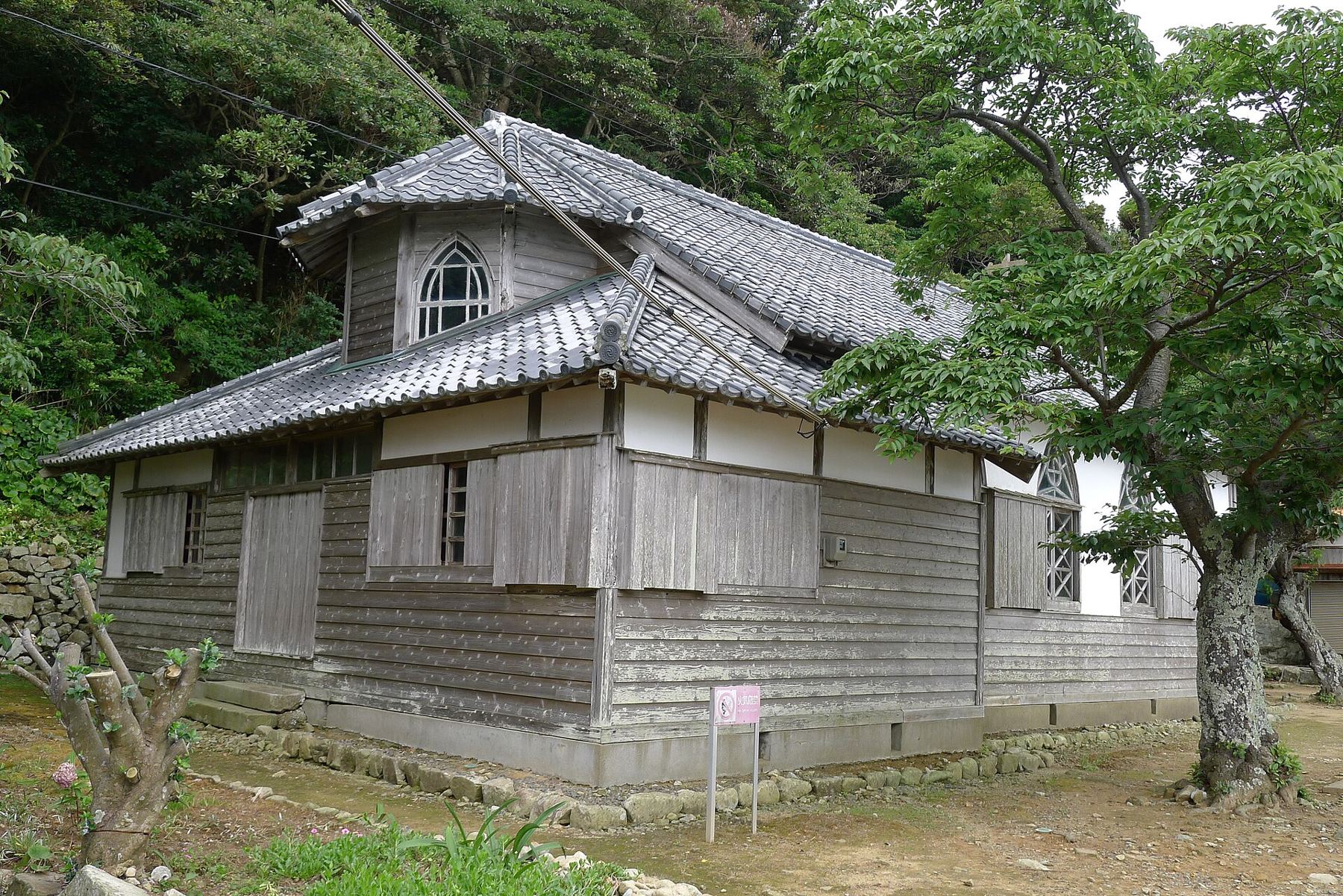
After the ban was lifted, the island's Christians returned to the Catholic Church and built churches in their own villages. The first was Hamawaki, in 1881. Fifty years later, in 1931, Hamawaki was rebuilt in reinforced concrete. The old wooden church was due to be pulled down.
Gorin could not afford a church of its own, because of its isolation and its money. So it asked for the old Hamawaki church, took it apart and rebuilt it in the hamlet. The prefecture's column on it is titled "the church moved by sea".
Sources: a church that moved by sea
The World Heritage panel and the Gotō school guide give the official account; the prefecture's heritage site gives the building data and the Rōya no history. Each part of the property is photographed and checked every year.
Kept, not used
In 1985 Gorin built a new church, but the old one was kept, and in 1999 it was designated an Important Cultural Property. It is a small wooden building that looks like a house from outside, with a ribbed vault inside. The prefecture calls it a leading example of early church building.
Some of the other churches are gone: the Nagaeri church was dismantled in 2020 and only its site is kept. At Rōya no Sako a memorial church was built in 1984; inside, the carpet marks out the size of the old prison, and every autumn believers gather there for a festival of the martyrs. Since 2011 Hisaka has also been an .
