十Christian Japan
Place guide · Hirado & Ikitsuki · Village and sacred mountain

Kasuga Village and Mt Yasumandake, Hirado

World Heritage component

On the west coast of Hirado island, a valley of rice terraces runs down from a holy mountain to the sea. There is no church in it. How did the Christians of Kasuga keep their faith for two hundred years, and why did they never come back to the Catholic Church?

3 min read8 sources5 pinsVisitingTap any name, place or term to learn moreTimeline

Kasuga's Christians prayed to what was already holy around them: a mountain of the old gods and an island where martyrs had died. They kept the faith so well inside village life that, when the ban ended, they chose to keep it as it was.

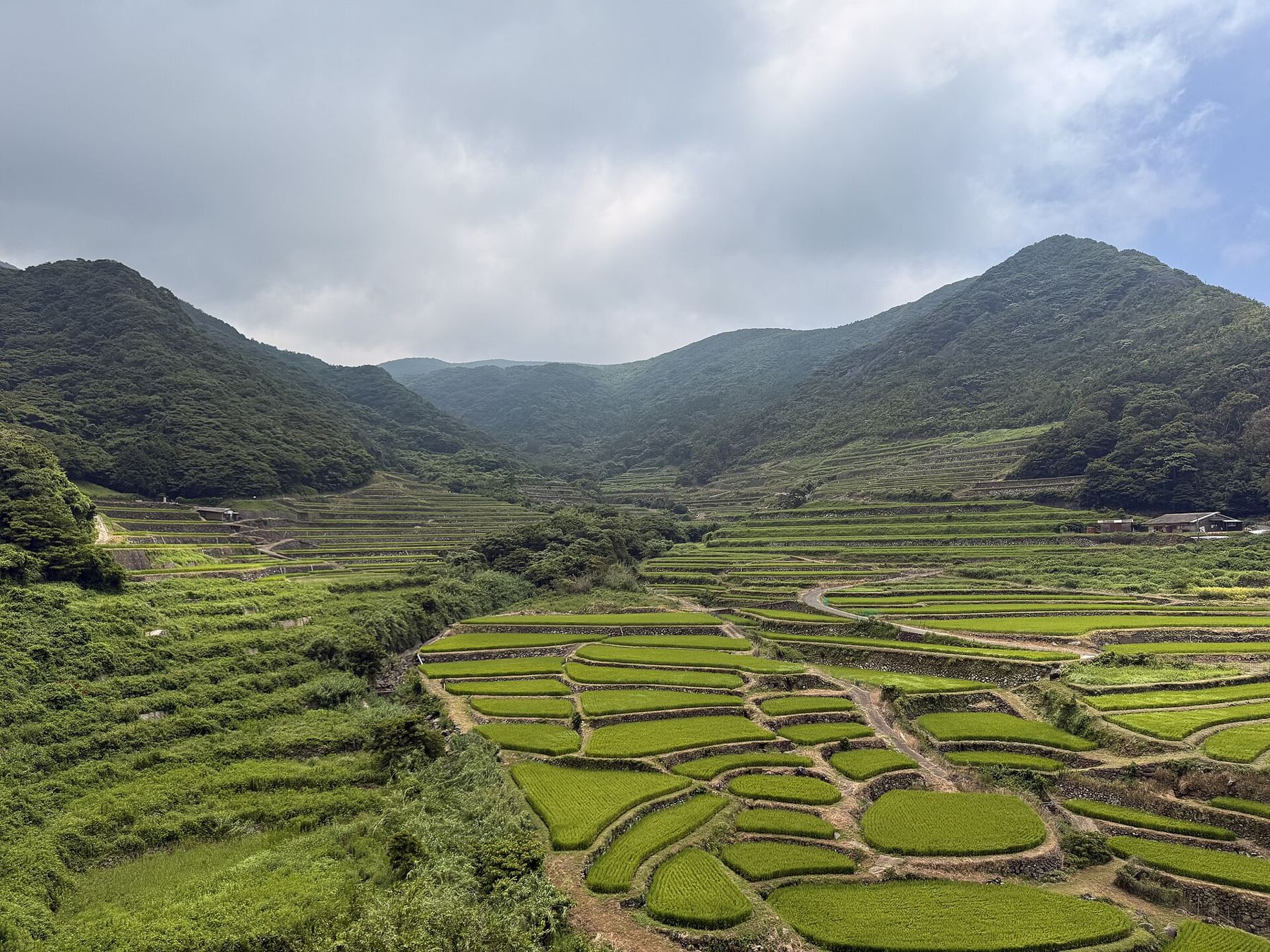
Rice terraces running down to the sea on Hirado island
Rice terraces running down to the sea on Hirado island.Rice terraces, Hirado. Bryanmackinnon, CC BY 4.0. Commons

In 60 seconds

The place in 7 steps. Each line is footnoted.

  1. 1550Francis Xavier brings Christianity to Hirado; the local lord Koteda converts, and the faith reaches Kasuga.
  2. 1561Luis de Almeida writes of the road to a cross at Kasuga.
  3. 1599The Matsura lord bans Christianity and the Kotedas leave Hirado.
  4. 1609Gaspar Nishi is beheaded at Kurose-no-tsuji on Ikitsuki.
  5. 1622Father Camillo Costanzo is martyred; no missionary comes to Hirado again.
  6. 1865News of the Discovery at Ōura reaches Hirado, but Kasuga does not return to the Church.
  7. 2018Kasuga, Mt Yasumandake and Nakaenoshima are listed as part of the World Heritage property.

The road to the cross

In 1561 the Jesuit Luis de came to Kasuga. He wrote that when he arrived, the road leading to the cross looked as it does when people are waiting for a procession of the Blessed Sacrament. A year later the village had its own Misericórdia, the "group of mercy" that cared for the sick and the poor.

That cross has gone. In the middle of the valley stands a small wooded hill, Maruo-yama, where the first Christians were buried. A guide for local schoolchildren says there were once a church and a cross in Kasuga, and that the cross may have stood on Maruo-yama.

On the mapKasuga and its holy places
Kasuga village, Mt Yasumandake, Nakaenoshima. Full atlas and pin sources
1550 to 1622

How the faith came, and how it was left alone

Xavier brought Christianity to Hirado in 1550. The lord of the island's west coast, Koteda, became a Christian, and so the faith spread to Kasuga. A Jesuit letter of 1563 shows that the Christians of Kasuga had formed a , a confraternity.

In 1599 the Matsura lords of Hirado banned the faith, and the left the island. The Catholic bishops' history says Jerónimo Koteda and his cousin Baltasar went to Nagasaki with six hundred retainers. Missionaries still came secretly to Hirado after the national ban of 1614. After Father was martyred in 1622, none came again. From then on the kumi leaders kept the community together.

Sources: how the faith came, and how it was left

The World Heritage page sets out the history from Jesuit letters and village records. The prefecture's おらしょ site quotes Almeida's letter.

1622 to 1865

A mountain and an island

The leaders' houses had a Buddhist altar and a Shinto shelf like any other. In a back room, the nando, they hid their own holy things: the . The children's guide describes two of them. The otenpensha was a bundle of 46 cords with a metal cross at the tip, used to strike away illness. The okamisama were sixteen wooden tablets, one for Mary and fifteen for the events of her life.

Outdoors they prayed to Mt , the highest peak in the Hirado area, which had been a mountain of Buddhist and Shinto worship long before Christianity came. In the sixteenth century its temple, Saizenji, had been a strong enemy of the missionaries. Under the ban, a path ran up to the summit from Kasuga, and the whole village prayed there. On the summit is a small stone shrine that the hidden Christians called the "Kirishitan shrine". In their prayer of calling, the kamiyose no , the mountain is "Yasumandake-sama".

Out at sea they prayed to , the island where Christians had been executed, and drew holy water from it.

Across the strait

Gaspar Nishi on Ikitsuki

The Kotedas also ruled Ikitsuki, the island just north. was born there in 1556 and baptised at the age of two. When the Kotedas left in 1599 he stayed, and with his wife Ursula became a catechist of the island. He was charged with keeping the faith and baptising, and asked to die at Kurose-no-tsuji, where Father Cosme de Torres had raised a great cross in 1563. On 14 November 1609 he was beheaded there. Ursula and their son João died nearby at about the same time.

The Christians of Ikitsuki kept his grave through the years of hiding, and in 1993 a great cross was raised again at Kurose-no-tsuji. Gaspar's son Tomás Nishi was martyred at Nagasaki in 1634 and canonised in 1987.

On the mapHirado and Ikitsuki
Kasuga village, Nakaenoshima, Shima no Yakata museum, St Francis Xavier Memorial Church. Full atlas and pin sources
Today

No church

After 1865 the news of the Discovery at Ōura soon reached Hirado, and Catholic objects made abroad in the nineteenth century found their way into Kasuga's nandogami, a sign of contact with the Paris missionaries. But Kasuga did not return to the Catholic Church. Its people kept the faith as they had received it, and so there is no church in the village. Christians who kept the hidden faith in this way, outside the Church, are called . In the twentieth century the old forms faded, and today some families keep the objects privately.

The prefecture says the village's landscape has changed little since the sixteenth century.

Timeline

The dated story

Every dated event on this page, with its sources. Filter by section.

  1. 718Shirayama-hime Shrine on Yasumandake founded
  2. 1550Xavier in Hirado; Kotedas convert
  3. 1556Gaspar Nishi born on Ikitsuki
  4. 1561Almeida describes the road to the cross at Kasuga
  5. 1562Misericórdia group at Kasuga
  6. 1563Torres raises a cross at Kurose-no-tsuji
  7. 1563Jesuit letter records a kumi at Kasuga
  8. 1599Matsura ban; the Kotedas leave Hirado
  9. 14 Nov 1609Gaspar Nishi beheaded at Kurose-no-tsuji
  10. 1622Camillo Costanzo martyred; no more missionaries
  11. 1634Tomás Nishi martyred at Nagasaki
  12. 1865News of the Discovery at Ōura reaches Hirado
  13. 1987Tomás Nishi canonised
  14. 1993Cross raised again at Kurose-no-tsuji
  15. Apr 2018Kasuga guidance house opens
  16. 2018World Heritage component
Atlas

Where it happened

Each pin is a place named on this page. Coordinates come from official prefecture maps, OpenStreetMap or Wikidata, as listed. Rows marked "not yet pinned" have no verified pin.

This placeRelated site
PlaceWhy it matters hereCoordinatesCoordinate source
Kasuga villageThe hidden Christian village33.3412219, 129.443182OpenStreetMap node/4583423112
Mt YasumandakeHoly mountain; stone shrine on the summit33.337027, 129.4658571OpenStreetMap node/9625865289; Wikidata Q11450944
NakaenoshimaIsland of the martyrs33.3732515, 129.4651713OpenStreetMap way/130937882
Shima no Yakata museumIkitsuki museum of the hidden Christians33.355404, 129.430941OpenStreetMap node/1423809624
Kurose-no-tsujiGaspar Nishi's grave and crosslocation not separately pinnednot yet pinned
St Francis Xavier Memorial ChurchHirado town33.3696232, 129.5495894OpenStreetMap way/787827963
Name cards

People, places and events

Who and what this page touches. Dashed cards are pages still to come.

Visiting

If you go

Practical details change. Check with the operators before you travel. Churches are places of worship: please follow the visitor manners asked of you.

Read next

Where to go from here

Glossary

Words on this page

nandogami 納戸神
Holy objects kept hidden in the back room of a house.
kumi 組
A Christian confraternity in a village.
orashio オラショ
Prayers passed down from the Latin oratio.
Kakure Kirishitan かくれキリシタン
Those who kept the hidden faith after the ban and did not return to the Church.
Sources

Footnotes

Translations from Japanese sources are ours.

  1. Nagasaki Prefecture, World Heritage Division, "平戸の聖地と集落(春日集落と安満岳)" (component of the Hidden Christian Sites), source link (checked 19 Oct 2026)
  2. Nagasaki Prefecture, おらしょ こころ旅, "春日集落," source link
  3. Nagasaki Prefecture, おらしょ こころ旅, "安満岳," source link
  4. Nagasaki Prefecture, おらしょ こころ旅, "中江ノ島," source link
  5. Catholic Bishops' Conference of Japan, "生月の殉教者 ガスパル西玄可とその家族," source link
  6. UNESCO World Heritage Centre, "Hidden Christian Sites in the Nagasaki Region" (no. 1495, 2018), source link
  7. Nagasaki Prefecture, World Heritage school guide for Hirado (PDF), source link
  8. Nagasaki Prefecture, おらしょ こころ旅, "平戸市生月町博物館・島の館," source link
Images

Image credits