十Christian Japan
Place guide · Goto Islands · Hidden Christian village

Kashiragashima Village and Church

World Heritage component

No one wanted to live on Kashiragashima. It was where the sick were sent. So a Buddhist pioneer invited hidden Christians to settle it with him, and they hid behind him. How did that island end up with a church of cut stone?

3 min read9 sources4 pinsVisitingTap any name, place or term to learn moreTimeline

A refuge no one else wanted. Hidden Christians settled an island of the sick under a Buddhist leader's cover, welcomed a priest within two years of the Discovery, and spent ten years building a church from their own sandstone.

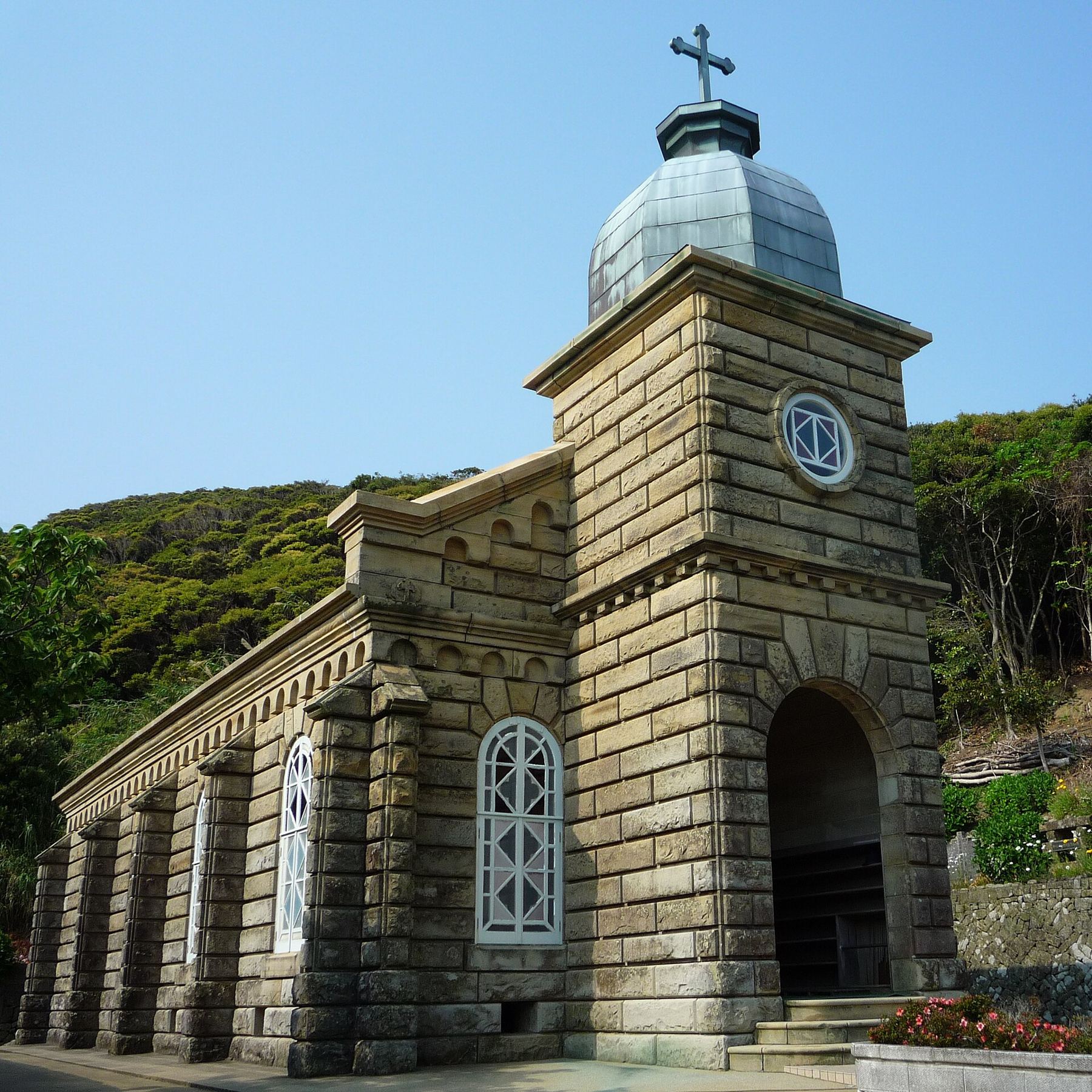
Kashiragashima Church, a grey sandstone church with a domed tower
Kashiragashima Church, a grey sandstone church with a domed tower.Kashiragashima Church. けんみんたろう, CC BY-SA 3.0. Commons

In 60 seconds

The place in 8 steps. Each line is footnoted.

  1. Before mid-1800sKashiragashima is almost empty; sick people are brought there to live.
  2. Mid-1800sThe Buddhist pioneer Maeda Gidayū brings hidden Christians from Tainoura to settle.
  3. 1867The hidden Christian leader Domingo Matsujirō moves to the island; a priest from Ōura says Mass.
  4. 1887A first wooden church is built near Matsujirō's house.
  5. 1910Work begins on a stone church designed and built by Tetsukawa Yosuke.
  6. 1919The sandstone church is completed.
  7. 2001It becomes an Important Cultural Property.
  8. 2018Kashiragashima is listed as a World Heritage component.

The island of the sick

Kashiragashima is a small island off the east coast of Nakadōri, in the northern Gotō Islands. The school guide for Shin-Kamigotō says it was uninhabited until about the middle of the 19th century, except for sick people brought from other places to live there. The prefecture calls it a place of convalescence that people kept away from.

That made it useful. , a local leader, wanted to open the island but found no one willing to go. So he invited people from the Tainoura district, who were hidden Christians. By moving with a man who was not a Christian, the school guide says, they could keep what they believed out of sight. The prefecture says the same: they settled under a Buddhist pioneer, camouflaging their faith.

the prefecture's heritage site says settlers came in the late 18th century; the school guide says the island was empty until the mid-19th century.

On the mapKashiragashima off Nakadōri
Kashiragashima Church, Aosagaura Church, Ōso Church. Full atlas and pin sources
1800s

Bones in the sand

In 1995 an excavation at the Shirahama site found human bones from the time of the ban, buried in a way only Christians used. Up the hill at Tashiro, the settlers cut the steep slopes into fields for sweet potatoes. They brought the skill of dry-stone walling from , and their stone walls and stone-sided huts still stand.

1865 to 1887

A priest on the island

After the Discovery at in 1865, Kashiragashima's hidden Christians went secretly to the church to meet the missionaries. , a leader of the hidden Christians of Sotome and the upper Gotō, moved to the island in 1867 and built his house here. That same year the islanders invited from Ōura to say Mass. Note: Christianity was still banned in 1867.

Matsujirō's house became a "". In 1887 the first wooden church was built near it.

Sources: a priest on the island

The World Heritage panel and the Shin-Kamigotō school guide give the official account; the prefecture's cultural properties database gives the building history and designation. The 1867 Mass comes from the prefecture's heritage site.

1910 to 1919

Ten years of stone

When the wooden church grew old, the islanders decided to build in stone. Work began in 1910. The families of a small hamlet put all their strength into it, and it took ten years: the church was finished in 1919. , the Gotō master carpenter, designed and built it. The school guide says the believers worked together with stone cut nearby. The prefecture's heritage site describes walls of , sandstone from the coast around the island, a round window, and an octagonal dome sheathed in copper on the bell tower.

Inside it is a surprise: a pastel interior covered in flowers, against the heavy stone outside. The database calls it one of the few stone churches in western Japan, and outstanding among the island churches.

Today

Two churches across the strait

Across the strait on Nakadōri, Tetsukawa's other churches tell the same story in brick. At Aosagaura the believers carried the bricks up from the shore in 1910. At Ōso, near Aokata, the first wooden church of 1879 was moved to Wakamatsu, where it became Doinoura church, and Tetsukawa built a brick church in 1916, banded with dark under an octagonal dome.

Timeline

The dated story

Every dated event on this page, with its sources. Filter by section.

  1. Late 1700s or mid-1800sHidden Christians settle with Maeda Gidayū (Disputed)
  2. 1865Kashiragashima leaders visit Ōura
  3. 1867Domingo Matsujirō moves to the island; Father Cousin says Mass
  4. 1879First wooden church at Ōso
  5. 1887First wooden church on Kashiragashima
  6. 1910Stone church begun; Aosagaura brick church built
  7. 1916Ōso brick church by Tetsukawa
  8. 1919Kashiragashima stone church completed
  9. 1995Excavation at Shirahama finds Christian burials
  10. 14 Nov 2001Kashiragashima church becomes an Important Cultural Property
  11. 2007Ōso church becomes a prefectural cultural property
  12. 2018World Heritage listing
Atlas

Where it happened

Each pin is a place named on this page. Coordinates come from official prefecture maps, OpenStreetMap or Wikidata, as listed. Rows marked "not yet pinned" have no verified pin.

This placeRelated site
PlaceWhy it matters hereCoordinatesCoordinate source
Kashiragashima ChurchTetsukawa's stone church of 191933.0124, 129.18286Wikidata Q11664924
Aosagaura ChurchTetsukawa's brick church of 191033.02764, 129.08742Wikidata Q11662623
Ōso ChurchTetsukawa's brick church of 191632.985138, 129.048712Nagasaki Prefecture tourism portal map pin; Shin-Kamigotō tourism portal pin 32.985072, 129.0487004 agrees within 10 m
Ōura CathedralWhere the islanders met the priests32.734189, 129.8701625OpenStreetMap way/243003159
Maeda Gidayū's grave, FukuuraInscription on the island's founding-not yet pinned
Shirahama siteChristian burials found in 1995-not yet pinned
Name cards

People, places and events

Who and what this page touches. Dashed cards are pages still to come.

Visiting

If you go

Practical details change. Check with the operators before you travel. Churches are places of worship: please follow the visitor manners asked of you.

Read next

Where to go from here

Glossary

Words on this page

temporary chapel 仮の聖堂
A leader's house used as a chapel before a church was built.
rusticated stone ルスティカ積
Walls of rough-faced cut stone.
over-fired brick 焼き過ぎ煉瓦
Dark brick fired at high heat, used in bands at Ōso.
Sources

Footnotes

Translations from Japanese sources are ours.

  1. Nagasaki Prefecture World Heritage Division, component panel "9. Villages on Kashiragashima Island" (kirishitan.jp), source link
  2. "Nagasaki and Amakusa Hidden Christian Sites" Preservation and Utilisation Committee, 学校教育用補助教材(新上五島町用)[School supplement, Shin-Kamigotō Town edition] (March 2020), pp. 9 to 14, source link
  3. Nagasaki Prefecture, おらしょ こころ旅, "頭ヶ島天主堂" (history, data, access, column summaries), source link
  4. Nagasaki Prefecture cultural properties database, "頭ヶ島天主堂," source link
  5. UNESCO World Heritage Centre, "Hidden Christian Sites in the Nagasaki Region" (no. 1495, 2018), source link
  6. Nagasaki Prefecture tourism (ながさき旅ネット), "大曽教会" (map pin, address, access), source link
  7. Nagasaki Prefecture cultural properties database, "大曾教会," source link
  8. Nagasaki Prefecture tourism (ながさき旅ネット), "教会見学時マナーのご案内," source link
  9. Shin-Kamigotō Town tourism (新上五島町観光なび), "大曽教会," source link
The wider story

For the wider story around this place, see The Gotō Islands and the Church.

Images

Image credits