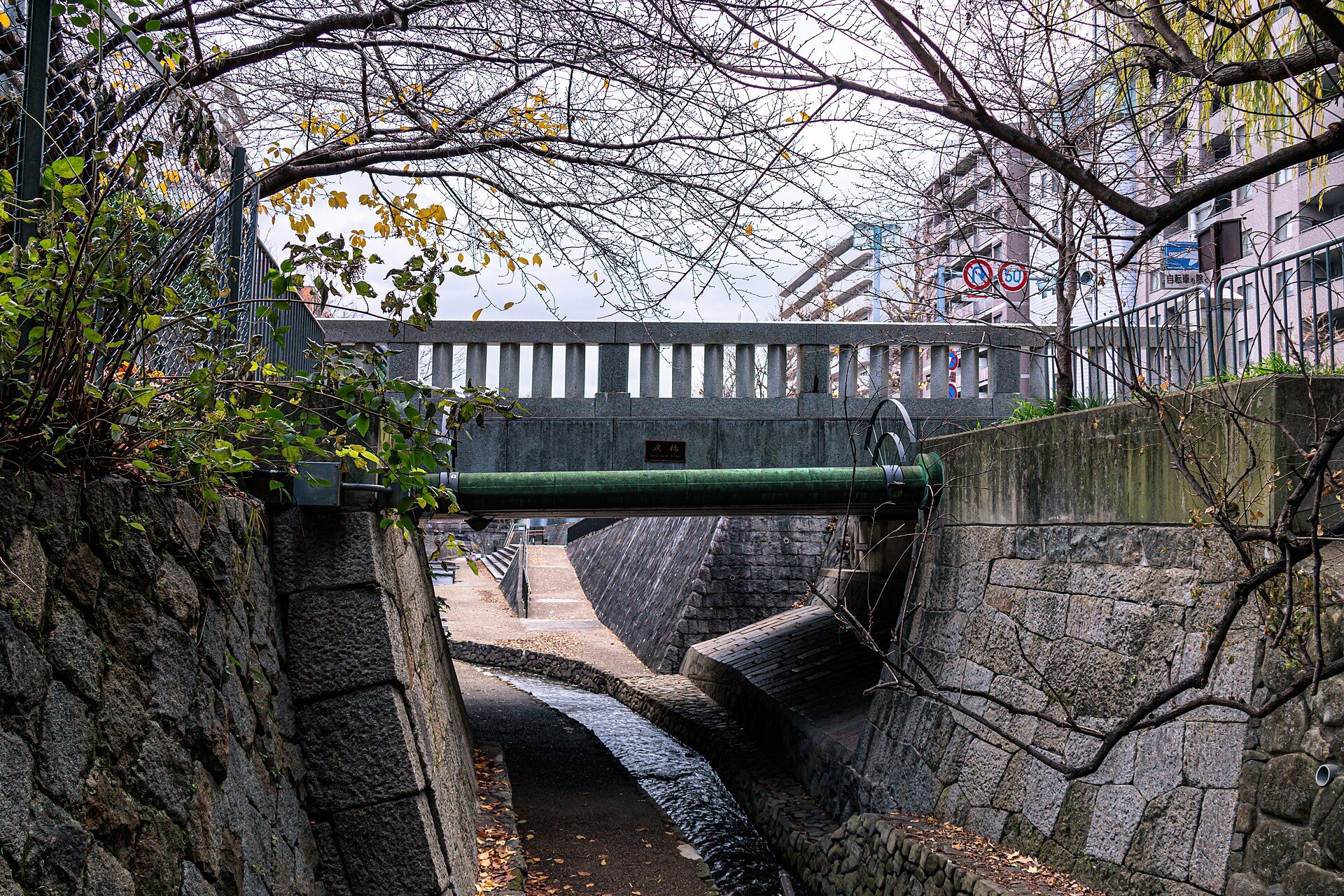
At the bridge
In the winter of 1597 the prisoners were brought out of the gaol in Kyoto, still bound, and walked to this bridge, Ichijō Modoribashi. There their ears were cut with a blade.
Hideyoshi had ordered both ears and the nose cut off. The executioner threw the ear lobes on the ground. A Christian, , picked them up and took them to the Jesuit Father . Then, as was the custom for criminals, the officials put the twenty-four on ox-carts and paraded them through the city to shame them, the .
Sources: at the bridge
The Jesuit and Franciscan accounts, as summarised by the town of Togitsu and the Pauline sisters' Laudate site, which give the place and the date. The Jesuit historian Diego Yuki retells the march from those accounts, and the geographer Asō Masaru of Ritsumeikan University places the bridge in the map of Christian Kyoto.
The Kyoto martyrs
Many of the twenty-six were Kyoto people. Hideyoshi's sentence, carried on a lance at , said the friars had come from the Philippines as envoys and stayed in Miyako preaching the forbidden law. , a catechist of forty-nine, had run the Franciscans' St Joseph's hospital in Kyoto. , a silk weaver of twenty-eight, had moved his shop next to their convent of Our Lady of the Angels. Francis, a Kyoto carpenter, followed the prisoners all the way until he too was arrested and joined them. Diego Yuki SJ, long director of the Twenty-Six Martyrs Museum, writes that they sowed the Gospel all the way from Kyoto, with their mouths that could not be chained and their meekness in blessing their tormentors.
A bridge at the edge of the city
Ichijō Modoribashi was no ordinary bridge. Since the Heian period it had marked the edge of the capital, and in the middle ages it was where criminals were shown to the city; the head of the tea master Sen no Rikyū was exposed there. Just to the east, around Aburanokōji and Ichijō, lay the Christian quarter of upper Kyoto, Daiusu-chō, which later had a church of its own in the Keichō years. So the place chosen to shame the martyrs stood at the door of the Christian quarter.
Twenty-four
In October 1596 a Spanish galleon, the San Felipe, was driven onto the coast of Tosa in Shikoku, and Hideyoshi had its cargo seized. He had already ordered the missionaries out in 1587. Now he ordered the arrest of the missionaries and believers who had been preaching openly in Kyoto.
Twenty-four were taken: six Franciscan priests and brothers, three Japanese of the Jesuits, among them , and fifteen lay Christians close to the Franciscans. The Franciscans were led by , a Spanish priest who had come as an envoy of the governor of the Philippines. Among the laymen were boys; Louis Ibaraki was twelve.
The winter road
After Kyoto they were paraded through Osaka and Sakai. It was decided that they would die at Nagasaki, the city with the most Christians. On 9 January they left Sakai on foot. Two more Christians joined them on the road, and they became twenty-six. On 5 February 1597 they were crucified on the hill of Nishizaka.
An old bridge with older stories
The bridge already had a story before 1597. A notice by Kyoto City, quoted by Laudate, says that in 918, when the scholar Miyoshi Kiyoyuki died, his son Jōzō hurried back from Kumano and met the funeral on this bridge; he prayed over the coffin and his father came back to life for a while, and so it was called Modoribashi, "the bridge of return".
