The riverbank
The fifty-two were put on ox-carts and drawn through the great streets of the capital. Twenty-six were men and twenty-six women, and eleven had not yet reached fifteen. They were brought to the riverbed of the Kamo between Rokujō and Shichijō, about where Shōmen bridge crosses today, where twenty-seven crosses had been set up on the shogun's order. They were tied two or three to a cross.
The governor of Kyoto, , had firewood piled high under the crosses and between them, so that their suffering would not be long. By the time all was ready it was evening. When the fire was lit the martyrs called aloud the names of Jesus and Mary.
, the wife of John Hashimoto Tahyōe, died with five of her children. Tied to the cross with three of them, she held four-year-old Lucia tightly to the last.
The bishops' list of the 188 names the whole family: John Hashimoto Tahyōe, a samurai of high rank, his wife Tecla, and their children Catarina, 13, Tomás, 12, Francisco, 8, Pedro, 6, and Luisa, 3. Laudate calls the little girl Lucia, aged four; the bishops' list says Luisa, three, and Profillet's martyrology says Lucie, three.
Not all of them had been poor. Gabriel, from Owari, had left the service of a lord and a large income, Profillet writes, "to lead a life of want and feed on the bread of sorrow for the love of Jesus Christ, his new master". Note: our translation.
Sources: the riverbank
The two priests who stayed in hiding, and , cared for the martyrs, buried them and made a record of the martyrdom. The Bishops' Conference and the Pauline sisters' Laudate site retell it from that record. The bishops' list of 2007 gives each of the 52 names, with age and home province where known. Profillet's martyrology (1895) dates the burning 7 October 1619; the bishops give 6 October.
A church grown poor
Until 1612 the church of Kyoto had known days of glory; by 1619 persecution had made it poor. Most of the faithful were humble people living along a street called , keeping their faith quietly. After the national ban and expulsion order of 1614 the hunt for Christians grew harder everywhere.
Early in 1619 the shogun Tokugawa Hidetada stepped up the persecution, and Itakura, who until then had looked the other way, put most of the believers in prison. On 10 January thirty-six from Daiusu-machi were taken to the Ogawa gaol; others followed in April and July. Several died of the harsh conditions inside. Hidetada, visiting Fushimi, heard that Christians were still held and in anger ordered the execution of all of them, even those already released. The martyrs, by contrast, were full of joy and prepared to give everything to Christ.
Three great martyrdoms
The Church in Japan speaks of three "great martyrdoms": Nagasaki on 10 September 1622, Edo on 4 December 1623, and this one in Kyoto. For a long time the Kyoto martyrs were left aside, although the record of their deaths is detailed. The Bishops' Conference calls theirs a martyrdom of small children and of young mothers who offered them.
A stone by the river
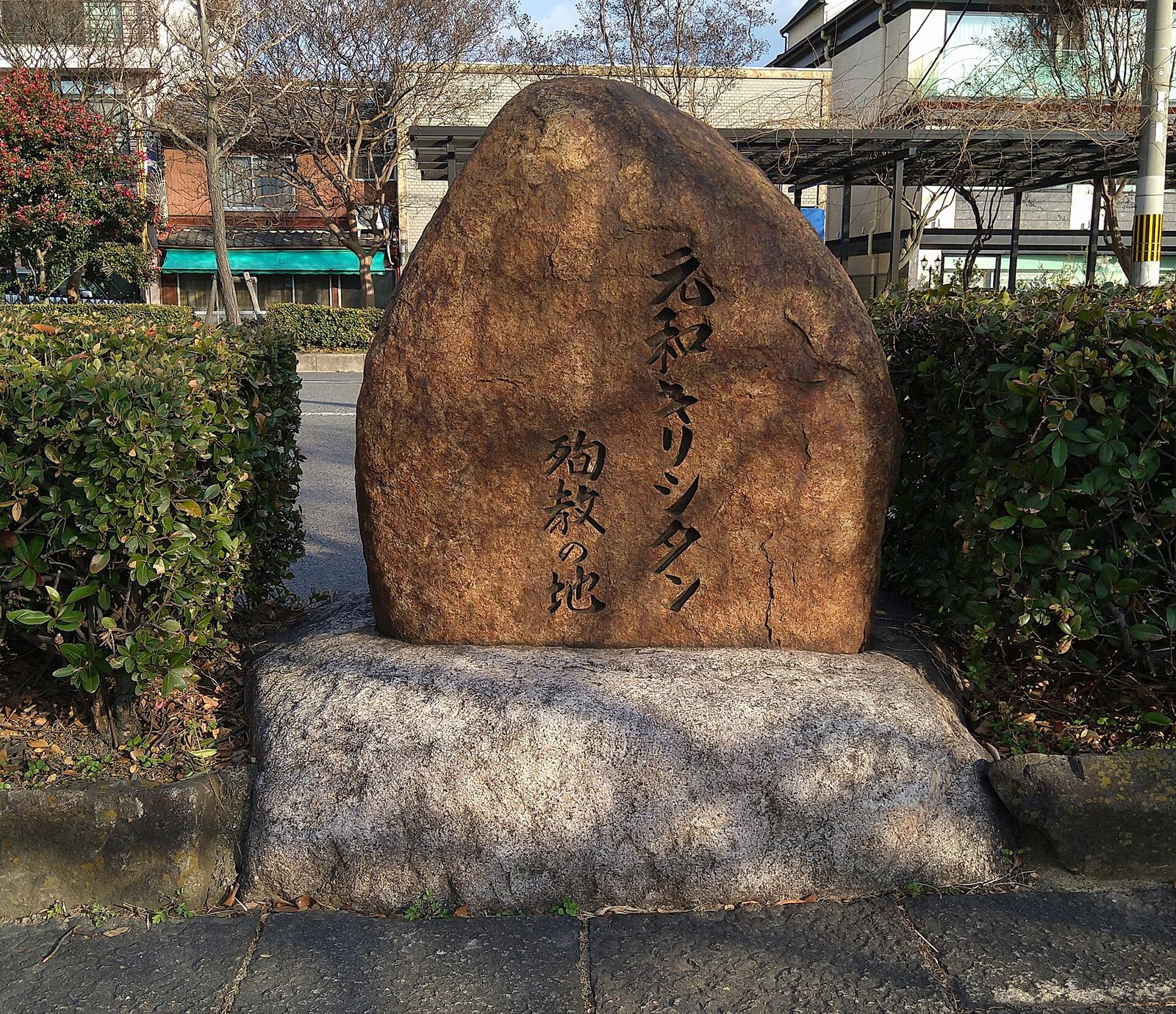
In August 1994, when Kyoto marked the 1,200th year of the capital, a monument of fine Kurama stone was set on the riverside walk, carved "元和キリシタン殉教の地", "the place of the Christian martyrdom". Under it, Laudate says, a white jar holds fifty-two red rose ribbons, each written with a martyr's name.
