十Christian Japan
Place guide · Xavier's Japan & the north · Kirishitan site

Fukuhara, Mizusawa: Gotō Juan and the Canal That Bears His Name

Water still runs through the rice fields of the Isawa plain in a canal called Juan-zeki, which its keepers call the only farm canal in Japan named with a Christian name. The samurai who began it in 1618 never saw it finished: he chose exile rather than give up his faith, and walked away with twelve of his men.

4 min read7 sources2 pinsVisitingTap any name, place or term to learn moreTimeline

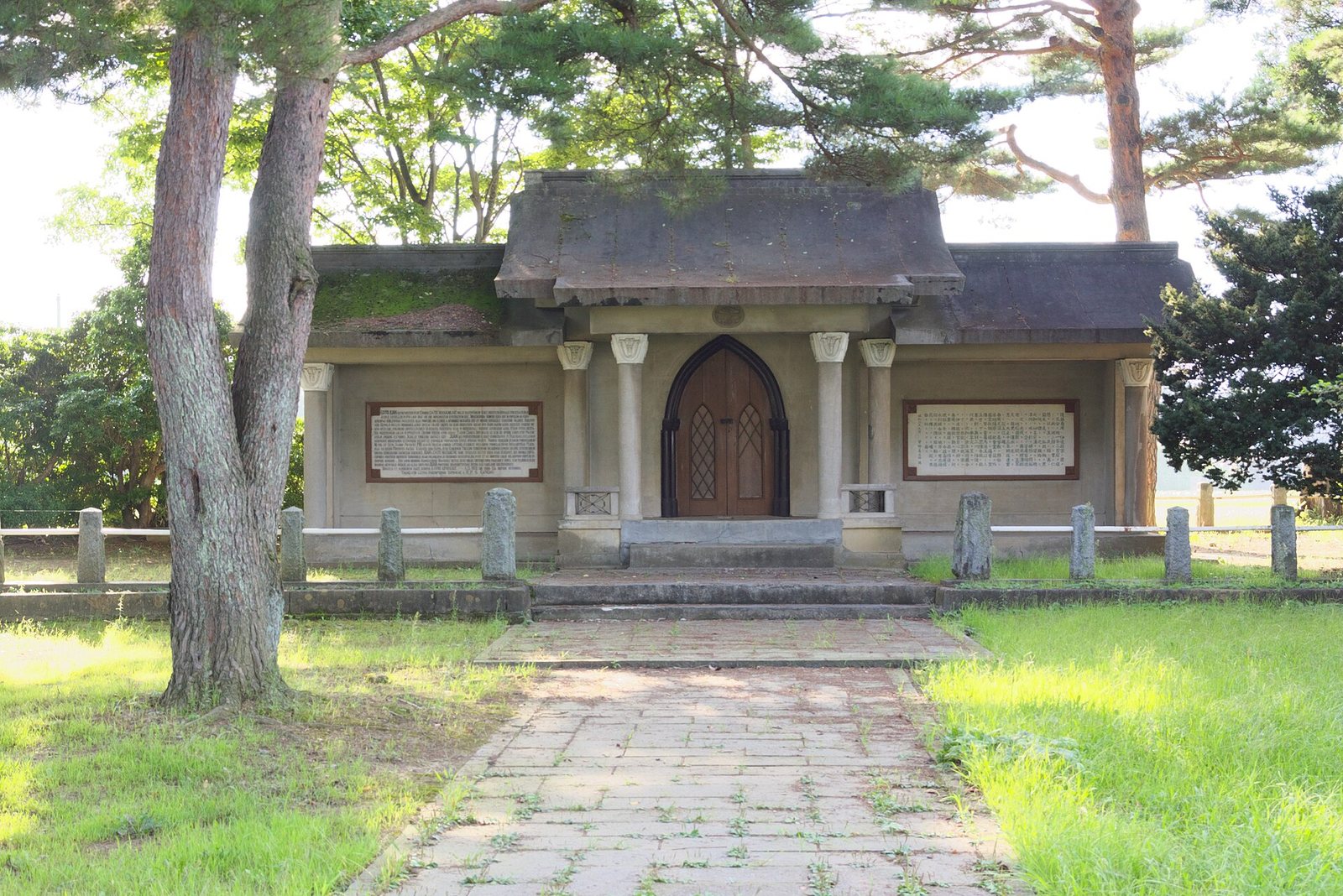
Gotō Juan, a retainer of Date Masamune, cared for his people as a Christian lord should, and his canal fed the plain for centuries after he disappeared. His neighbours, Christians too, finished the work; three hundred years later the farmers who drew its water built him a mausoleum with an inscription in Japanese and Latin.

A small stone mausoleum with a tiled roof and arched wooden door at the end of a paved path between trees
A small stone mausoleum with a tiled roof and arched wooden door at the end of a paved path between trees.Gotō Juan's mausoleum, Ōshū, 21 August 2007. Juan Gotoh, CC BY 3.0. Commons

In 60 seconds

The place in 10 steps. Each line is footnoted.

  1. 1618Gotō Juan, lord of the Fukuhara residence, begins digging the canal.
  2. 1577Born Iwabuchi Matagorō, son of the lord of Fujisawa castle.
  3. 1597Baptised on Uku island in the Gotō Islands; takes the name Gotō Juan.
  4. 1616Masamune grants him Fukuhara in Isawa.
  5. Feb 1624Masamune's men take his house; Juan leaves Fukuhara for exile in Nanbu rather than renounce.
  6. 1624A great drought strikes the plain.
  7. 1631Senda Sama and Endō Daigaku complete the canal, more than 20 km long.
  8. 1924The court honours Juan posthumously with junior fifth rank.
  9. Nov 1931Local people build the Gotō Juan mausoleum.
  10. Every MayA festival remembers his work.

A desert to be watered

Gotō Juan was born in 1577 as Iwabuchi Matagorō, third son of the lord of Fujisawa castle in Iwai. After his elder brother fell to Toyotomi Hideyoshi he wandered far from home, and in Nagasaki he came to the faith. In 1597 he was baptised on Uku island in the Gotō Islands, and took the name Gotō Juan. In 1616 , who hoped to learn from him about the West, made him through Hasekura Tsunenaga the adopted brother of his retainer Gotō Nobuyasu and granted him Fukuhara in Isawa. So Gotō Juan became a vassal of Date Masamune and lord of the residence at Fukuhara. The inscription on his mausoleum remembers him as a ruler who always treated his people with kindness, and who, seeing their poverty, gave away his own wealth and even borrowed to help them.

In 1618 he began to dig a to bring the water of the Isawa river onto the dry terraces. The work was hard: he was trying to lift water from a fierce river to the upper part of the terrace, and it took new knowledge and invention. He dug 1,700 metres, from Kanenyūdō on the upper Isawa to Ōchigai, before the work stopped.

Sources: a desert to be watered

The Isawa Plain Land Improvement District, which still runs the canal, tells the story on its site and records the mausoleum and its inscription. Juan's Christian life and his exile come from the Jesuit Annual Letters, retold by Hubert Cieslik SJ, and from Sakurai Yasuto's study of Peter Kasui Kibe, which sketches Juan's life.

On the mapThe Isawa plain
Gotō Juan garden. Full atlas and pin sources

A Christian land

Under Juan, his lands at Mizusawa, which the Jesuits called Miwake, were entirely Christian, and while Sendai itself was too dangerous, the Jesuits made it the centre of their mission in the north. From here the priests went out to Tsugaru, Akita, Nanbu, Mogami and Yonezawa. Masamune let Juan keep his faith in secret on three conditions: no priest to live in his lands, nothing done to spread the faith, and silence about the permission.

At Christmas 1623 Father Diogo kept the feast with Juan and his people. On the Epiphany a letter came from the Superior General of the Society of Jesus naming Juan a special benefactor of the Society, with a share in all its spiritual goods. It was the last Christmas of the Christian community of Miwake.

The choice

Masamune protected his Christian retainer and urged him to give up his faith. Juan would not. Masamune wrote to him himself, and friends begged him to yield at least for appearances; he stood firm. Under strict orders from the shogun Tokugawa Iemitsu, Masamune at last sent men after him, and Juan went away with twelve of his followers. In February 1624 the domain's men took his house and burned the homes of the Christians; the next day Juan set out for exile in Nanbu, the Jesuit letter says. The canal's keepers say only that no one knows where he went. Carvalho, hidden in the mountains above, was taken a few days later, questioned at Mizusawa and led to his death at Sendai.

Fifteen years later, in 1639, the Jesuit Peter Kasui Kibe, the first Japanese pilgrim to Jerusalem, was arrested at Mizusawa too, where a Christian couple had sheltered him; he died a martyr in Edo.

On the mapFrom Mizusawa to Sendai
Gotō Juan garden, Ōhashi. Full atlas and pin sources
1624 to 1631

The neighbours finish the work

The same year, 1624, brought a terrible drought; the rice fields dried white and cracked, and the lower Isawa suffered worst. Two men of nearby villages, of Kojō and of Maesawa, took up Juan's work. Like him they were Christians. With the help of many farmers they overcame the difficulties and finished the canal in 1631; it is the present upper Juan canal, more than 20 km long. The water reached the middle of the plain and turned uncertain fields along small streams into a great rice land.

Today

The mausoleum and the garden

In 1931 the Juan canal water users' association and local people gave the materials and the labour to build a mausoleum. Its inscription is in Japanese and Latin, and inside is a statue of Juan. Around it, on the place where his residence is said to have stood, is the small Gotō Juan garden, with the mausoleum and an old samurai house of the late Edo period, the Yoshida house, moved here. Every May a festival of prayer remembers his work.

Timeline

The dated story

Every dated event on this page, with its sources. Filter by section.

  1. 1618Juan begins the canal
  2. 1577Juan born at Fujisawa
  3. 1597Baptised on Uku island
  4. 1616Granted Fukuhara
  5. Christmas 1623Carvalho keeps the feast at Miwake
  6. Feb 1624Juan leaves Fukuhara for Nanbu rather than renounce
  7. 1639Kibe arrested at Mizusawa
  8. 1624Great drought on the plain
  9. 1631Canal completed by Senda and Endō
  10. 1924Posthumous court rank
  11. Nov 1931Mausoleum built
Atlas

Where it happened

Each pin is a place named on this page. Coordinates come from official prefecture maps, OpenStreetMap or Wikidata, as listed. Rows marked "not yet pinned" have no verified pin.

This placeRelated site
PlaceWhy it matters hereCoordinatesCoordinate source
Gotō Juan garden, FukuharaMausoleum on the residence site39.132542, 141.120651GSI address search for 奥州市水沢西田115, address level
Ōhashi, Hirose River, SendaiWhere Carvalho, questioned at Mizusawa, died38.2581683, 140.8600848OpenStreetMap way/38812565, bridge level
Name cards

People, places and events

Who and what this page touches. Dashed cards are pages still to come.

Visiting

If you go

Practical details change. Check with the operators before you travel. Churches are places of worship: please follow the visitor manners asked of you.

Read next

Where to go from here

Glossary

Words on this page

canal 堰
Weir and irrigation channel; Juan-zeki is the Juan canal.
Sources

Footnotes

Translations from Japanese sources are ours.

  1. Isawa Plain Land Improvement District (胆沢平野土地改良区), "寿安堰," source link (checked 19 Oct 2026)
  2. Isawa Plain Land Improvement District, "7.後藤寿庵廟堂" (monuments list), source link (checked 19 Oct 2026)
  3. AMOR web magazine, "仙台キリシタン殉教碑" feature (22 Sep 2018), source link (checked 19 Oct 2026)
  4. Iwate Prefecture tourism (いわての旅), "後藤寿庵苑," source link (checked 19 Oct 2026)
  5. Hubert Cieslik SJ, "Father Diego Carvalho (1578 to 1624), a Sendai Martyr," Early Jesuit Missionaries in Japan 9, reprinted in Francis Britto, *All about Francis Xavier* (Sophia University).pdf
  6. Sakurai Yasuto, "日本人初のエルサレム巡礼者," *ヨーロッパ文化史研究* 24 (Tohoku Gakuin University, 2023), source link
  7. Yamaguchi Yōichi, "日本キリスト教史における東北," *聖学院大学総合研究所紀要* 54 (2013): 116 to 127, source link
Images

Image credits