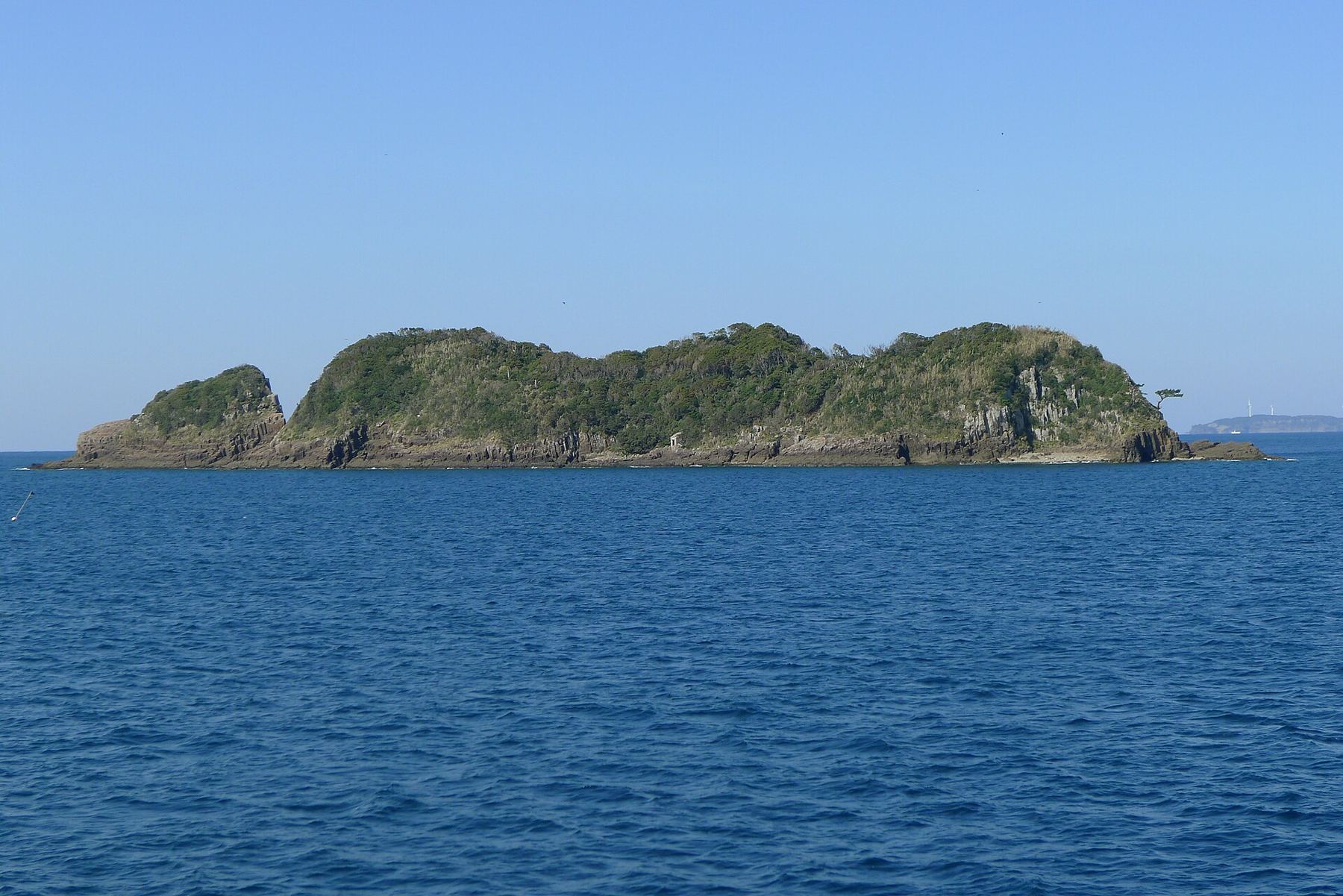
Water from the rock
The island is about 400 metres long and 50 metres wide, and nobody lives on it. It rises 34.6 metres from the sea, about two kilometres off the north-west coast of Hirado island.
In the hidden years, people from and the other villages of the west coast came to it for the : they took the water that seeps out of its rocks as holy water. A children's guide from the prefecture puts it simply: for the hidden Christians it was a precious place, where they took the water seeping from the rock to make holy water.
Sources: water from the rock
The World Heritage page and the prefecture's おらしょ site record both the executions and the ceremony. A photograph of an omizutori is held by the Ikitsuki museum, .
The martyrs
Records say that in the first years of the ban, the Hirado domain executed Christians on the island. Because martyrs had died there, the hidden Christians honoured it as an island of martyrdom, .
The old Catholic martyrology of the Church of Japan, compiled by the Abbé Profillet, keeps some of their names. On 27 May 1622 two men were rowed out to the island: João Sakamoto Zaemon, who had given shelter to the Jesuit Father Camillo Costanzo, and (Profillet writes "Indégoutchi"), master of a boat. João's neck had been bound tight with a cord so that he could not speak. In the boat Damian took an oar and rowed with the oarsmen, singing the praises of God. On the island the officers tied a strip bearing a pagan formula round João's head; he could not tear it off, so he cried out as best he could that he was a Christian. He was beheaded first. Damian lifted up his head and kissed it, said "Praised be the Most Holy Sacrament!", and offered his own neck. He was forty-two. Note: our translation of Profillet. On 5 March 1624 his whole family followed him: his mother Isabel, seventy-four, his wife Beatriz, born at Tachinohama on Ikitsuki, and their four children, among them Madalena, thirteen, João, nine, and little Isabel, seven, who was struck down on her mother's body. As the boat brought them to the island, the family of João Sakamoto Zaemon, a martyr of 1622, arrived for the same end. The two families greeted each other with love and promised to meet again in heaven. Sakamoto's widow Maria and her son Pedro, ten, watched the others die and then were killed; her three grown sons were tied in straw sacks and thrown into the open sea.
The sociologist Sakai Nobuo, working from Pagès' history, also names the Deguchi family and João Sakamoto among those who died on Nakaenoshima, and calls it the place where many Kirishitan of Ikitsuki met their deaths.
The martyrs of Nakaenoshima were not among the 188 beatified at Nagasaki in 2008: the bishops' list of the 188 names only the Nishi family, martyred in 1609, for Ikitsuki, and none for Hirado. Profillet listed them as Venerable.
Local people still have several names for it: "San Juan-sama", "Gosantai-sama" and "Omukae-sama".
Sources: the martyrs
The names come from the Jesuit and other letters gathered by Léon Pagès in the nineteenth century and set out, martyr by martyr, in Profillet's martyrology; the prefecture's pages give the place and its meaning for the hidden Christians.
Seen from the shore
The prefecture's guide for schools marks a viewing point for Nakaenoshima on its map of Hirado. From Kasuga, below its holy mountain , the island can be seen out at sea.
