十Christian Japan
Place guide · Goto Islands · Hidden Christian village

Nozaki Island village ruins

World Heritage component

Nozaki was a holy island of the Shinto gods, home to a shrine priest and about twenty households. Hidden Christians chose it precisely because no one would look for them there. Why does a brick church now stand alone above an empty island?

2 min read9 sources3 pinsVisitingTap any name, place or term to learn moreTimeline

Hiding in the gods' island. Hidden Christians settled Nozaki as parishioners of its Shinto shrine, built churches after the ban ended, and left in the 20th century, leaving the church and the shrine priest behind.

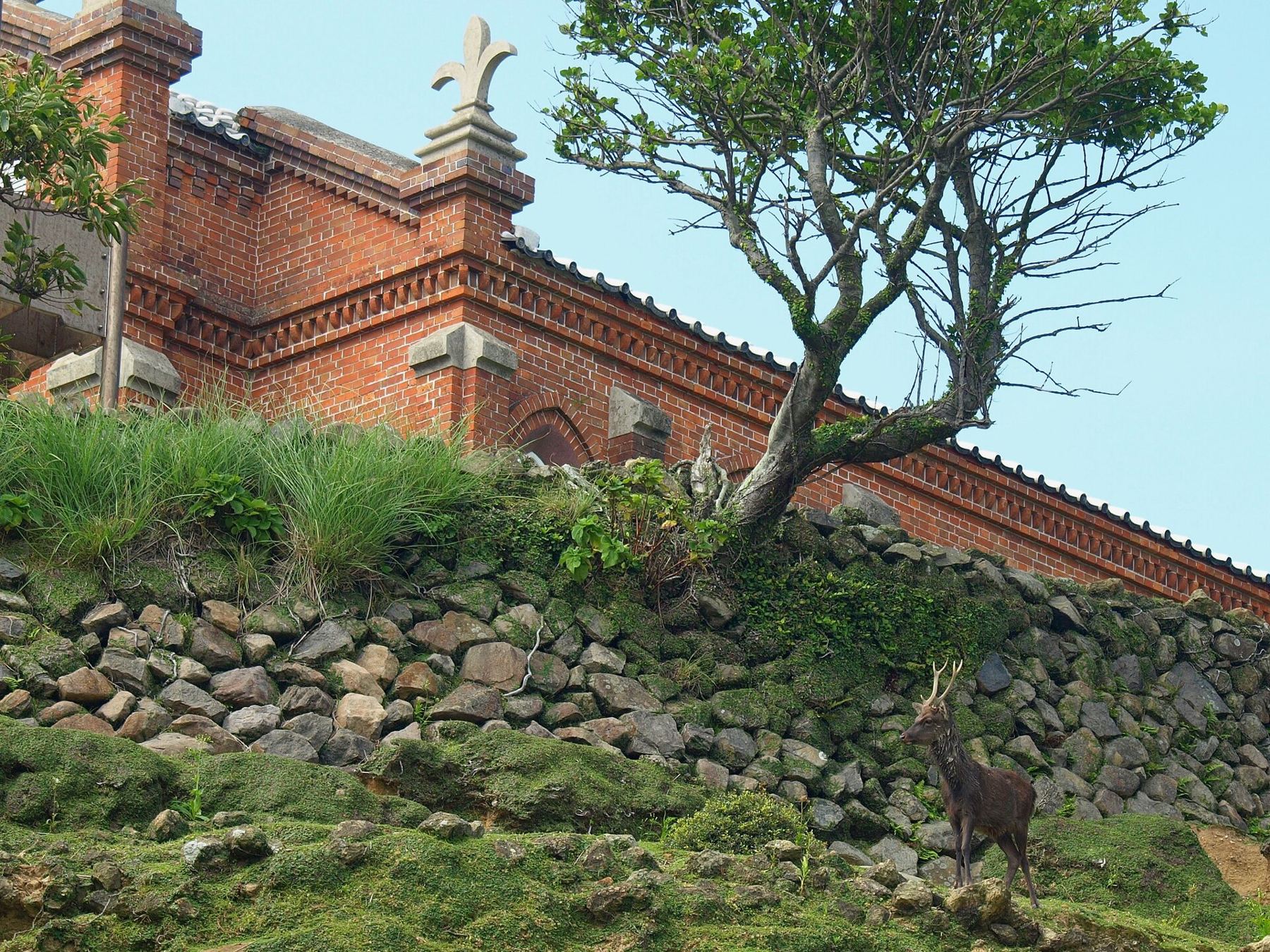
The brick church of Nokubi on a green hillside above the sea, Nozaki Island
The brick church of Nokubi on a green hillside above the sea, Nozaki Island.Nozaki Island, 2010. ぱちょぴ (uploader's own photo), CC BY-SA 3.0. Commons

In 60 seconds

The place in 8 steps. Each line is footnoted.

  1. 704By tradition the shrine of Ojika is divided, and Okinokōnoshima Shrine is founded on Nozaki.
  2. 1800sHidden Christians from Sotome settle Nozaki as parishioners of the shrine.
  3. 1881A first church is built at Funamori, in the south.
  4. 1882A first church is built at Nokubi, in the centre.
  5. 1908Tetsukawa Yosuke builds the brick church at Nokubi with the believers' savings.
  6. 1966The people of Funamori move off the island together.
  7. 1971The last Mass is said at Nokubi.
  8. 2018Nozaki is listed as a World Heritage component.

The island of the gods

At the north end of Nozaki stands . For people across the Gotō Islands the island was holy ground, and they came to the shrine to pray. The prefecture says it was a sacred place of Shinto where ordinary people could not make their homes: only the shrine priest's house and about twenty households lived at Nozaki, on the east coast.

That is what drew the hidden Christians. In the 19th century some of those who had spread out from chose Nozaki as a place to settle, became , parishioners of the shrine, and hid their faith behind it. The school guide gives their reasoning: they thought that there they were unlikely to be suspected.

On the mapFrom Sotome to the gods' island
Former Nokubi Church, Shitsu Church. Full atlas and pin sources
1800s

Two hidden villages

The hidden Christians made two villages: Nokubi in the centre of the island and Funamori in the south. In the middle of Nokubi are the remains of their leader's house, where the prefecture believes various religious rites were held in secret during the ban. Even the shrine helped: next to the priest's house stands a , a hall for praying to the shrine from afar on days when the sea was too rough, built during the ban, and the hidden Christians prayed there too.

Their graves look like temple graves. The school guide says the difference is underground: the dead were laid in the opposite direction.

1881 to 1908

A church built on sardines

After the ban was lifted, the people of Nozaki returned to the Catholic Church and built churches in both villages: Funamori in 1881 and Nokubi in 1882. The prefecture reads those two churches as the moment the age of hiding ended on the island.

In 1908 the seventeen households of Nokubi built a third church, of brick. It was the first brick church designed and built by , the Gotō carpenter who learned church building from French priests. The school guide says it was paid for with money the believers saved from fishing for , a small silver sardine. Inside is a ribbed vault.

Sources: a church built on sardines

The World Heritage panel and the Ojika school guide give the official account; the prefecture's tourism portal adds the seventeen households and Tetsukawa's first brick church.

1966 to 1989

The last Mass

The island emptied in the 20th century. The people of Funamori moved away together in 1966. At Nokubi the last Mass was said in 1971, and the building began to decay. The town of Ojika paid for a full restoration in 1985, and in 1989 the church was designated a cultural property by Nagasaki Prefecture. The shrine priest stayed longest: the school guide says he kept the shrine until 2001.

On the mapNokubi today
Former Nokubi Church, Nozaki port. Full atlas and pin sources
Today

A church above an empty island

Nozaki is almost uninhabited now. The church still stands on its hill above the ruins of Nokubi. The path that joined Nokubi and Funamori, about 2.8 km, is described by the prefecture as a road of prayer walked for more than a hundred years. Since 2011 the Ojika islands have been an Important Cultural Landscape.

Timeline

The dated story

Every dated event on this page, with its sources. Filter by section.

  1. 704Okinokōnoshima Shrine founded (Tradition)
  2. 1800sHidden Christians settle Nokubi and Funamori
  3. 1881First church at Funamori (Setowaki)
  4. 1882First church at Nokubi
  5. 1908Brick church at Nokubi by Tetsukawa Yosuke
  6. 1966Funamori villagers move away
  7. 1971Last Mass at Nokubi
  8. 1985Ojika restores the church
  9. 1989Prefectural cultural property
  10. 2001The shrine priest leaves the island
  11. 2011Ojika islands named an Important Cultural Landscape
  12. 2018World Heritage listing
Atlas

Where it happened

Each pin is a place named on this page. Coordinates come from official prefecture maps, OpenStreetMap or Wikidata, as listed. Rows marked "not yet pinned" have no verified pin.

This placeRelated site
PlaceWhy it matters hereCoordinatesCoordinate source
Former Nokubi ChurchTetsukawa's brick church of 190833.187978, 129.129208Nagasaki Prefecture tourism portal map pin; checked against OpenStreetMap way/455082358 and Wikidata Q11646223, both within 0.1 km
Nozaki portLanding for the town boat from Ojika33.1887531, 129.1390547OpenStreetMap way/1283260232
Shitsu Church, SotomeWhere the settlers came from32.84392, 129.70092Wikidata Q11395699
Okinokōnoshima ShrineThe island's Shinto shrine-not yet pinned
Funamori village ruinsThe southern village-not yet pinned
Name cards

People, places and events

Who and what this page touches. Dashed cards are pages still to come.

Visiting

If you go

Practical details change. Check with the operators before you travel. Churches are places of worship: please follow the visitor manners asked of you.

Read next

Where to go from here

Glossary

Words on this page

ujiko 氏子
Member of the community attached to a Shinto shrine.
yōhaisho 遥拝所
A place to pray toward a shrine that cannot be reached.
kibinago キビナゴ
A small silver sardine; the fishing that paid for the church.
Sources

Footnotes

Translations from Japanese sources are ours.

  1. "Nagasaki and Amakusa Hidden Christian Sites" Preservation and Utilisation Committee, 学校教育用補助教材(小値賀町用)[School supplement, Ojika Town edition] (March 2020), pp. 10 to 14, source link
  2. UNESCO World Heritage Centre, "Hidden Christian Sites in the Nagasaki Region" (no. 1495, 2018), source link
  3. Nagasaki Prefecture World Heritage Division, component panel "8. Remains of Villages on Nozaki Island" (kirishitan.jp), source link
  4. Nagasaki Prefecture tourism (ながさき旅ネット), "野崎島の集落跡," source link
  5. Nagasaki Prefecture tourism (ながさき旅ネット), "【小値賀】旧野首教会," source link
  6. Nagasaki Prefecture, おらしょ こころ旅, columns "キリシタン集落をつないだ里道," "舟森の思い出" and "舟森の「だんな様」" (summaries), source link
  7. Nagasaki Prefecture World Heritage Division, 2024 leaflet (component summaries), source link
  8. Nagasaki Prefecture, おらしょ こころ旅, "旧野首教会" (data: 1908, design and build Tetsukawa Yosuke, ribbed vault, brick, prefectural designation 1989), source link
  9. Ojika Island Tourism, "ご来島の前に," source link
The wider story

For the wider story around this place, see The Gotō Islands and the Church.

Images

Image credits