十Christian Japan
Place guide · Nagasaki · Church

Ōno Church and Ōno Village, Sotome

World Heritage component

The hidden Christians of Ōno prayed at the village shrines, and quietly gave the mountain god a second name. What did it mean to hide a saint inside a Shinto shrine, and what did they build when they no longer had to?

2 min read10 sources3 pinsVisitingTap any name, place or term to learn moreTimeline

A saint inside a shrine, a church of stone. Ōno's hidden Christians worshipped at Shinto shrines that held their own secret objects of faith; after 1873 a French priest built them a small church of local stone that still stands.

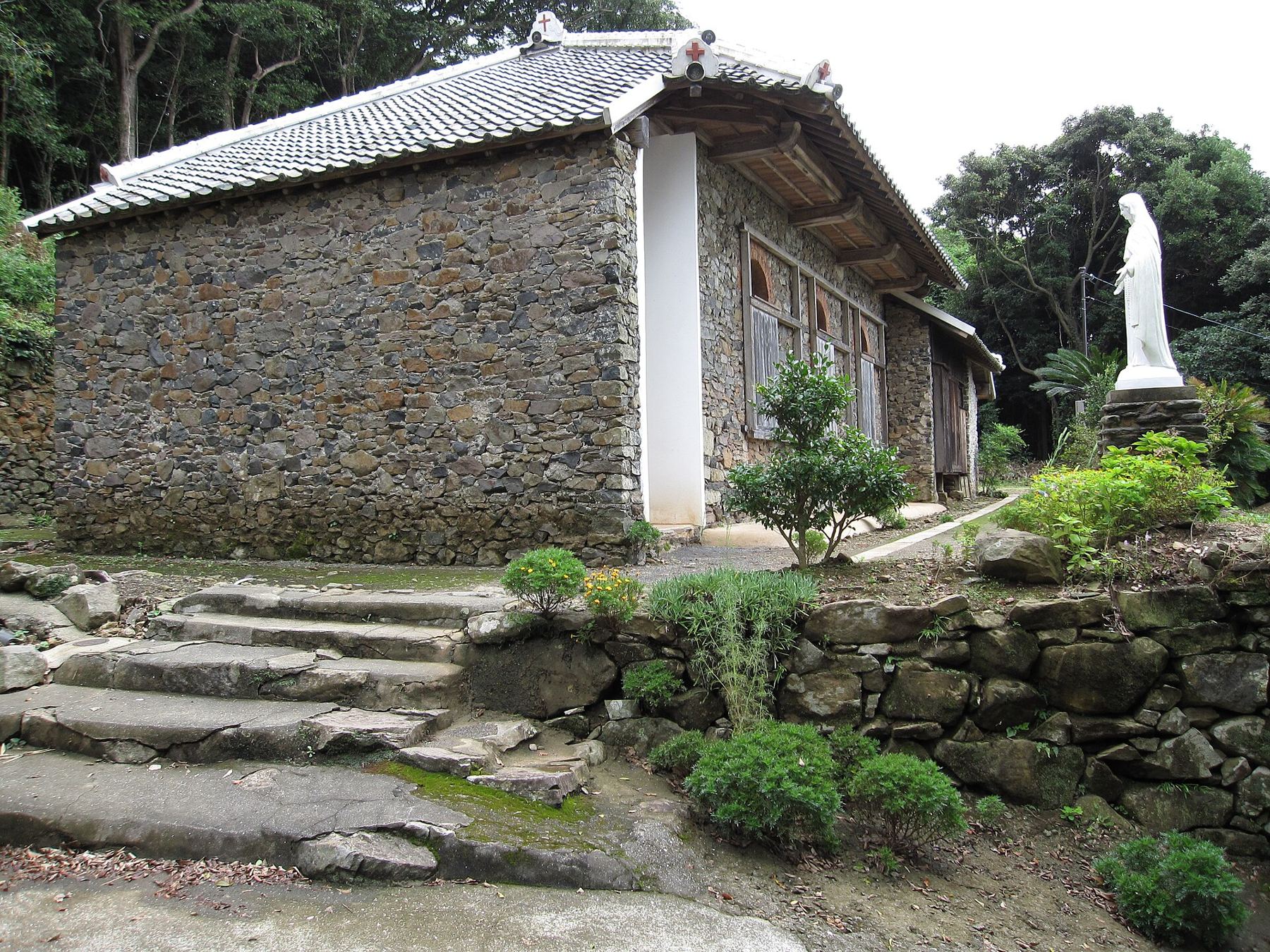
Ōno Church, a low stone church with a tiled roof among trees
Ōno Church, a low stone church with a tiled roof among trees.Ono Church in Nagasaki. Sapphire123, CC BY-SA 3.0. Commons

In 60 seconds

The place in 7 steps. Each line is footnoted.

  1. 1600s to 1800sŌno's hidden Christians are outwardly Buddhists and shrine parishioners.
  2. 1600s to 1800sAt Tsuji Shrine they quietly identify the mountain god with "San Jiwan".
  3. After 1873Most return to the Catholic Church and walk to Shitsu for Mass.
  4. 1893Father de Rotz builds Ōno church for those who cannot reach Shitsu.
  5. 2008Ōno church is designated an Important Cultural Property.
  6. 2018Ōno Village is listed as a World Heritage component.
  7. TodayMass is said here once a year.

The mountain god's other name

Tsuji Shrine stands in the northeast of Ōno, kept by the families of the Tsuji district for generations. It was a shrine to a mountain god, part of the nature worship of the area. But the prefecture says the hidden Christians of Ōno laid a second figure over that god: "San Jiwan", a Christian saint, whom they made their own secret object of faith.

That is why Ōno is one of the four World Heritage villages chosen to show what hidden Christians prayed to. In , just down the coast, it was pictures. In Ōno it was shrines: outwardly the villagers were Buddhists and , parishioners of the village shrines, and inside those shrines they kept their own objects of faith. At Ōno Shrine, too, the school guide says, they prayed so that no one could tell they were Christians.

On the mapŌno on the Sotome coast
Ōno Church, Shitsu Church, Bastian yashiki site. Full atlas and pin sources
1865 to 1893

A long walk to Mass

After the Discovery at on 17 March 1865, and once the ban was lifted, most hidden Christians of Ōno returned to the Catholic Church. For years they walked to Shitsu Church for Mass. In 1893 Father , the parish priest of Sotome, built them a church of their own in the middle of the village, as a chapel of Shitsu: a , with no priest of its own.

He built it for the 26 Christian households around Ōno. It looks like a farmhouse, but its walls are not. They are basalt from the hills around, set in a mortar of red earth mixed with lime: the "". The heritage site notes the wind screen in front of the door, and how the wall has stood for more than 130 years.

Sources: a long walk to mass

The World Heritage panel gives the official reading of Ōno; the prefecture's heritage site gives the building's data (1893, design by de Rotz, stone, ICP 2008). The same page gives the 26 households and notes that only a priest's room on the south side, added in 1926, has changed.

On the mapThe walk to Shitsu
Ōno Church, Shitsu Church. Full atlas and pin sources
Today

Once a year

Ōno church stands tucked away in the hills, in contrast to Shitsu on its open height. It is no longer a regular church: the heritage site says a memorial Mass is said here once a year. The site of Bastian's hut and the shrines where the villagers once prayed are within reach on the same coast.

Timeline

The dated story

Every dated event on this page, with its sources. Filter by section.

  1. 1600s to 1800sHidden Christians worship at Tsuji and Ōno shrines
  2. 17 Mar 1865The Discovery at Ōura
  3. 1873 onwardŌno Christians return and walk to Shitsu
  4. 1893Ōno church built by de Rotz
  5. 1926Priest's room added on the south side
  6. 2008Ōno church becomes an Important Cultural Property
  7. 2018World Heritage listing
Atlas

Where it happened

Each pin is a place named on this page. Coordinates come from official prefecture maps, OpenStreetMap or Wikidata, as listed. Rows marked "not yet pinned" have no verified pin.

This placeRelated site
PlaceWhy it matters hereCoordinatesCoordinate source
Ōno ChurchDe Rotz's stone chapel of 189332.86478, 129.68594Wikidata Q11439617
Shitsu ChurchWhere Ōno's Christians walked to Mass32.84392, 129.70092Wikidata Q11395699
Bastian yashiki siteHut of the catechist Bastian (Tradition)32.8606511, 129.7073579OpenStreetMap node/4583458604
Tsuji ShrineMountain god identified with San Jiwan-not yet pinned
Name cards

People, places and events

Who and what this page touches. Dashed cards are pages still to come.

Visiting

If you go

Practical details change. Check with the operators before you travel. Churches are places of worship: please follow the visitor manners asked of you.

Read next

Where to go from here

Glossary

Words on this page

de Rotz wall ド・ロ壁
Wall of local basalt set in a mortar of red earth and lime, devised by de Rotz.
ujiko 氏子
Member of the community attached to a local Shinto shrine.
chapel of ease 巡回教会
A church without a resident priest, visited for Mass.
Sources

Footnotes

Translations from Japanese sources are ours.

  1. Nagasaki Prefecture World Heritage Division, component panel "6. Ono Village in Sotome" (kirishitan.jp), source link
  2. "Nagasaki and Amakusa Hidden Christian Sites" Preservation and Utilisation Committee, 学校教育用補助教材(長崎市用)[School supplement, Nagasaki City edition] (March 2020), p. 13, source link
  3. Nagasaki Prefecture, おらしょ こころ旅, "大野教会堂" (data, access, column summaries), source link
  4. UNESCO World Heritage Centre, "Hidden Christian Sites in the Nagasaki Region" (no. 1495, 2018), source link
  5. Nagasaki Prefecture World Heritage Division, 2024 leaflet "長崎と天草地方の潜伏キリシタン関連遺産" (component summaries), source link
  6. Same school supplement (March 2020), map of Ōno and caption "大野神社," pp. 10 and 13, source link
  7. Oratio.jp, column "バスチャン伝説," source link
  8. Nagasaki Prefecture tourism (ながさき旅ネット), "教会見学時マナーのご案内," source link
  9. Nagasaki Prefecture, おらしょ こころ旅, burari column "石積みが美しい大野教会堂" (listed on the Ōno page), source link
  10. Ōura Cathedral (Nagasaki Church Trust), "歴史 / History," source link (checked 19 Oct 2026)
Images

Image credits