十Christian Japan
Place guide · Beyond Japan · Memorial

Rome of the Japanese Embassies, 1585 and 1615

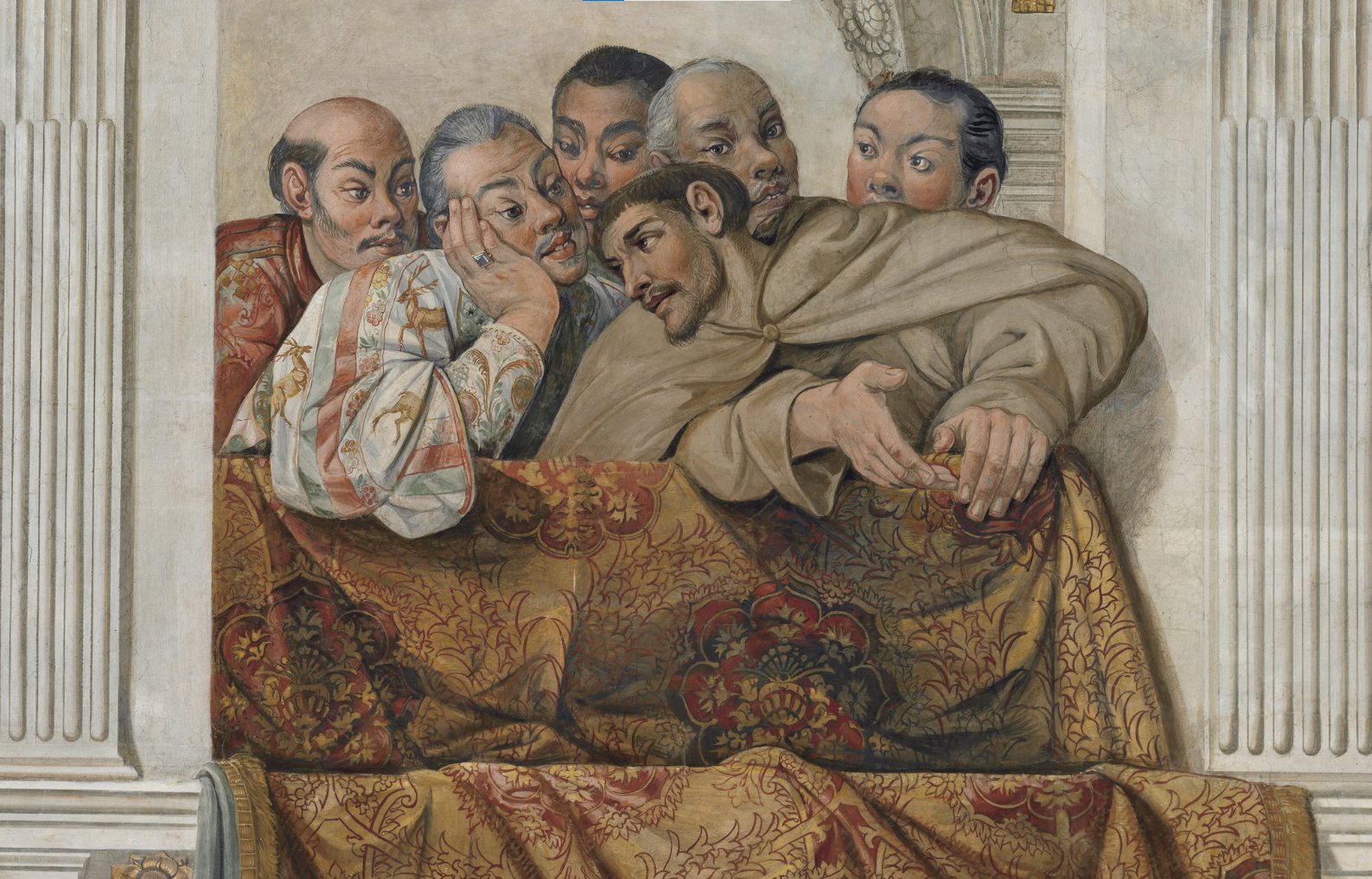
High on the wall of the great hall of the Quirinal Palace, a painted group of Japanese gentlemen leans over a balcony, in Japanese dress. They are the embassy of Hasekura Tsunenaga, received by Pope Paul V in 1615, thirty years after four Japanese boys had been received by Gregory XIII.

2 min read7 sources3 pinsVisitingTap any name, place or term to learn more

Through line. Twice in the Christian Century, Japanese Catholics made the voyage to Rome and were received by the pope as sons of a young Church. Rome honoured both embassies, and the city still keeps their memory in fresco, while their letters, portraits and a Roman citizenship certificate are kept in Sendai and the Vatican.

Fresco of a group of Japanese and European men in robes leaning over a painted balcony hung with a red carpet
Fresco of a group of Japanese and European men in robes leaning over a painted balcony hung with a red carpet.Japanese embassy in the frieze of the Sala Regia, Quirinal Palace, 1616 to 1617. Workshop of Agostino Tassi, Giovanni Lanfranco and Carlo Saraceni, public domain. Commons

In 60 seconds

The place in 8 steps. Each line is footnoted.

  1. 1582Four boys from the Arima seminary set out from Nagasaki on Valignano's plan.
  2. 23 Mar 1585They reach Rome and are received by Pope Gregory XIII.
  3. 1585A pamphlet printed at Reggio describes their stay in Rome.
  4. 25 Oct 1615Hasekura Tsunenaga's embassy enters Rome; on 29 October he rides in the formal entry procession.
  5. 3 Nov 1615Hasekura meets Pope Paul V and hands over Date Masamune's letter.
  6. 1615Rome grants Hasekura and seven others citizenship, and raises him to the nobility.
  7. 1616 to 1617The Japanese embassy is painted in the Sala Regia of the Quirinal.
  8. 2013The embassy's materials are entered in UNESCO's Memory of the World.

Four boys and Gregory XIII

The Jesuit Visitor Alessandro had the idea of sending a mission from Japan to Europe. In 1582 four young students of the seminary at Arima left Nagasaki as envoys of three Christian lords of Kyushu. By way of Macao, Goa and the Cape of Good Hope they reached Lisbon, and they were received by King Philip II of Spain and by two popes, Gregory XIII and Sixtus V. They reached Renaissance Rome on 23 March 1585 and had their audience with Gregory XIII; before and after, they were welcomed with great honour all over Italy and Spain.

A pamphlet printed at Reggio in 1585, now in the Tokyo National Museum, describes the boys' stay in Rome, the audience with Gregory XIII and the welcome given them by the Medici Grand Duke of Tuscany. In 2009 a portrait in the Trivulzio collection in Milan was found to bear the name "Mansio" and the year 1585: it is , chief of the envoys, painted to mark their visit to Venice.

? How do we know? four boys and gregory xiii

The Reggio pamphlet of 1585 is a printed account from the time; the Nagasaki Museum of History and Culture and the Japan Tourism Agency summarise the embassy.

On the mapRome
Palazzo del Quirinale, St Peter's Basilica, Chiesa del Gesù. Full atlas and pin sources
1615

Hasekura before Paul V

Thirty years later another embassy came, sent by of Sendai. On 25 October 1615 it entered Rome; on the 29th Hasekura, splendidly dressed, rode in the formal procession of entry; and on 3 November he met Pope . Masamune's letter to the pope asked for Franciscan friars to be sent to spread the faith in his domain, and for the pope's help with the King of Spain over trade with Mexico. Written in Japanese and in Latin on beautiful paper scattered with gold and silver leaf, both versions are still kept in the Vatican Library.

In Rome, the Sendai City Museum says, Hasekura's noble character was praised. He was raised to the nobility, and he and seven others received the citizenship of Rome. The parchment certificate, written in Latin in gold, names him "PHILIPPO FRANCISCO FAXECVRA ROCVYEMON", with "SANDAI", "VOXV" and "IDATE MASAMVNE". He brought it home, with a portrait of Paul V and an oil portrait of himself praying with a rosary before the crucified Christ, probably painted in Rome: the oldest oil painting of a real Japanese person to survive in Japan.

1616 to 1617

The fresco in the Sala Regia

The of the Quirinal Palace, now called the Salone dei Corazzieri, was the hall where the popes held public audiences and met foreign ambassadors. Between 1616 and 1617 a workshop led by Agostino Tassi and Giovanni Lanfranco painted its frieze to praise Paul V's ties with the East and Africa and his missionary work. Among the eastern embassies looking out from the painted loggia is the Japanese one, led by , which had visited Rome in 1615.

Atlas

Where it happened

Each pin is a place named on this page. Coordinates come from official prefecture maps, OpenStreetMap or Wikidata, as listed. Rows marked "not yet pinned" have no verified pin.

This placeRelated site
PlaceWhy it matters hereCoordinatesCoordinate source
Palazzo del QuirinaleThe Sala Regia and its fresco of the Japanese embassy41.9007009, 12.4861213OpenStreetMap relation/2707110
St Peter's Basilica, RomeThe Vatican, where Masamune's letters are kept in the Library (not pinned separately)41.90222, 12.45342Wikidata Q12512
Chiesa del Gesù, RomeConsecrated four months before the boys arrived41.8958842, 12.4798212OpenStreetMap way/25610962
Timeline

The dated story

Every dated event on this page, with its sources. Filter by section.

  1. 1582Tenshō embassy leaves Nagasaki
  2. 23 Mar 1585Tenshō envoys reach Rome and meet Gregory XIII
  3. 1585Reggio pamphlet printed
  4. 25 Oct 1615Keichō embassy enters Rome
  5. 3 Nov 1615Hasekura meets Paul V
  6. 1615Roman citizenship granted
  7. 1616 to 1617Sala Regia frieze painted
  8. 2009Mancio Itō portrait identified in Milan
  9. 2013UNESCO Memory of the World registration
Name cards

People, places and events

Who and what this page touches. Dashed cards are pages still to come.

Visiting

If you go

Practical details change. Check with the operators before you travel. Churches are places of worship: please follow the visitor manners asked of you.

Read next

Where to go from here

Glossary

Words on this page

Sala Regia サラ・レジア
The audience hall of the Quirinal Palace, now the Salone dei Corazzieri.
Sources

Footnotes

Translations from Japanese sources are ours.

  1. Nagasaki Museum of History and Culture, 『新発見!天正遣欧少年使節 伊東マンショの肖像』 exhibition page (2016), source link (checked 19 Oct 2026)
  2. Japan Tourism Agency, Multilingual Commentary Database, "The Four Members of the Tenshō Embassy Have an Audience with the Pope" (R1-00823), source link (checked 19 Oct 2026)
  3. Cultural Heritage Online (文化遺産オンライン), "天正遣欧使節記" (Tokyo National Museum), source link (checked 19 Oct 2026)
  4. Sendai City Museum, "主な収蔵品 12 支倉常長に関する資料(3): 5 ローマ教皇に会う" (updated 1 Feb 2024), source link (checked 19 Oct 2026)
  5. UNESCO Memory of the World, "Materials Related to the Keicho-era Mission to Europe (Japan and Spain)," source link (checked 19 Oct 2026)
  6. Museum With No Frontiers, Discover Baroque Art, "Quirinale Palace, Frieze of the Sala Regia," source link;BAR;it;Mon11;11;en (checked 19 Oct 2026)
  7. Sendai City Museum, "主な収蔵品 10 慶長遣欧使節(1)," source link, and collection database record ID 92, "ローマ市公民権証書," source link (checked 19 Oct 2026)
Images

Image credits