The pictures in the headman's house
In the headman's house at Shitsu there was a statue the villagers called "Inassho-sama", Saint Ignatius. The headman was a hidden Christian himself. The magistrate's office next door made villagers tread on images of Christ, the , but the school guide says it looked the other way as long as the rice tax was paid. Today the statue is in the Sotome History and Folk Museum.
Shitsu is one of four World Heritage villages chosen to show what hidden Christians prayed to. Here the answer is pictures. In the houses of their leaders the people kept a painting of the Fifteen Mysteries of the Rosary and an image of Saint Michael. They also leaned on catechisms and a church calendar. The original paintings were lost in a fire and copies survive.
Keeping time without a priest
Without priests, the hidden communities of Sotome were led by their own officers: a who kept the calendar, and a who baptised. The feasts were kept by a church calendar for the year 1634, converted to the lunar calendar. the calendar is said to come from , a Japanese catechist of Sotome, and is called "Bastian's calendar".
Their graves look like piles of stones. The school guide says hidden Christian graves had no stone towers like later graves, only local stones heaped up, and that burial customs differed from those of Buddhist neighbours. The graves at Shōbuda and Hatakui are still looked after by local people.
Shitsu also sent its people away. The prefecture says many hidden Christians moved from this area to the and other islands, and their communities spread there. The school guide gives the reason: Sotome had too many people to feed.
Coming back by stages
After the Discovery at on 17 March 1865, the people of Shitsu returned to the Catholic Church in stages. Not everyone came back. In the hamlet of Nonaka the community split over whether to keep the old prayers or adopt the Church's, and neighbours quarrelled over who should keep the holy pictures.
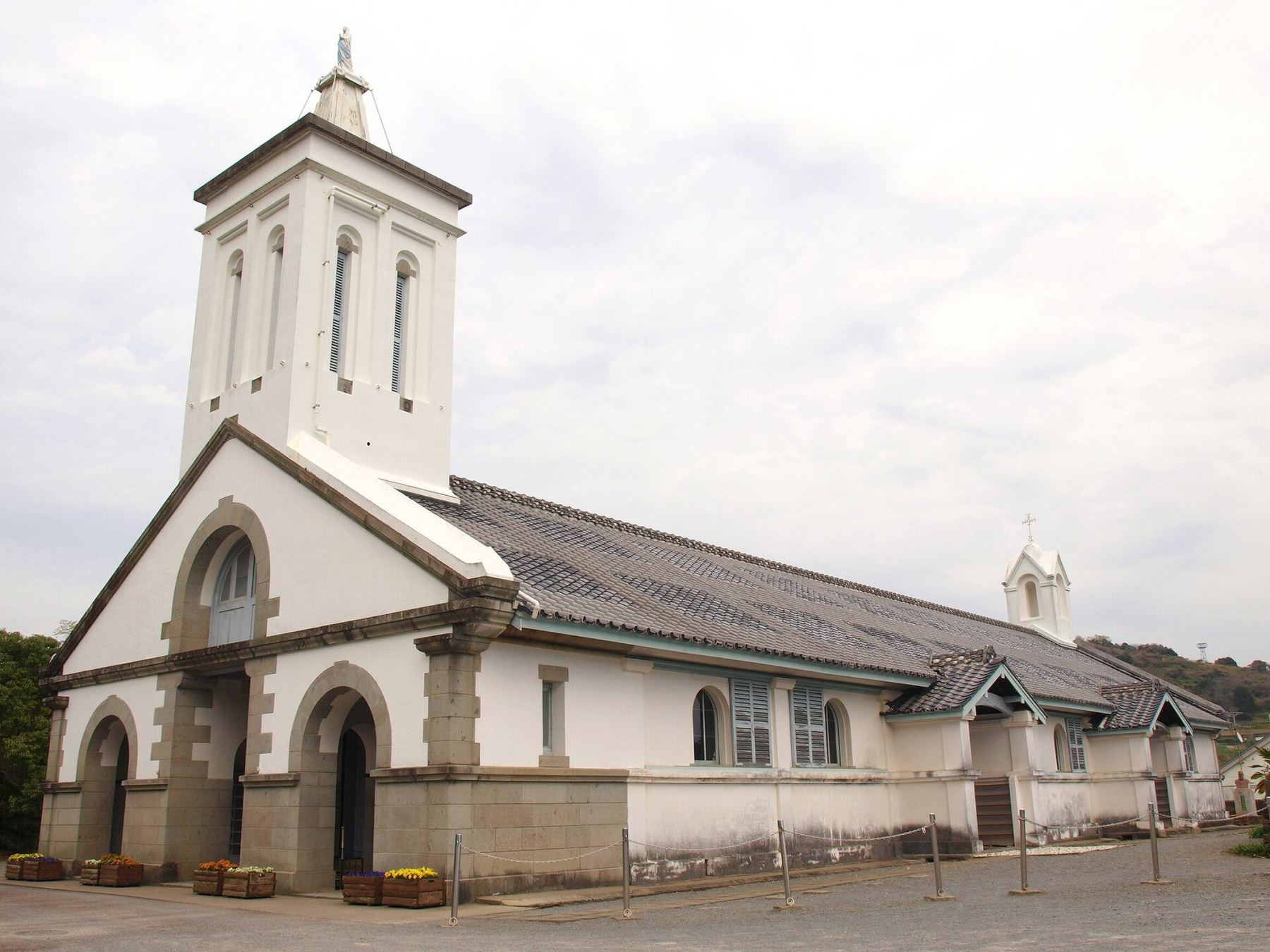
In 1879 a new parish priest arrived: , of the Paris Foreign Missions Society, who had landed in Nagasaki in 1868 and printed catechisms by lithograph at Ōura. In 1882 he built Shitsu Church on the height looking down on the village. He kept the roof and ceiling low against the strong winds from the sea.
Sources: coming back by stages
The prefecture's World Heritage panel and its heritage website give the official history; the 2020 school guide for Nagasaki City adds the local detail. The 2025 monitoring report checks the state of each part of the village every year.
A priest who stayed
De Rotz saw how poor Sotome was. The prefecture's heritage site says he was shocked and gave the whole fortune he had inherited from his family in France to the people of Sotome. In 1883 he opened a workshop beside the church, the Shitsu Aid Centre, so that village women could earn a living, with a macaroni factory and a sardine-net works. He imported tools and taught people to use them with drawings.
He also built in a new way. At , a few kilometres up the coast, he raised a chapel in 1893 with walls of local stone set in a mortar of red earth and lime, now called the . The church at Shitsu was enlarged in 1891 and again in 1909 as the parish grew.
The coast of Silence
Shitsu Church is still a parish church, kept by its own members. The Aid Centre, the de Rotz Memorial Museum and the Sotome History and Folk Museum stand nearby, and a monument to 's novel Silence looks out over the sea. Inland, at Shrine, the keeper of the Kurosaki community still recites the old prayers at the San Jiwan festival each November.
