The pond
Behind the main hall of Kōrinji there was a large pond. The officials used it to make the Christians give up their faith. In the eleventh month of the old calendar, when snow was falling, was told to strip and go into the pond. Kunitarō and his son Jinzaburō, and Tomohachi, were thrown into the ice too.
They did not give up. The mural inside the chapel shows Sen'emon and Jinzaburō sunk in the icy pond with their hands joined in prayer, and below them women and children saying the rosary in the temple.
Sources: the pond
A government report on the exiles kept in the National Archives, and the memories the exiles told later, known as the "stories of the journey". The diocese of Hiroshima has published both.
The journey
After the Discovery at Ōura in 1865 the Urakami Christians declared their faith, and the government decided to exile the whole village: the exile the Christians would call the , the journey. In July 1868 114 leaders, all men, were sent to Hagi, Tsuwano and Fukuyama. Twenty-eight came to Tsuwano by way of Onomichi and Hatsukaichi. In 1870 the rest of the village followed: in all 3,394 Urakami Christians were sent to twenty domains, and 613 died in exile (other counts about 660: Disputed). Tsuwano, though one of the smallest domains to receive them, took 125 more, nearly all of them the families of the first 28.
Each morning a Shinto priest read a prayer explaining why Japan was a land of the gods and urged them to change. Then they were set to work: the men at straw work, the women at washing and sewing. Those who gave up the faith were housed in a former nunnery; those who would not were held in Kōrinji, a disused temple, behind a fence. Forty-seven were packed into two rooms. At first they were treated with some care, but then their food was cut to a little thin barley gruel a day, and eight soon gave in. By the time the 125 arrived, eight of the first 28 had died and eight had given up the faith.
The mural shows another of them, Yūjirō, made to sit naked for two weeks in the cold of the eleventh month and whipped, looking at a mother sparrow and her young on the temple roof.
Yasutarō and the lady in blue
The worst punishment was the , a cage three feet square. The mural shows three of them, and in one, , meeting a lady like the Virgin Mary.
The hill was called Otome-yama. It came to be called Otome-tōge, the Maiden's Pass, after 's book Otome-tōge. The diocese says that because of the lady who came to Yasutarō, the name now recalls the holiest of maidens, Mary.
A chapel in the clearing
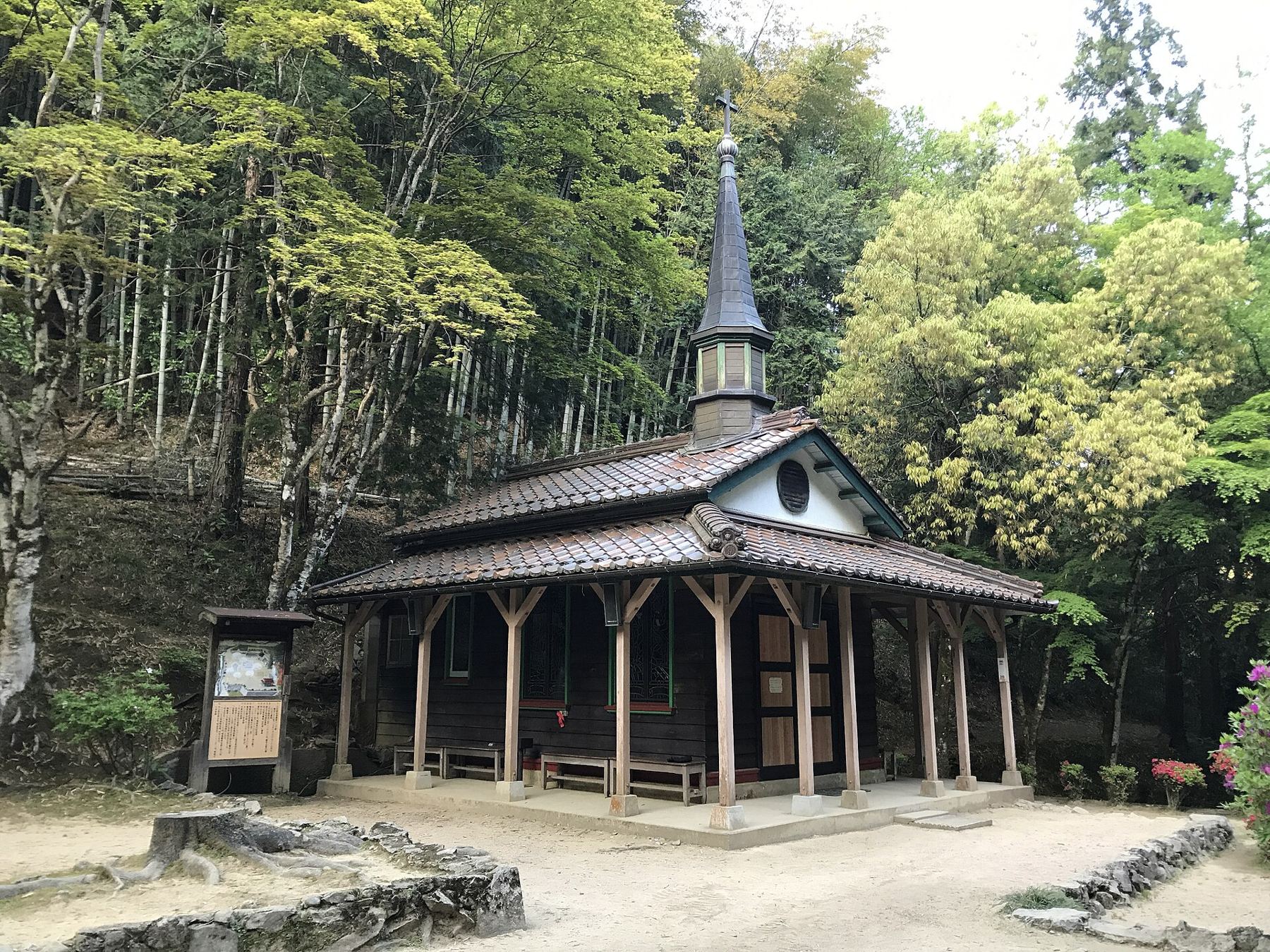
In 1891 Father collected the remains of the 36 witnesses buried at Kabuzaka, the next valley, into one grave, inscribed with the Beatitude "Blessed are those who are persecuted for righteousness' sake". In 1922 he raised a monument, "The Light of Faith", on the hill. In 1939 Father Sermenio bought the land of the old Kōrinji, and in 1951 Father Nebel built the Chapel of St Mary there. The path from Otome-tōge to Kabuzaka is now a Way of the Cross.
In the town, Tsuwano Catholic Church was built in 1931 by the German Father Schäfer, a Gothic church with tatami floors and stained glass. Next to it, a small exhibition about Otome-tōge shows notice boards against Christianity of 1682 and 1868, and Nagai Takashi's last manuscript, Otome-tōge.
