十Christian Japan
Place

Urakami: The Village That Kept the Faith

A farming valley just north of Nagasaki that was given to the Jesuits in 1584, kept its faith in secret for seven generations, was exiled whole in 1870, came home in 1873 and was almost destroyed by the atomic bomb in 1945.

7 min read1,492 words13 sourcesTap any name, place or term to learn moreTimeline
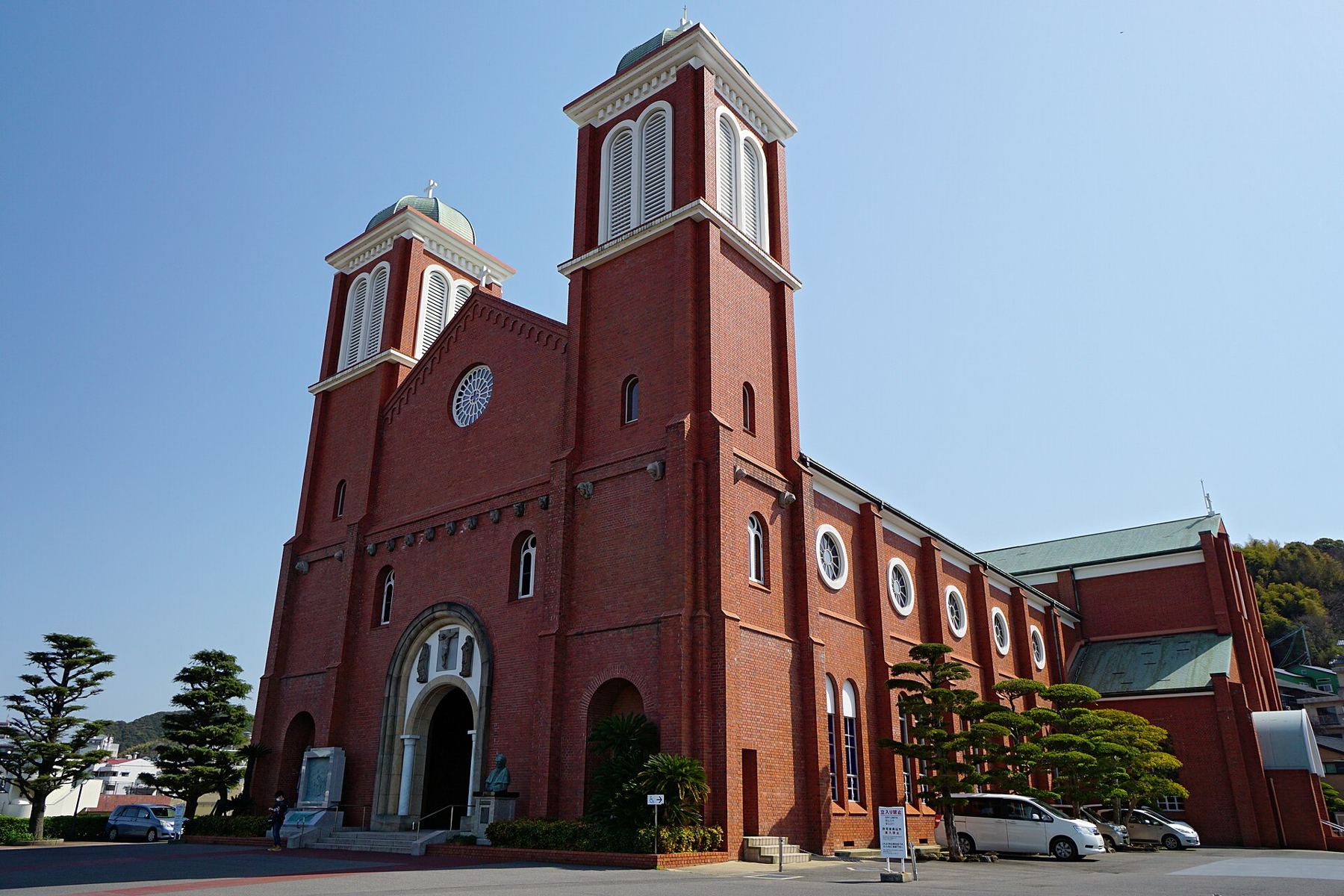
Urakami Cathedral today
Urakami Cathedral today 663highland, 21 March 2020, CC BY 2.5. Wikimedia Commons (credit checked on the Commons file page, 19 Oct 2026)

In 60 seconds

The opening line of each part of the story.

  1. A white-bait fishing tripSome time after 1614, when the Christian churches of Nagasaki were closed, two men from Urakami went fishing for white-bait at the weir on the Urakami river.
  2. Church landThe name Urakami means "above the bay": the inlet of Nagasaki harbour once reached deep inland, and the farming country at its head was "the land above the bay." Christianity reached Nagasaki around 1567, and Urakami soon after.
  3. How the secret was kept**An organisation.** Magoemon and Shichirōzaemon's network had three offices.
  4. Four crackdownsThe village was not always lucky.
  5. Found, and taken awayOn 17 March 1865 a group from Urakami, among them the midwife Isabelina Sugimoto Yuri, walked into the new French church at Ōura and told Father Petitjean, "Our hearts are the same as yours." Within days half the village was visiting; within two years it had four secret chapels.
  6. The church on the headman's …The returnees were desperately poor.
  7. 11:02 a.m.At 11:02 a.m.

A white-bait fishing trip

Some time after 1614, when the Christian churches of were closed, two men from Urakami went fishing for white-bait at the weir on the Urakami river.One was Magoemon, who had been the doorkeeper and cook at the village church of Santa Clara until it was shut, and who now lived in Nakano, where 's little house stands today. The other was his friend Shichirōzaemon from Oka.

Magoemon had asked his friend along for a reason he could not bring himself to say. Since the ban, neighbours who knew perfectly well that they had all been Christian no longer dared ask one another whether they still were. "At this rate," he worried, "the Christians will die out." For two or three days at the weir the words would not come. When at last he spoke, Shichirōzaemon threw up both hands in agreement; he had been waiting to say the same thing.

On the mapWhere this happened
Every place in the atlas below that has coordinates. Gold pins are approximate or town level. Full atlas and pin sources

Urakami today is a district of Nagasaki city, with a rebuilt cathedral on the Takaya ground. Everything since Magoemon's fishing trip comes back to this: a community that kept a secret together, paid for it together, and came home to build on the very place where it had been tested.

Church land

The name Urakami means "above the bay": the inlet of Nagasaki harbour once reached deep inland, and the farming country at its head was "the land above the bay."Christianity reached Nagasaki around 1567, and Urakami soon after. In 1584 the lord gave Urakami to the Society of Jesus as a fief, in thanks for his victory at Okitanawate. From then, the parish history says, it was a Christian village "in name and in fact."

When expelled the missionaries in 1587, Urakami became, like Nagasaki, land under the ruler's direct control, and it stayed so under the Tokugawa.In 1603 a fine church was built at Santa Clara with the alms of Portuguese and Japanese Christians, with a resident priest.

In 1605 a headman was appointed for the village, now called Urakami Yamazato. He was Kikuchi Masashige, a masterless samurai from Higo, whose house stood at , the rise where the cathedral stands today. He took the name Takaya, and his family ruled Urakami's Christians until the end of the shogunate.Yamazato had five hamlets: Magome, Sato, Nakano, Motohara and Ieno. Apart from Magome, the parish history says, every farming family in the four was Christian.

How the secret was kept

An organisation. Magoemon and Shichirōzaemon's network had three offices. A single for Urakami kept the calendar of feasts, called the hiyori or "'s calendar," and handed down prayers and teaching. A in each hamlet passed these on and baptised. A kikiyaku in each smaller district knew every household and carried the word to each person.Magoemon was the first chōkata. The office was elective, but his descendants were chosen for seven generations.

A mask. Every family belonged to the Pure Land temple Shōtokuji. When someone died, the priest came to chant. In the next room the Christians recited a prayer "to undo the sutra"; the body was laid in the coffin facing away from the priest; and when he had gone, they opened the coffin and removed the Buddhist objects.Graves kept the old Christian shape but lost their crosses; later, when that too drew questions, families used plain field stones, noishi, which needed no Buddhist name.

Feast days in disguise. The feast of Santa Clara fell near the Bon festival in the old calendar, so each summer the villagers gathered at the site of their lost church and prayed under cover of the Bon dance.

A face they could not refuse to tread on. From 1641 the village was made to tread on the each New Year, at the headman's house. Before and after, they prayed the , the prayer of contrition.

Four crackdowns

The village was not always lucky.

In 1790 the headman, Takaya Eizaemon, accused nineteen villagers of Christianity after many refused to give money for 88 stone Buddhas he planned for a temple. The arrests were led by an official the headman had bribed. There was no proof; plans to dig up graves for Christian objects, or to plant a foreign image from Amakusa, came to nothing, and the case dragged on until 1795.In 1839 (or 1842: ) the chōkata Rigorō and other leaders were arrested and then released, for reasons the official records do not explain.In 1856 the chōkata Kichizō and most of the leaders were imprisoned and tortured. Kichizō died in prison, his son was banished, and of the four baptisers only Domingo survived.Among Kichizō's possessions the magistrate's officers listed "a white porcelain standing Buddha called ," that is, Santa Maria.

After Kichizō, no chōkata was appointed. Nine years later the village found priests again.

Found, and taken away

On a group from Urakami, among them the midwife Isabelina , walked into the new French church at and told Father , "Our hearts are the same as yours."Within days half the village was visiting; within two years it had .

Then came the break. In April 1867 the villagers refused temple funerals and asked to leave Shōtokuji; on 15 July 1867 (13 July in one prefectural source: ) the four chapels were raided.In 1868 the new Meiji government sent 114 leaders into exile, and in January 1870 it sent the rest: 3,394 people to twenty-odd domains across western Japan. Urakami became an empty village.

Its people called the exile , the journey. When the ban was lifted in 1873, about 1,900 came home, by the parish count, and that September 736 of them had no house at all.Some 613 had died in exile, by the Japan Tourism Agency's figure; other counts differ ().

The church on the headman's ground

The returnees were desperately poor. In July 1874 dysentery broke out on Iōjima outside the harbour and spread to Urakami, and smallpox followed. The French priest nursed the sick, helped by young people just back from exile, among them Iwanaga Maki, who went on to found the community later called the Urakami Jūjikai, which raised orphans.

In 1880 the Takaya headman's family, its power gone with the old order, sold its estate. On 4 June the Urakami Catholics bought it for 1,600 yen, and on 15 August they said their first Mass in the old house, where they had trodden on the .The next year they raised a cross on a nearby hill, Jūjiyama, in reparation for the treading and in thanks that the persecution was over.

On that ground Father Pierre Fraineau began a brick cathedral in 1895, collecting coins from house to house. He died in 1911; it was dedicated on 18 March 1915 by the parish's date (Urakawa, writing in 1928, gives 17 March 1914: Disputed), and its twin towers were finished in 1925.In front of it stood a , where, the parish says, the ancestors had been tied and questioned, and beside it the headman's stone water basin.

11:02 a.m.

At 11:02 a.m. on 9 August 1945 an exploded about 500 metres above Matsuyama-machi in Urakami.In the cathedral, priests were hearing confessions before the Feast of the Assumption; both priests and the people inside were killed.Of about 12,000 Catholics in Urakami, Archbishop Nakamura said in 2025, about 8,500 died.

On 23 November 1945, about 600 surviving parishioners gathered in front of the ruins for a requiem. When the exiles came home in 1873, Bishop Urakawa told them, there were at least ruined houses in Urakami; now there was not one.At Christmas 1945 the cathedral's bell, dug from the rubble almost undamaged, rang again from a frame of three logs.

Timeline

The dated story

Every dated row in this story, with its source.

  1. c.1567Christianity reaches Nagasaki and Urakami
  2. 1584Arima Harunobu gives Urakami to the Jesuits
  3. 1588Direct rule
  4. 1603Santa Clara church rebuilt
  5. 1605Takaya headman appointed
  6. 1614Ban; Santa Clara closed
  7. 5 Nov 1624Martyrs Caio (53) and Diego (40) burned, as recorded in the parish history
  8. 1641Treading of fumi-e begins in Urakami
  9. 1790 to 1795First crackdown
  10. 1839 or 1842Second crackdown
  11. 1856Third crackdown; chōkata Kichizō dies in prison
  12. 17 Mar 1865Discovery at Ōura
  13. 15 Jul 1867Fourth crackdown begins
  14. Jan 1870Whole village exiled
  15. 1873Return
  16. 1874Dysentery and smallpox; de Rotz and Iwanaga Maki
  17. 4 Jun 1880Takaya estate bought
  18. 14 Sep 1881Jūjiyama cross
  19. 1895 to 1925Cathedral built
  20. 9 Aug 1945Atomic bomb
  21. 24 Dec 1945Bell rings again
Atlas

Every place in this story

Every place in this story. Each pin is marked as an exact site, town level or approximate. Rows without coordinates are listed as not pinned.

Exact siteApproximate or town level
PlaceWhy it matters hereCoordinatesCoordinate source
Urakami Cathedral (Takaya estate)Headman's house; fumi-e; cathedral32.77616, 129.86839Exact site OpenStreetMap way/280652259 (浦上天主堂)
Santa Clara church site, Urakami (exact place to confirm)Church of 1603; Bon prayers32.78177, 129.86298Town level OpenStreetMap node/8444648291 (大橋町), district per Nagasaki Prefecture feature vol.5
Beatosu-sama grave (Hashiguchi-machi)Martyred family (Tradition)32.78003, 129.86342Exact site Map point on the Nagasaki Atomic Bomb Museum remains course map, ikou10
Chōkata house site (in front of Nyokodō)Magoemon's line32.77893, 129.86557Exact site near Nyokodō 32.77893, 129.86557 (exact site); house site itself not pinned
Four secret chapels1865 to 186732.77815, 129.86474Exact site one of the four chapels, San Francisco Xavier secret chapel site, Hashiguchi-machi; the others are pinned on the Discovery 1865 atlas
Mount IwayaPrayer toward Kashiyama (Tradition)32.79332, 129.83041Exact site 32.79332, 129.83041 (exact site)
JūjiyamaCross of 188132.78533, 129.87618Exact site 32.78533, 129.87618 (exact site)
Hypocenter, Matsuyama-machi9 Aug 194532.77376, 129.86324Exact site 32.77376, 129.86324 (exact site)
Read next

Where to go from here

Full record

Key facts

FactValueStatusSource
NameUrakami ("above the bay"); formally Urakami Yamazato villageSolid
Jesuit fief1584, gift of Arima HarunobuSolid (parish, from Kami no kazoku 400 nen)
Direct ruleFrom 1588 (after the 1587 edict)Solid
HamletsMagome, Sato, Nakano, Motohara, Ieno; all but Magome ChristianSolid (one source)
HeadmanTakaya family from 1605Solid
Santa Clara churchRebuilt 1603; closed 1614Solid
OrganisationChōkata (1), mizukata (each hamlet), kikiyaku (each district); founded by Magoemon and ShichirōzaemonTradition (founding story)
Crackdowns1790 to 1795; 1839 or 1842; 1856; 1867Disputed (second date)
Discovery17 Mar 1865Solid
Exile114 leaders (1868) and 3,394 people (1870)Solid (figures vary by source)
Returnc.1,900 (parish); 1,930 or 2,911 elsewhere; 613 dead (JTA)Disputed
Takaya estate bought4 Jun 1880, 1,600 yenSolid
CathedralBegun 1895; dedicated 18 Mar 1915 (parish; Urakawa 1928 gives 17 Mar 1914: Disputed); towers 1925Solid
Bomb9 Aug 1945, 11:02 a.m. c.8,500 of 12,000 Catholics killedSolid (figures from Archdiocese)
Glossary

Words in this story

chōkata 帳方
"Keeper of the book." The leader who kept the book of feasts (in Sotome, the calendar called the Ochō).
fumi-e 踏み絵
"Picture to step on." An image of Christ or Mary that people were made to tread on to prove they were not Christian, from 1628.
Hantamaruya はんたまるや
"Santa Maria." The name officials recorded for the Urakami villagers’ main image in the 1850s.
Konchirisan コンチリサン
From the Portuguese contrição. A prayer of sorrow for sin, said by many after treading on the fumi-e.
tabi 旅
"The journey." What the Urakami villagers called their exile of 1868 to 1873.
Sources

Footnotes

  1. 1 Urakami Cathedral parish history, "浦上小教区の成りたち" (based on the parish's Kami no kazoku 400 nen, 1983). source link (checked 19 Oct 2026)
  2. 2 Urakami Cathedral parish history, "禁教時代(迫害と殉教)." source link (checked 19 Oct 2026)
  3. 3 Urakami Cathedral parish, "沖に見えるはパーパの舟よ" (Iwaya-san page, from Kataoka Yakichi, Nagasaki no Kirishitan). source link (checked 19 Oct 2026)
  4. 4 Urakami Cathedral parish history, "キリシタンの復活." source link (checked 19 Oct 2026)
  5. 5 Miyazaki Kentarō, "The Kakure Kirishitan Tradition," in Mark R. Mullins (ed.), Handbook of Christianity in Japan (Brill, 2003), p. 21.
  6. 6 Japan Tourism Agency, "Chronology of Christianity in Japan Centered on Nagasaki" (R1-00782). source link
  7. 7 Urakami Cathedral parish history, "復活後の迫害1." source link
  8. 8 Urakami Cathedral parish history, "総流配より帰郷後の窮乏." source link
  9. 9 Urakami Cathedral parish history, "本聖堂の建立." source link (checked 19 Oct 2026)
  10. 10 Urakami Cathedral parish history, "原爆被災." source link (checked 19 Oct 2026)
  11. 11 Archbishop Peter Nakamura Michiaki, homily, 9 Aug 2025, Archdiocese of Nagasaki. source link (checked 19 Oct 2026)
  12. 12 Urakami Cathedral parish history, "平和の建設." source link
  13. 13 Japan Tourism Agency, Multilingual Commentary Database, "高札撤去:信仰が自由な時代へ" (PDF) source link (checked 19 Oct 2026)

Additional sources used only in this page's features:

  • G1 Hand to Hand fn 14: Miyazaki Kentarō, "The Kakure Kirishitan Tradition," in Mullins (ed.), Handbook of Christianity in Japan (Brill, 2003), ch. 2, pp. 19 to 34. ISBN 90-04-13156-6 / Hand to Hand fn 6: Oratio.jp (Nagasaki Prefecture), column "バスチャンの日繰りとは?" (text by Kawamura Noriko) [source link) (checked 19 Oct 2026)
  • G2 Hand to Hand fn 3: Japan Tourism Agency, Multilingual Commentary Database, "Chronology of Christianity in Japan Centered on Nagasaki" (R1-00781, FY2019; text by the Nagasaki and Amakusa World Heritage council). [source link) (checked 19 Oct 2026) / Hand to Hand fn 10: Japan Tourism Agency, Multilingual Commentary Database, "The Age of Hiding" chronology (R1-00782, FY2019). [source link) (checked 19 Oct 2026) / Hand to Hand fn 11: e-Kokuho (National Institutes for Cultural Heritage), "板踏絵 無原罪の聖母," Tokyo National Museum C-711, part of the Important Cultural Property group 長崎奉行所キリシタン関係資料. [source link) (checked 19 Oct 2026)
  • G3 Hand to Hand fn 14: Miyazaki Kentarō, "The Kakure Kirishitan Tradition," in Mullins (ed.), Handbook of Christianity in Japan (Brill, 2003), ch. 2, pp. 19 to 34. ISBN 90-04-13156-6
  • G4 Hand to Hand fn 13: Urakami Cathedral parish history pages, "総流配より帰郷後の窮乏 / 仮聖堂の建立 / 十字架山参詣地設立" (quotes Sada's memoir and Nagasaki Prefecture reports) [source link) (checked 19 Oct 2026) / Miyazaki Kentarō, "Roman Catholic Mission in Pre-Modern Japan," in Mullins (ed.), Handbook of Christianity in Japan (Brill, 2003), ch. 1, pp. 1 to 18. Same book as footnote 5.
  • G5 Hand to Hand fn 19: Urakami Cathedral parish history pages, "復活後の迫害1" (draws on Urakawa Wasaburō, 浦上切支丹史, and the memoirs of Kataoka Sada, Takagi Sen'emon and Moriyama Jinzaburō) [source link) (checked 19 Oct 2026) / Hand to Hand fn 20: Archdiocese of Nagasaki, 2018 page on the 150th anniversary of the Urakami exile (tabi). [source link) (checked 19 Oct 2026)
The wider story

For the wider story around this place, see Nagasaki: the Christian city.

Images

Image credits

  • Hero: 663highland, 21 March 2020, CC BY 2.5. Wikimedia Commons (credit checked on the Commons file page, 19 Oct 2026)

Map data © OpenStreetMap contributors. Identifications follow each image's Wikimedia Commons description.