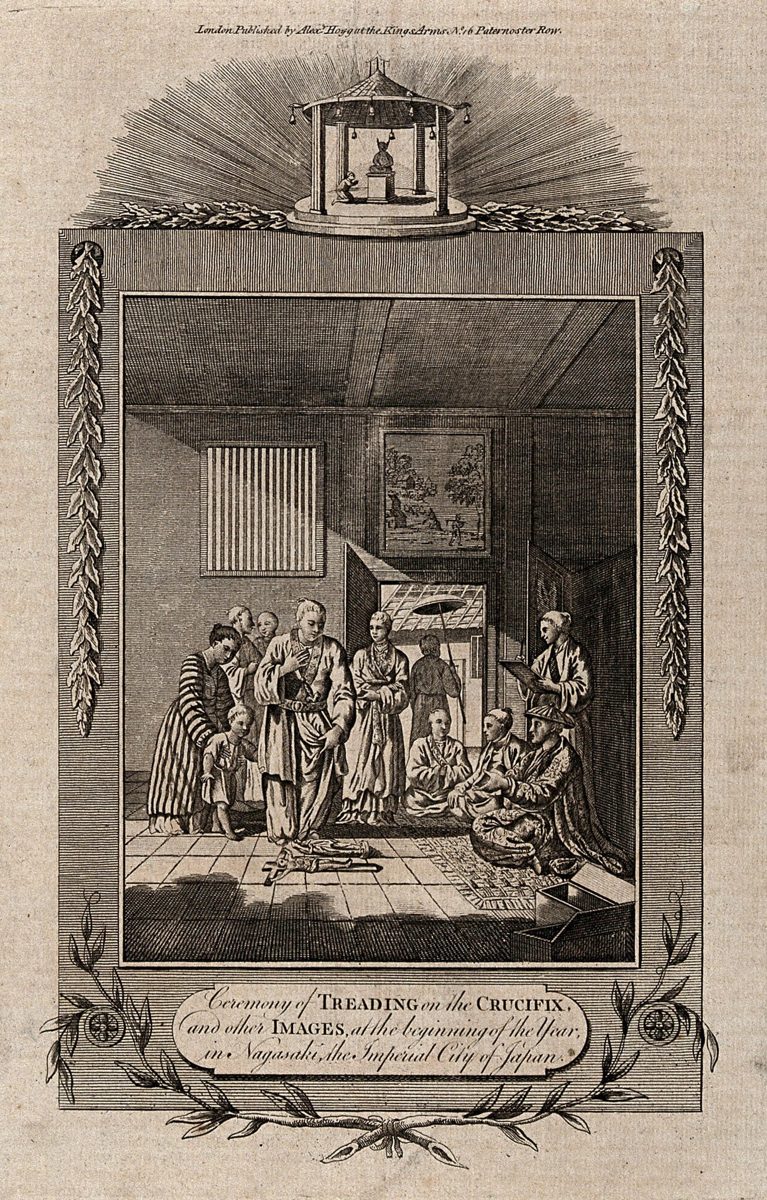
New Year at the headman's house
In , the farming valley just north of , the New Year brought a summons. On fixed days every household had to go to the house of the village headman, the , and walk across a small plate laid on the floor. On the plate was a figure of Christ or of Mary.
Many of the people who stepped on it were Christians. They had been baptised in secret, and they prayed to Mary before porcelain figures of Kannon.The Urakami parish history says that as they trod on the image, against their will, they prayed the , the prayer of contrition.They put their feet on the face they loved, and asked forgiveness at the same moment.
The custom is usually told as a story of persecution, and it was. But it was also something stranger: a ritual that a whole society performed together, Christians and non-Christians, officials and townspeople, every year for generations. This page asks how a test designed to catch believers became a calendar event, and what it did to the faith of the people it was meant to destroy.
How it began
The practice in Nagasaki began, according to the eighteenth-century local history Nagasaki kōsō, in 1628 (Kan'ei 5), under the magistrate Mizuno Morinobu.Standard Japanese reference works agree on 1628, or more loosely "the 1620s."Its first purpose was narrow. Mizuno used it on korobi, people who had already renounced the faith, to check that they had not gone back to it, and he made them tread on the painted hanging scrolls that Christians themselves had venerated.The historians Yasutaka Hiroaki and Uchijima Minako point out that at this stage it looked more like an administrative check than an instrument of terror.
Paper wears out under feet. The next year the new magistrate, Takenaka Shigeyoshi, set cast metal images of Christ and Mary into wooden boards so that many more people could be tested.These were the ita-fumie, board . The images were small devotional plaques, around ten by twenty centimetres, of the kind that the missionaries had brought to Japan. Most of those in Japan, the authors suggest, were inexpensive Spanish work; the finer ones were Italian.
In 1669, under the magistrate Kōno Michisada, the paper images had torn and there were not enough metal ones, so the magistrate ordered a caster of Motofurukawa-machi, Hagiwara Yūsa, to make twenty more in brass.One account says the craftsmen were made to swear an oath and worked in a temporary hut in front of the Nishi Yakusho, and that all twenty were cast in a single day. The author of Nagasaki kōsō gives this only as "one account," and Yasutaka and Uchijima treat it with care ().The oath, they suggest, was meant to stop the craftsmen being converted by the images they were copying.
The brass plates show four scenes: Christ crowned with thorns (Ecce Homo), Christ on the cross, the Pietà, and Our Lady of the Rosary.Comparing them with the older board plaques, the authors find details simplified or lost, and each plate a little different. Whoever made the moulds, they conclude, did not understand the Christian meaning of what he was copying.
A calendar of feet
In time the treading in Nagasaki became a fixed New Year event, carried out ward by ward.Yasutaka and Uchijima reconstruct the schedule from the records.
On the second day of the first month, the plates were taken out of the shūmon-gura, the storehouse for confiscated Christian objects at the magistrate's Tateyama office.The next day they went to the town elders, whose own households trod first. From the fourth day the plates went round the city, one or two to each ward: on the fourth day twelve plates served seventeen wards; on the fifth, ten plates nineteen wards; and so on until the eighth.On the ninth day it was the turn of the Dōza and the Chinese quarter.Then the plates went out to the villages: Nagasaki village from the twelfth, Urakami Yamazato on the fourteenth and fifteenth, Urakami Fuchi on the sixteenth and seventeenth, and the outlying villages through the second month. When they came back, the magistrate's office collected the registers of everyone who had stepped.
In a 2020 public lecture, Harada Hiroji of the Nagasaki Historical Society noted that every ward had its fixed day, and said that anyone not at home on that day "could not complain if they were suspected."He argued from the records that the magistrate's office lent ten plates, and that a figure of twelve in the 1797 Nagasaki saijiki is probably a mistake ().
Treading became so much a part of the Nagasaki year that ebumi entered the haiku calendar as a word for spring.
In Urakami, the parish history says, the treading began in 1641. On the day, every man, woman and child had to step, the sick and babies included.
Lending the faces
The fumi-e also tied the domains of Kyushu to the shogunate's man in Nagasaki. The magistrate kept the plates and lent them out: by one reference count, ten board fumi-e and the twenty brass ones, thirty in all.Nagasaki kōsō lists the borrowers: Shimabara, , Ōmura and in Hizen, Kurume in Chikugo, Kitsuki, Takeda, Usuki, and Hita in Bungo, and Nobeoka in Hyūga, which it counts as "ten places."Others borrowed at times. Many domains did not borrow at all, and some, like Kumamoto, had their own.
Ōmura began borrowing after the Kōri crackdown of 1657, when 603 were found in its territory and 406 were beheaded, by Yasutaka and Uchijima's count.(Miyazaki gives 608 and 411: .)In the second month of 1658 the domain sent an officer to Nagasaki to ask for plates "as a warning for the future." He came back in the eighth month with two, one for the mainland villages and one for the islands, and the whole domain was tested in under a week.Yasutaka and Uchijima read the borrowing as a pledge of loyalty to the shogunate as much as a hunt for believers.
In Kumamoto the practice was called kagefumi, "treading the shadow," and the plates kageita. Samurai, and townsmen allowed to wear swords, were excused with their families. The test drew the line of the social order as well as the line of faith.
What it did to the faith
From the 1660s, the treading was extended from suspected Christians to everyone in the Kyushu domains, and it became part of how the domains governed their people.The historian Miyazaki Kentarō counts the fumi-e among the instruments of the early Tokugawa ban, alongside rewards for informers, the five-household groups, written renunciations and temple registration, and says that they controlled ordinary people as much as Christians.
The hidden Christians stepped and went home.
But it left a wound. Miyazaki suggests that for people who denied God underfoot every year, God the Father came to seem a fearsome judge. The centre of their devotion shifted, without anyone deciding it, to the gentle and forgiving figure of Mary.The prayer of contrition at the headman's house is the same wound seen from inside.
When the exiled Urakami Christians came home in 1873, they carried that memory with them. In 1880 they bought the Takaya house, the place where they had trodden on the image, and made it their church.In 1881, urged by their priest, they raised a great cross on a hill nearby, Jūjiyama, for two reasons: to make reparation for the treading of the fumi-e, and to give public thanks that the persecution was over.
The end of the treading
When did it end? . The Urakami parish history says the last treading in Nagasaki was in 1857 (Ansei 4), after the Dutch chief Donker Curtius urged its abolition.A Japan Tourism Agency chronology dates the magistrate's order ending it to 1858.Reference works tie the end to the Japan United States treaty of 1858, and note that registers show treading went on for some years outside Nagasaki.The ban on Christianity itself lasted until 1873.
The objects in the magistrate's storehouse went on public display at the Imperial Household Museum in Tokyo in 1906, and were designated Important Cultural Properties in 1977.Today they are in the Tokyo National Museum as the "Nagasaki Magistrate's Office Christian Materials," which also include items seized from believers in Urakami, a among them.Nineteen of the twenty brass fumi-e of 1669 survive there.They are worn smooth in places by two centuries of feet.
Be careful with "fumi-e" elsewhere. Many objects in Japan are called fumi-e, but the historian Kataoka Chizuko warns that without firm evidence they were used in the searches, they cannot be called fumi-e.
