An entry in an interrogation record
In 1856 officers of the Nagasaki magistrate arrested the leader of the hidden Christians of Urakami, a man named Kichizō. Among his belongings was a white porcelain statue of Kannon. The record of the arrest describes "a white-fired Buddhist image called Hantamaruya" (ハンタマルヤと申す白焼仏像). Hantamaruya is Santa Maria, softened in the mouths of people who had prayed it for generations without priests. 1
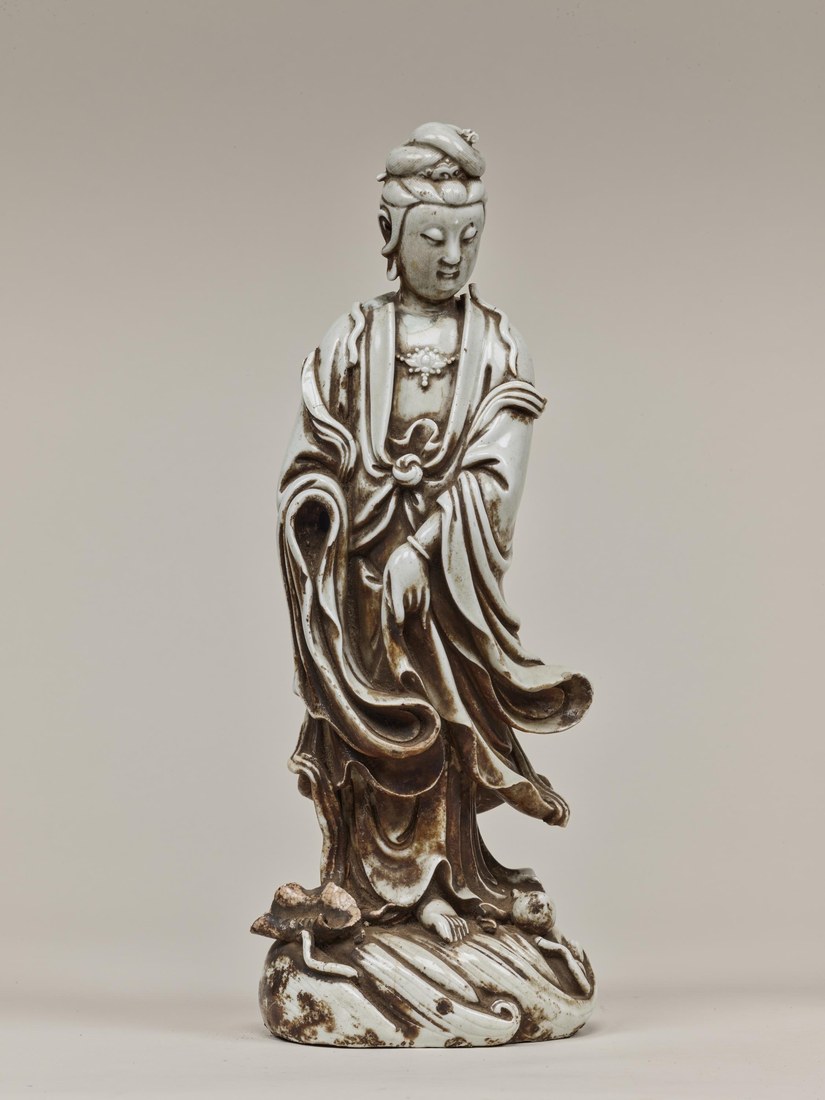
The Tokyo National Museum believes that statue is the one now numbered C-600, the figure in our slide. 1 If so, it shows something that no written creed could: a Chinese image of the bodhisattva of mercy, kept in a Japanese farmhouse, prayed to as the Mother of God. Notethe museum's wording is "believed to correspond" (該当するとみられ), not a certain identification. 1
What a Maria Kannon is
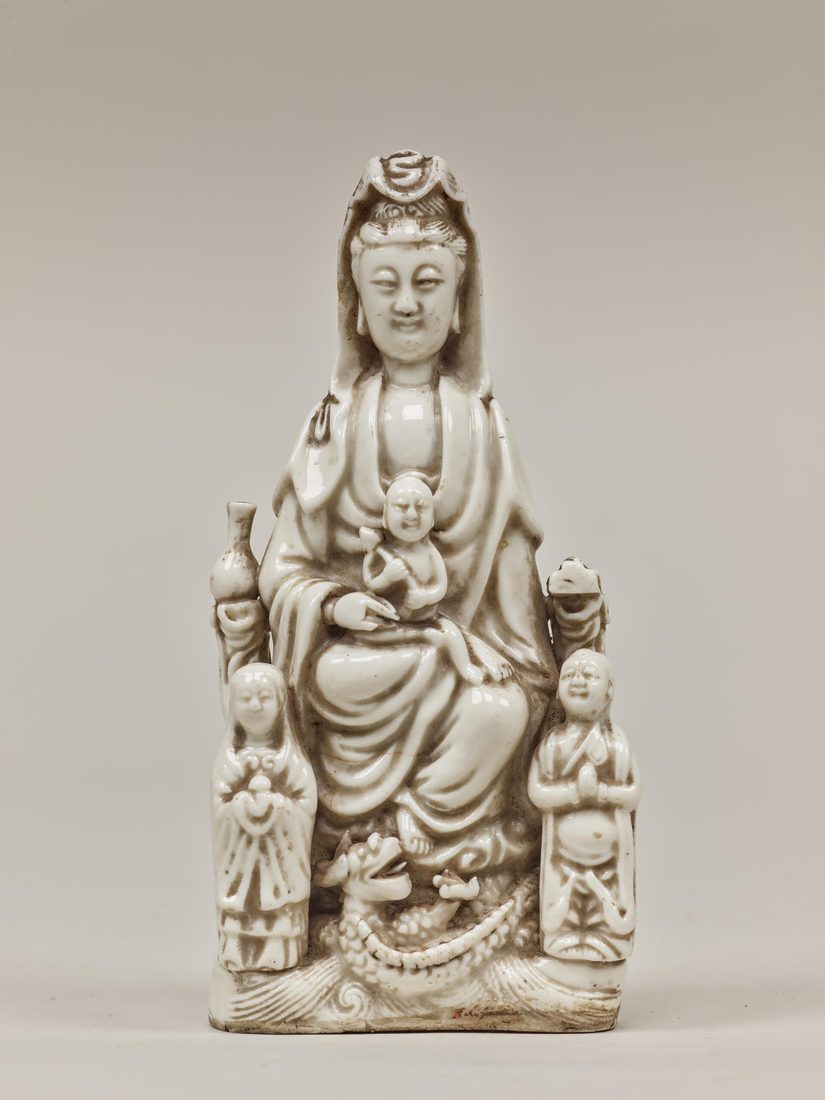
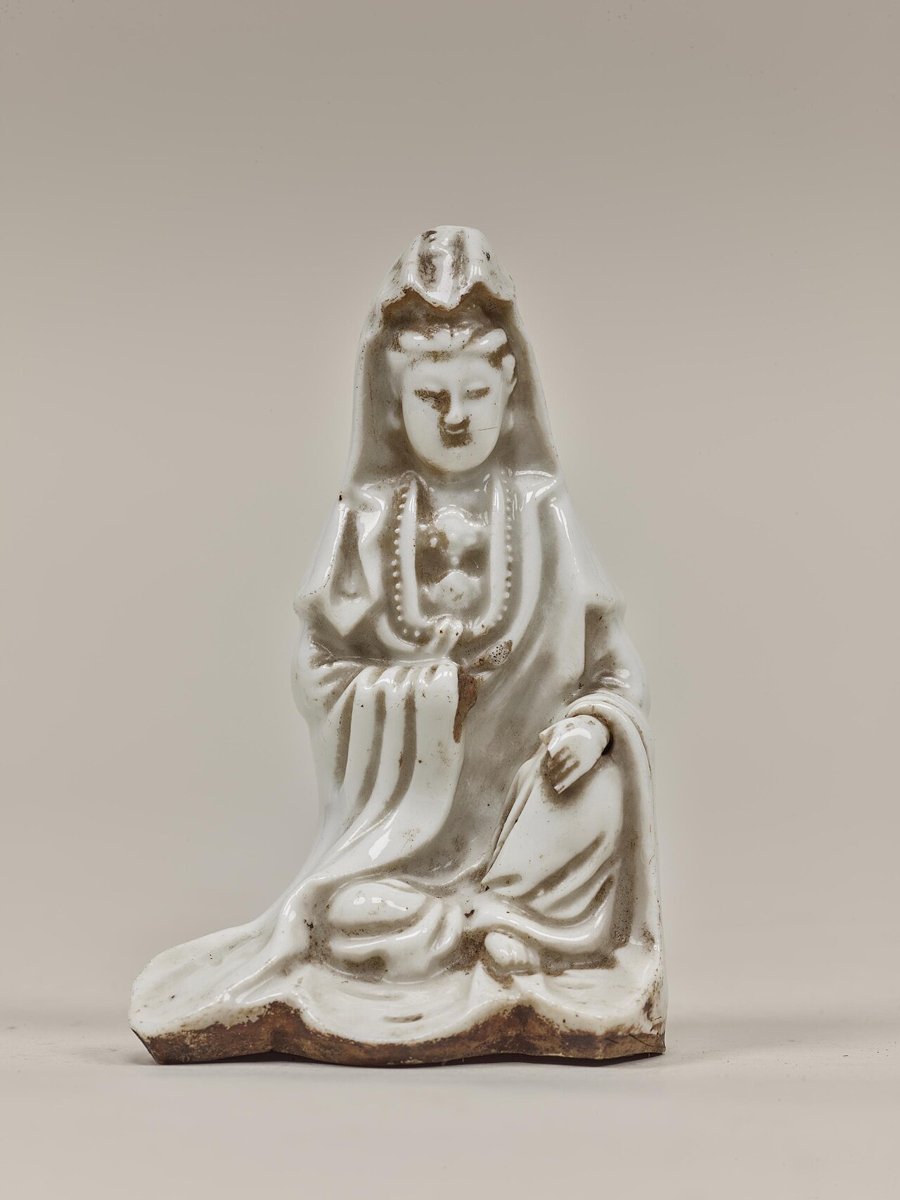
The museum's own note on a sister figure explains the term. "Maria Kannon" refers to Kannon images made in places such as Fujian in China as objects of prayer for children, safe birth and child-rearing, and brought to Kyushu. Because they show a figure holding an infant, seated on a rock, in pure white porcelain, believers compared them to the pure Virgin Mary and venerated them as such. 2 Both C-600 and its sister figure C-605 are attributed to the Dehua kilns (徳化窯) in China, Ming to Qing dynasty, 17th century. 1,2
The figure in the picture
Slide 6 shows Tokyo National Museum C-600, catalogued as 観音菩薩立像 (standing Kannon), white porcelain from the Dehua kilns, Ming to Qing dynasty, 17th century, 41.8 cm high, an Important Cultural Property. 1 The museum's note calls it the white porcelain Kannon "possessed by Kichizō, who was a leader of the hidden Christians of Urakami village". 1 The photograph is ColBase's frontal view, cropped for the slide. 1
It is not the type most often described as a Maria Kannon. The museum's general description speaks of seated figures holding an infant, and the photograph shows a standing figure with no child: a crowned head, a jewelled pendant at the chest, robes falling in deep folds, and bare feet on a base carved like a breaking wave. 1,2 That makes Kichizō's figure a useful corrective. Whatever drew him to it, it was not a resemblance to a mother and child. Unverifiedwhy this figure was chosen, or how it came to Urakami, is not recorded in the sources we have read.
The figure belongs, like the fumi-e of slide 5, to the Christian materials of the Nagasaki Magistrate's Office designated in 1977, which include 79 "Maria Kannon images and others". 3 The designation text explains that these materials include objects seized in the great Urakami crackdowns of 1856 and 1867. 3 Its smaller sister C-605, a seated Kannon 22.4 cm high, appears among the images below. 2 Unverifiedwe have not found a record linking C-605 itself to a specific seizure.
Three crackdowns in Urakami
Kichizō's arrest was not the first time the authorities came to Urakami. The Japan Tourism Agency's timeline lists a first crackdown from 1790, when nineteen people accused by the headman of Yamazato village were released for lack of evidence, and a second in 1839 or 1842, when leaders called chōkata were arrested after being informed on and then released. 5 The third, from 1856, was harsher: Kichizō, the chōkata, and other Christians were imprisoned and tortured, though the case was officially handled as an isolated "foreign religion" affair (異宗一件). 5 It was in this crackdown that "Hantamaruya" entered the magistrate's records. 1
The storehouse already held very different images of Mary. When the Tokyo National Museum mounted a small exhibition on "The Virgin Mary and the Faith of Japan's Hidden Christians" in 2023, it showed C-600 beside European pictures that had also been in the magistrate's keeping: a "Madonna of the Thumb" from 17th-century Italy and a panel of three saints from Europe, along with a rosary seized in Urakami. 6 Side by side, the European Madonna and the Chinese Kannon show two ways the same devotion reached Japan: one carried by missionaries, the other bought in a port and given a new name. 1,2,6
From the storehouse to Ueno
The confiscated figures spent the rest of the Edo period in the magistrate's religion storehouse. In 1874 they went to Tokyo, passing between ministries until they settled with the imperial museum. The museum later sorted them by their recorded origin: "formerly kept in the magistrate's religion storehouse", "received by the magistrate in 1856", "received in 1867 from the Christians of Urakami village", and "received in Urakami village". 4 They were first shown publicly in 1906 and are now in the Tokyo National Museum. 4
The Kannon and the question
When the Urakami villagers walked into Ōura Church in March 1865 and asked "Where is the statue of Santa Maria?", some of them, like Kichizō, had kept images like these. 1,5 The French statue answered the question with a familiar face; the porcelain Kannon had been keeping it open for two centuries. Within two years, in 1867, the authorities raided Urakami again, and more devotional objects were seized and sent to the same storehouse. 3,4