Thirty minutes of prayer
On a November day in 2025, at a small shrine in on the west coast of , a man of seventy-five knelt and recited prayers for about thirty minutes from memory.He was the , the keeper of the calendar, of the community, and the words he recited had come down to him, person to person, from Japanese Christians of the early seventeenth century.
He is one of the last. When the scholar Miyazaki Kentarō counted households around 2000, he found about 60 in the , 50 in Sotome and 350 on , perhaps 1,000 to 1,500 people in all.On , three of the last village-level groups dissolved between March 2024 and New Year 2025.
The communities answered one question with their lives: what does it take to keep a faith when everything that usually carries it, clergy, churches, books, has been taken away?
Two names for two eras
Japanese historians use two words. Senpuku , "underground" or hidden Christians, are those of the ban, roughly 1614 to 1873, who were registered at Buddhist temples or Shinto shrines and practised in secret.Kakure Kirishitan are those who, after the ban ended in 1873, chose not to join the Catholic Church and went on practising in the old form.Even the spelling of kakure is argued over: written in kanji it stresses concealment, in katakana it suggests there is no longer any need to hide; the Ikitsuki historian Nakazono Shigeo uses hiragana as a middle way. On Ikitsuki itself, believers call themselves "old Christians" and Catholics "new Christians."
This site uses "Hidden Christians" for the ban period and "Kakure Kirishitan" for the communities after 1873.
The weight of the ban
Under the third shogun, , the regime built a net of controls: rewards for informers, the five-household groups, the , written renunciations, and registration at a temple. Miyazaki notes that these tools controlled ordinary people as well as Christians, and lasted until the end of the shogunate.The last priest in Japan was killed in 1644.
When hidden communities were found, the results could be terrible. In the Kōri crackdown of 1657 in Ōmura domain, 608 people were arrested and 411 beheaded, by Miyazaki's count (another study gives 603 and 406: ).In Ōmura, graves were dug up and the bones thrown into the sea, and families were made to call a Buddhist priest and cremate their dead.In the Amakusa crackdown of 1805, by contrast, 5,200 people were found, but the authorities treated them as misguided and spared them the worst. was raided in 1790 to 1795, 1842 and 1856.
So how did any of it survive?
The organisations that carried it
The answer begins before the ban. In the Christian century the missionaries organised lay , beginning with a misericordia in in 1554, and then groups dedicated to Santa Maria, the sacrament, the rosary and the martyrs. Each had officers, among them the , keeper of the books, and the jiiyaku, elder.When the priests were gone, these groups became the means of passing on prayers and rites.Nakazono says the same of Ikitsuki: after the Christian lords left the island in 1599, believers formed new confraternities and venerated holy pictures, and these became the village groups that carried the faith through 250 years.
In the Gotō Islands and Sotome the officers were the chōkata, who kept the calendar and led most rites, the , who baptised, and the elders. On Ikitsuki the equivalent roles were the oyajiyaku, ojiyaku and yakuchū.Baptism mattered most: it was what kept the community going, and so the baptiser carried the most taboos.In Urakami, when the missionaries returned in 1865, they found that the baptiser had been the only mizukata to survive the 1856 raid.
What they kept
Prayers. The , from Latin oratio, were passed on by mouth for some 230 years. A written copy could have cost a life.Some are in Latin, and many Japanese prayers are full of Latin and Portuguese words; a full set can take thirty or forty minutes even recited fast. On Ikitsuki they are said aloud; in Nagasaki, Gotō and Sotome they were said silently, perhaps because Ōmura's officials watched so closely.One sung Ikitsuki prayer, Gururiyōza, carries the same Latin words and tune as O gloriosa Domina in a score published in Spain in 1553.
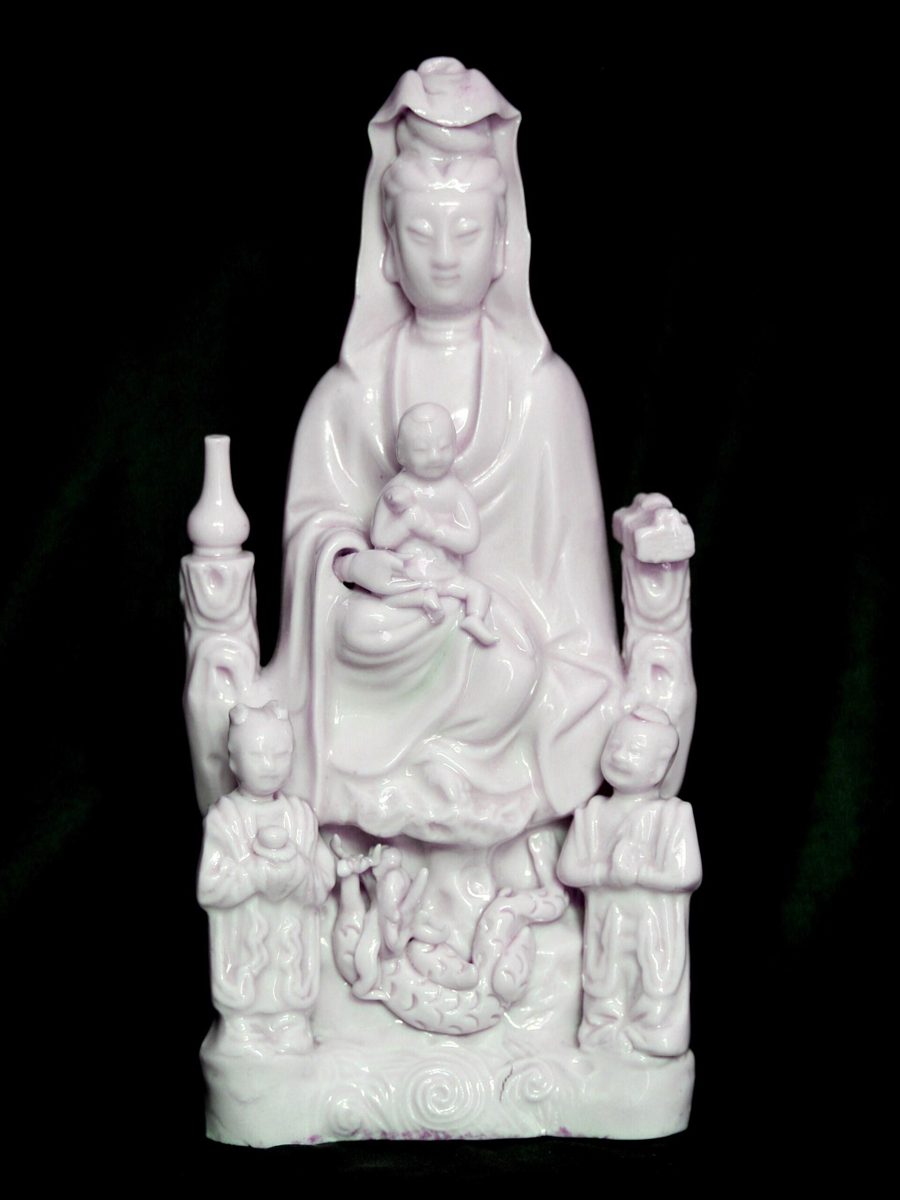
Images. Owning a statue of Mary was dangerous, so believers venerated Chinese porcelain figures of Kannon holding a child, now called . In interrogations at Urakami late in the Edo period, believers named "," Santa Maria, as their principal image.On Ikitsuki the highest object of worship is the gozensama, a hanging scroll of Christ, Mary or saints, kept in the house of the leader.
Rites. Baptism, Christmas Eve and Christmas, Easter and Palm Sunday were kept in their old forms. The funeral was doubled: the Buddhist priest chanted, and then the believers recited a prayer "to undo the sutra" and held their own rite.
A wound at the centre
The ban left marks on the faith itself. Every year believers had to tread on the . Miyazaki writes that afterwards they repeated the , the prayer of contrition, and that over time their devotion moved away from God as a strict father and judge toward Mary, mother and forgiver.
They also absorbed what surrounded them. Offerings of sake and raw fish, a meal shared with the deity, a banquet: Miyazaki finds the basic shape of Kakure rites to be the shape of Shinto ritual.On Ikitsuki, prayers open by calling down as many as fifty deities, and rites invented over the centuries far outnumber those inherited from the missionaries: prayers to stop the wind, to bring a soul into a new house or boat, to drive evil from fields.Holy water from the martyrs' island of Nakaenoshima is held to cleanse pollution.
The parting of the ways
After 1873 the communities divided. Many Hidden Christians returned to the Catholic Church under the Paris Foreign Missions priests. Others stayed as they were.Some turned to Buddhism or Shinto.Urakami, where people had been exiled for their faith, became Catholic. Ikitsuki, by contrast, almost entirely stayed Kakure; Nakazono says that just under 90 percent of its 11,000 residents were believers in 1954.
Why stay outside the Church when the Church was back? The keepers' most common answer, Miyazaki reports, is that they cannot throw away in their own generation what their ancestors risked their lives to keep.Others speak of wonders that prove their kami are real, of bonds of family and place, of fear of misfortune if the sacred objects are abandoned.Nakazono points to practical causes on Ikitsuki: the ancestral Buddhist altars, and a faith woven into the life of each village and household.
A debate scholars have not settled
Are the Kakure Kirishitan still Christians? This is , and the two scholars this page relies on most disagree.
Miyazaki argues that their religion now shows the typical marks of Japanese folk religion, layered beliefs, ancestor veneration, concern for worldly benefit, ritualism, and should be seen as a form of it; to focus on the Latin prayers and baptism, he warns, is to mistake vestiges for the whole.
Nakazono argues nearly the opposite. Without missionaries, he says, believers "didn't know what to change or how to do so," and so they passed down what they had learned in the same form; on Ikitsuki, Christianity stands alongside Buddhism and Shinto rather than mixing with them. Prayers, he adds, are less for teaching doctrine than for speaking to God, so keeping the original words is what matters.
Readers can hold both: a faith whose words are startlingly faithful to the sixteenth century, practised in a world that is thoroughly Japanese.
The end of a long line
Miyazaki recorded the dissolutions as they came: Neshiko on , the largest group, in 1992; Ienomachi, the last in Nagasaki city, in 1994; four Gotō groups the next year.Before they disbanded, groups cut rituals, simplified offerings, merged, admitted women as officers and relaxed taboos.Most former members became Buddhists, or on Gotō Shinto; surprisingly few became Catholics.
On Ikitsuki, Nakazono dates the decline to economic change: purse-seine fishing, construction work away from home and farm machines emptied the farm rituals of meaning, and depopulation broke the households that sustained the faith.In 2024 the Sakaime group dissolved, then Motofure Tsujigaito; Motofure Kobagaito ended with its New Year rite in 2025. Only one group at that level remains, in Yamada, kept by two households.Baptisms on the island stopped about three decades ago.
In 2018 UNESCO listed the Hidden Christian Sites in the Nagasaki Region as , recognising the tradition of the ban period.The living tradition, meanwhile, is ending in the homes where it began. At Sotome a chōkata still prays for thirty minutes, as the keepers before him did.
