十Christian Japan
Part of Urakami
Place

Jūjikayama: The Hill of the Cross at Urakami

In 1881 the Catholics of Urakami, home from exile, raised a cross on a hill above their valley in reparation for the fumi-e and in thanksgiving for the faith kept through the persecution. Pope Pius XII made it an official pilgrimage site in 1950, and the parish still prays the Way of the Cross there every Lent.

12 sourcesTimeline
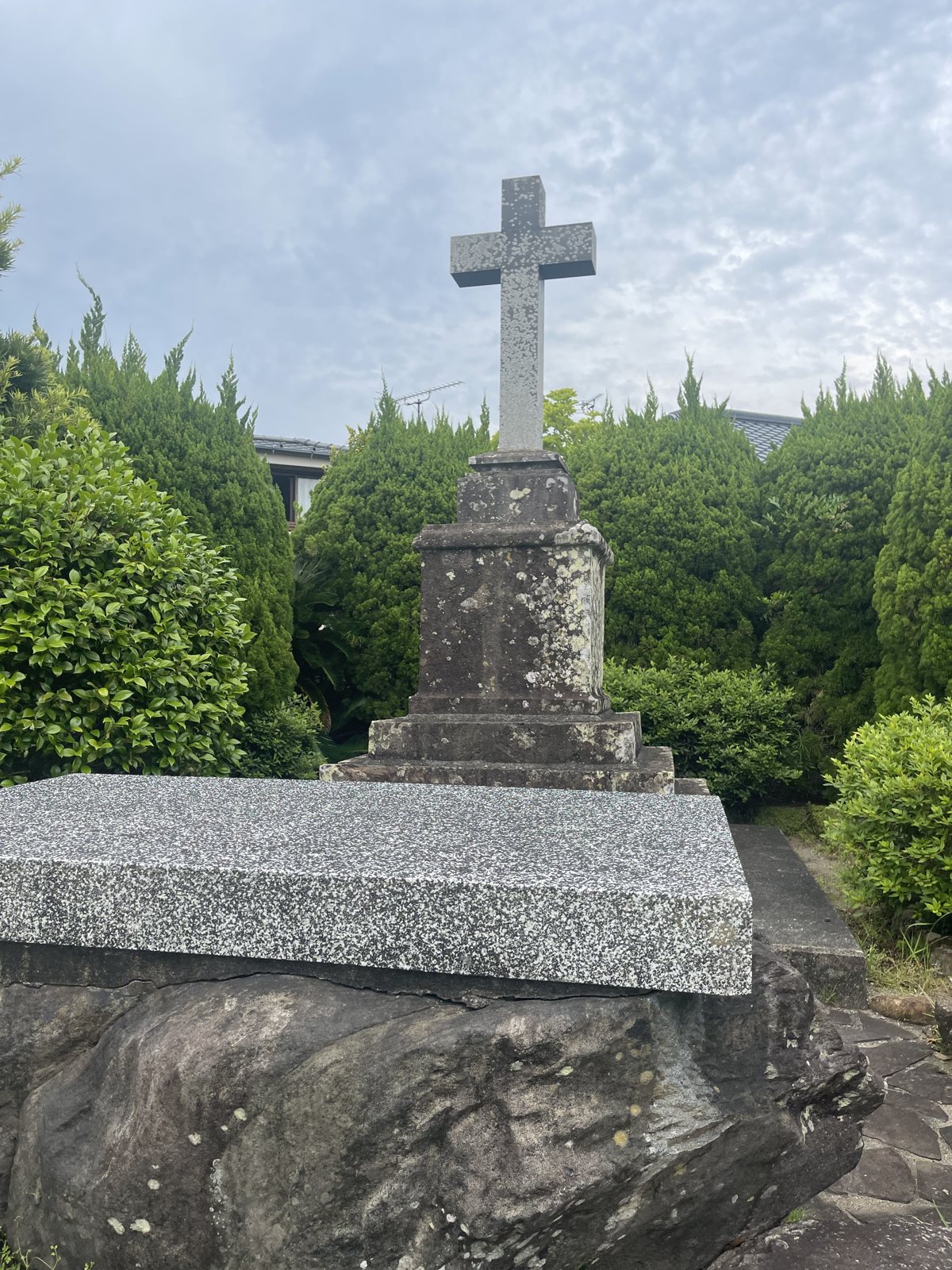
The stone cross of 1923, restored after 1945, Jūjikayama, June 2025
The stone cross of 1923, restored after 1945, Jūjikayama, June 2025 Private collection

The story

The opening line of each part of the story.

  1. The hill above the valleyJūjikayama (十字架山, "the Mount of the Cross") is a small hill in Tsuji-machi, once called the hill of Hira-gō (平郷の丘), in the Urakami district of Nagasaki. The name is read Jūjikayama.
  2. Reparation and thanksgivingThe Catholics of Urakami came home from exile in 1873. They rejoiced that they had kept the faith, but one sorrow stayed with them: the memory of the fumi-e.
  3. Sixty men and seven daysThe faithful vied with each other to give their labour. The base stone is 4 shaku (120 cm) square.
  4. Wood to stoneIn August 1923 the wooden cross, rotted by the weather, was replaced with a cross of stone. Note Both sources say the wooden cross had stood for "over fifty years" (50有余年), but 1881 to 1923 is 42 years. The atomic bomb of August 9, 1945 damaged it, and it was restored to the form it has today.
  5. Named by Pius XIIIn 1950 Bishop Yamaguchi Aijirō of Nagasaki went to Rome.
  6. Prayer on the hillSince 2009 Mass has been offered on the hill every year, on the Sunday nearest the Exaltation of the Holy Cross.
The place

The hill above the valley

Jūjikayama (十字架山, "the Mount of the Cross") is a small hill in Tsuji-machi, once called the hill of Hira-gō (平郷の丘), in the Urakami district of Nagasaki. The name is read Jūjikayama.

Houses and apartments now stand around it. The city guide puts the way up at the stone steps beside the St Francis Hospital bus stop, across the road from the hospital. On the slope up is a stone marker of the pilgrims' road, set up in 1927. At the top the stone cross stands in the middle, with the fourteen iron crosses of the Way of the Cross around the edge.
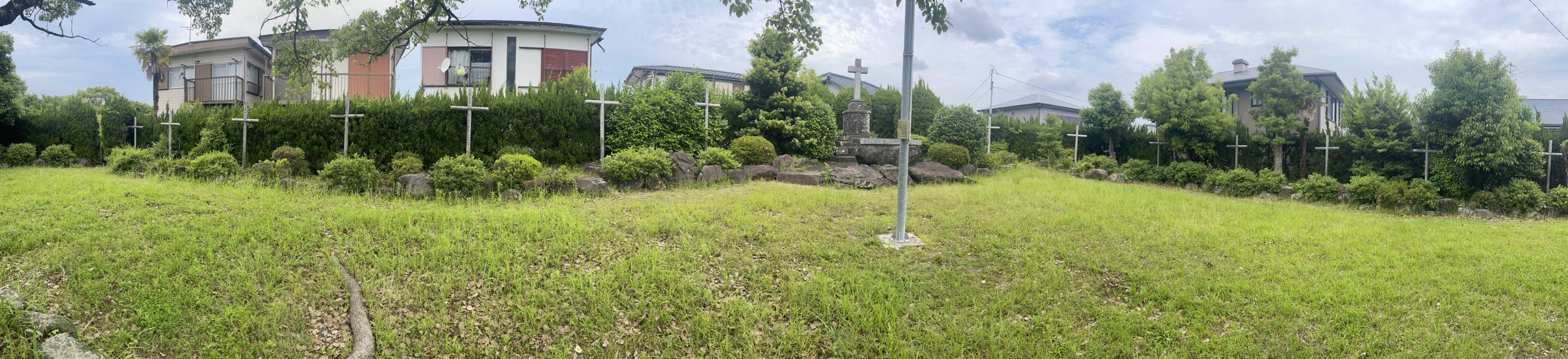
The top of the hill, with the cross in the middle and the iron Stations of the Cross around the edge
The top of the hill, with the cross in the middle and the iron Stations of the Cross around the edge Private collection
Why the cross

Reparation and thanksgiving

The Catholics of Urakami came home from exile in 1873. They rejoiced that they had kept the faith, but one sorrow stayed with them: the memory of the fumi-e. Under the shogunate their forebears had trodden on the holy image against their will, and once they understood how grave a sin it was, they were deeply troubled and resolved that it must be made up for.

Fr Eugène Puthod (プトー), the second parish priest of Urakami, knew what was in their hearts. He proposed: "Let us raise a cross on this hill and make it a holy place of reparation and thanksgiving." The hill was chosen because it looked like Calvary, where Christ suffered. The year before, the faithful had bought the headman's house where the treading had been held and made it a temporary church (see the Takaya estate). The archdiocesan newspaper calls that purchase an act of reparation and the cross a further one.

The parish history gives two reasons for the cross: reparation for the treading in the years of the ban, and thanksgiving that the persecution was over, professing the faith openly. The board on the hill names the intentions this way: to thank God for His protection in keeping the faith, and to make reparation and ask forgiveness for the sins of the faithful who trod on the image against their will and of the rulers who killed so many Christians. At the hill in 2023, Fr Kuzushima Hidenobu listed four: penance for the treading, done from 1629 to 1857; pardon for believers who pretended to go into exile but did not; reparation for the rulers' sins and pardon for those who took part in the persecution against their will; and thanks to God that the faith had held through 250 years of ban and persecution.
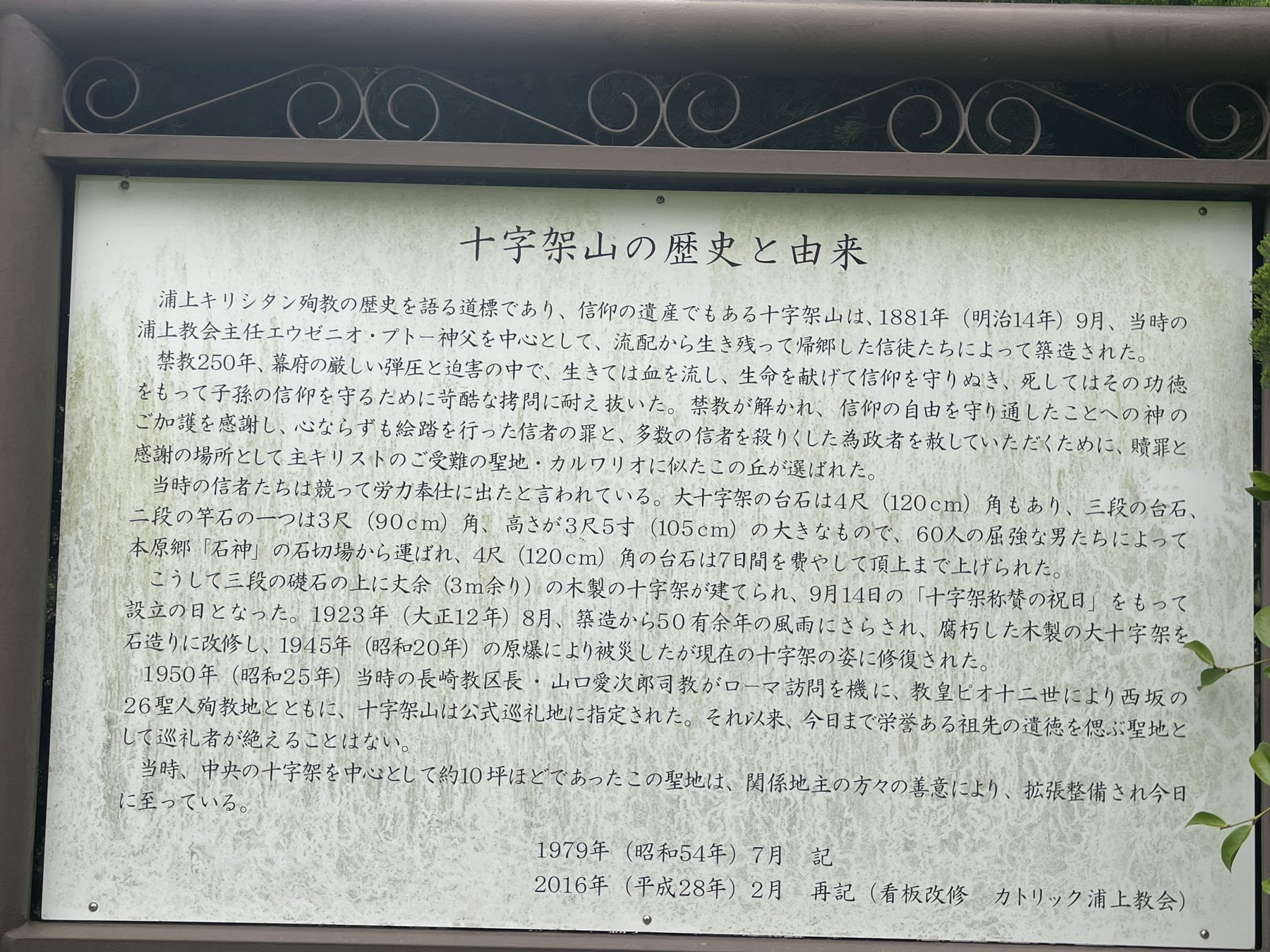
The parish's board on the hill, 「十字架山の歴史と由来」, first written in 1979 and renewed in 2016
The parish's board on the hill, 「十字架山の歴史と由来」, first written in 1979 and renewed in 2016 Private collection
Building

Sixty men and seven days

The faithful vied with each other to give their labour. The base stone is 4 shaku (120 cm) square. Of the three tiers of base stones and the two of shaft stones, one is 3 shaku (90 cm) square and 3 shaku 5 sun (105 cm) high. The stone came from the quarry at Ishigami in Motohara-gō. Strong men chosen from the whole village carried the base stone to the top over seven days, so that the work would be the whole village's offering.Tradition The board and the city guide give their number as sixty. The archdiocesan newspaper in 2012 gives the base stone as one metre square and the quarry as 1 km away.

On the three-tiered base they raised a wooden cross more than one jō (over 3 m) tall. September 14, the Exaltation of the Holy Cross, was set as the day of its founding, and the parish history says the forebears often prayed beneath it. At first the holy ground was only about 10 tsubo (about 33 square metres) around the cross. Later it was enlarged through the goodwill of the landowners.

1923 and 1945

Wood to stone

In August 1923 the wooden cross, rotted by the weather, was replaced with a cross of stone. Note Both sources say the wooden cross had stood for "over fifty years" (50有余年), but 1881 to 1923 is 42 years. The atomic bomb of August 9, 1945 damaged it, and it was restored to the form it has today.

The Church's pilgrimage site

Named by Pius XII

In 1950 Bishop Yamaguchi Aijirō of Nagasaki went to Rome. On that visit, at the bishop's audience with the Pope, Pope Pius XII designated Jūjikayama, together with Nishizaka, the place of the Twenty-Six Martyrs, as official pilgrimage sites of Nagasaki.

In 1952 the parish enlarged the top of the hill and set up fourteen wooden Stations of the Cross on both sides of the path up. The parish history calls the Way of the Cross held there the first outdoor Way of the Cross in Japan.Unverified For the centenary in 1981 the grounds were improved and the fourteen Stations were remade as iron crosses around the summit.

Today

Prayer on the hill

Since 2009 Mass has been offered on the hill every year, on the Sunday nearest the Exaltation of the Holy Cross. It is called the Jūjikayama Martyrs' Festival, and Urakami keeps it so that the hill stays a place of prayer. It is usually led by Urakami and the other churches of the Nagasaki Central district. In 2012 the archdiocesan newspaper reported the martyrs' memorial Mass held there on September 9, concelebrated by two priests of Urakami.

On September 10, 2023, the 150th year since the end of the exile, the archdiocese itself held the festival. More than 150 faithful came. Fr Kuzushima Hidenobu was principal celebrant in place of Archbishop Nakamura Michiaki, with seven priests concelebrating. On September 8, 2024, the sixteenth festival Mass, the parish priest Fr Yamamura Ken'ichi said Mass with about 60 faithful in heavy heat. In his homily he recalled that the Christians of Urakami raised the cross here in reparation for the treading they had kept up through seven generations of persecution, and to ask pardon for the sins of the rulers. He urged the faithful to keep coming to pray.

Every Friday in Lent, from the Friday after Ash Wednesday through Good Friday, the parish prays the Way of the Cross on the hill at 7:30 in the evening, with the same prayer in the cathedral at 7 for those who cannot climb. On Good Friday it is held at 3 in the afternoon, and the pilgrims leave the church at 2. At the first Friday of Lent in 2024, about fifty people came in the cold of the night. For Good Friday, April 3, 2026, the parish invited the faithful to carry a cross up the hill. Each year volunteers quietly cut the weeds and prune the trees so the Way of the Cross can be held there.
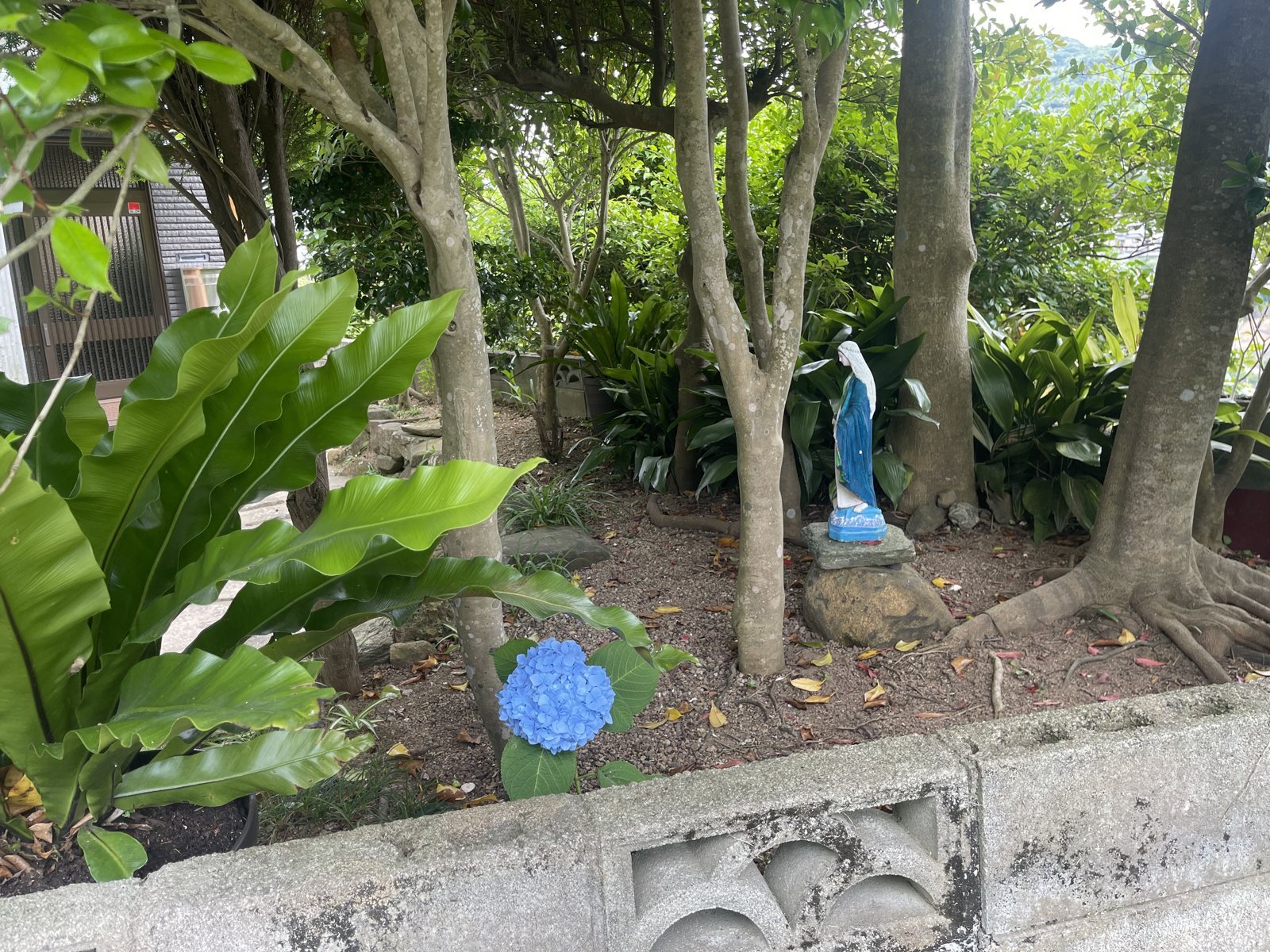
A statue of Our Lady near the hill
A statue of Our Lady near the hill Private collection

What is not yet known

Open questions
  • Takagi Sen'emon and the cross. Marnas (1897) and Bishop Cousin's letter of 1883 say Takagi Sen'emon got the governor's leave for a great stone cross on a hill above the valley. The parish history says the cross of 1881 was wooden and was replaced in stone in 1923. Whether they mean this cross is not stated.
  • The form of the 1950 designation. The parish, the board and the city all report it, but we have not found the Roman document itself.
  • The rite of September 14, 1881. The parish gives the date and says the people prayed under the cross, but we have not found a record of whether Mass was said or the cross blessed that day.

Who's who

  • Fr Eugène Puthod (プトー): Claude-Eugène Puthod (1855 to 1882), priest of the Paris Foreign Missions; second parish priest of Urakami, who proposed the cross in 1881. The board on the hill calls him エウゼニオ・プトー.
  • Takagi Sen'emon: Urakami leader of the exile years (see his page).
  • Bishop Yamaguchi Aijirō: Bishop of Nagasaki, whose 1950 visit to Rome brought the designation.
  • Pope Pius XII: Named Jūjikayama an official pilgrimage site in 1950.
  • Fr Kuzushima Hidenobu: Head of the archdiocesan secretariat; principal celebrant and preacher at the 2023 festival Mass for the 150th year since the exile ended.
  • Fr Yamamura Ken'ichi: Parish priest of Urakami; said the 2024 festival Mass.
Timeline

The dated story

Every dated row in this story, with its source.

  1. 1873Exiles return to Urakami
  2. 1880The faithful buy the Takaya house where the treading was held and make it a temporary church
  3. September 14, 1881Wooden cross raised on Jūjikayama at Fr Puthod's proposal
  4. August 1923Wooden cross replaced in stone
  5. 1927Stone marker of the pilgrims' road set up
  6. August 9, 1945Cross damaged by the atomic bomb, later restored
  7. 1950Pius XII names it an official pilgrimage site, with Nishizaka
  8. 1952Fourteen wooden Stations set up on the path
  9. 1981Centenary: iron Stations around the summit
  10. 2009Yearly festival Mass begins
  11. September 10, 2023Archdiocese holds the festival, 150th year since the exile ended
  12. September 8, 2024Sixteenth festival Mass
  13. Lent 2024 and Lent 2026Friday Way of the Cross on the hill
Full record

Key facts

FactValueStatusSource
Name十字架山, Jūjikayama, "the Mount of the Cross"Solid
LocationTsuji-machi, Nagasaki; 32.78533, 129.87618Solid
FoundedSeptember 14, 1881, at the proposal of Fr Eugène Puthod (プトー)Solid (parish history, board)
PurposeReparation for the fumi-e and thanksgiving for the faith keptSolid
First crossWood, over 3 m, on a three-tiered stone baseSolid
Base stone120 cm square (board, parish; 1 m in the 2012 newspaper); carried by sixty men over seven daysTradition (the carrying)
Stone crossAugust 1923; damaged in 1945 and restoredSolid
Pilgrimage site1950, by Pius XII, with NishizakaSolid (parish, board, city)
First outdoor Way of the Cross in Japan1952Unverified (parish claim)
Read next

Where to go from here

Sources

Footnotes

  1. 1 Urakami Cathedral parish history, 「総流配より帰郷後の窮乏 / 仮聖堂の建立 / 十字架山参詣地設立」, section 7 「十字架山参詣地設立」. source link (read October 24, 2026)
  2. 2 Information board on the hill, 「十字架山の歴史と由来」, written July 1979, rewritten February 2016 (board renewed by the Catholic Urakami Church). Read from a photograph taken on site on June 7, 2025 (Private collection).
  3. 3 Archdiocese of Nagasaki, 「9月10日 『旅』の終わり150周年記念 十字架山殉教祭」, with the homily of Fr Kuzushima Hidenobu (September 13, 2023). source link (read October 25, 2026)
  4. 4 Nagasaki City, 「ナガジン」 発見!長崎の歩き方, Urakami pilgrimage course, entry 「十字架山」. source link (read October 24, 2026)
  5. 5 おらしょ-こころ旅 (Nagasaki Prefecture heritage site), 「十字架山に登る」 (September 2, 2015), which gives the reading じゅうじかやま and the 1927 marker; and 「浦上信徒の聖地、十字架山へ」 (January 27, 2021), second page. source link (read October 24, 2026)
  6. 6 Urakami parish newsletter Kami no kazoku, October 2024, 「十字架山殉教祭 『信仰の丘』で信仰の源泉を思う」 (Morita Yūko). source link (read October 25, 2026)
  7. 7 Katorikku Kyōhō (Archdiocese of Nagasaki newspaper), no. 1130, October 1, 2024, p. 1, report 「“救いを望む神のみわざ” 十字架山殉教祭」 on the Mass of September 8, 2024. source link (read October 25, 2026)
  8. 8 Yoki Otozure (Archdiocese of Nagasaki newspaper), no. 999, October 1, 2012, p. 3, report 「『償いと感謝の聖地』十字架山で祈る」 on the Mass of September 9, 2012, Tsuji-machi, with a history of the hill drawn from the Urakami parish leaflet. source link (read October 25, 2026)
  9. 9 Urakami parish newsletter Kami no kazoku, March 2024, 「『十字架の道行』始まる」 and the Lenten schedule 「四旬節 十字架山での道行」. source link (read October 25, 2026)
  10. 10 Urakami parish newsletter Kami no kazoku, March 2026, 「こぞって十字架山へ」 (Fukahori Masanori). source link (read October 25, 2026)
  11. 11 Marnas 1897, La Religion de Jésus ressuscitée au Japon, vol. 2, pp. 431 and 485 (p. 485 for Bishop Cousin's letter of 1883), as cited on the site's Urakami page.
  12. 12 IRFA (Missions Étrangères de Paris archives), notice no. 1441, PUTHOD Claude-Eugène (1855 to 1882): put in charge of Urakami after the death of J.-B. Poirier (1881); administered the district about two years. source link (read October 25, 2026)
Images

Image credits

  • The stone cross of 1923, restored after 1945, Jūjikayama, June 2025: Private collection
  • The top of the hill, with the cross in the middle and the iron Stations of the Cross around the edge: Private collection
  • The parish's board on the hill, 「十字架山の歴史と由来」, first written in 1979 and renewed in 2016: Private collection
  • A statue of Our Lady near the hill: Private collection