A port between India and Japan
Malacca, at the tip of the Malay peninsula opposite Sumatra, had been held by the Portuguese since Afonso de Albuquerque took it from its Muslim rulers.It was the meeting place of the trade of the western Indian Ocean with China, Japan, the Moluccas and the Philippines, and it lay about 500 leagues from Goa.Many ships sailed from the port to China and Japan every year, and its residents had the closest dealings with those countries.Its people were mainly Malays, many of whom had become Christians and lived on friendly terms with the Portuguese.For the Jesuits it became the last stop on the road from India to Japan, and the post office of the Japan mission.
Xavier and Anjirō
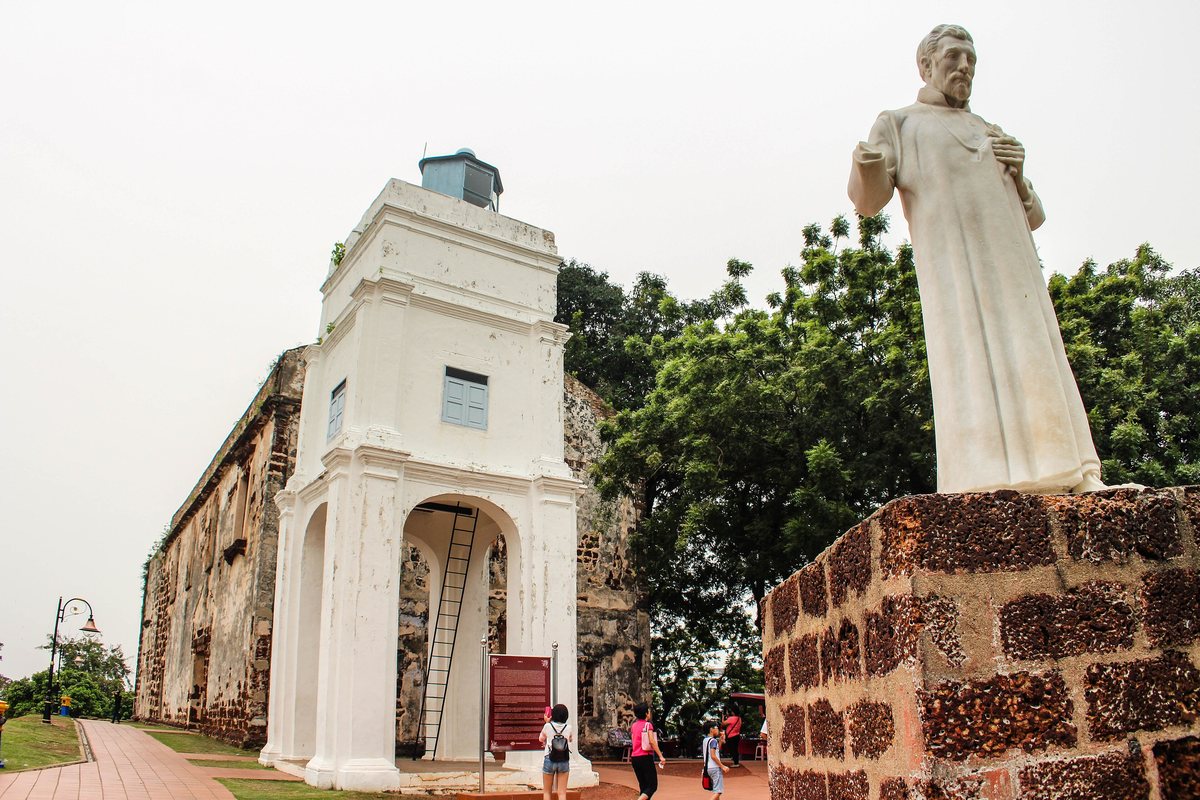
Francis Xavier (ザビエル) first reached Malacca on September 25, 1545, and there lived at the hospital, preached on Sundays and taught children their prayers every day.He began the custom of a man walking the streets at nightfall with a lantern and a bell, calling for prayers for the souls in purgatory and for those in mortal sin.Back from the Moluccas in July 1547, he waited four months for a ship to India.In December 1547 a Portuguese named Álvares brought him a Japanese man, Anjirō (アンジロー), in the hermitage of Nossa Senhora do Monte.As the Japanese later recalled, "and we found him in a church of Our Lady performing a wedding, and he delivered me to him" (translated).The little hilltop chapel, built in 1521, was given to the Jesuits by Bishop João de Albuquerque in 1549 and was later renamed St Paul's by the Dutch.The town's vicar, Afonso Martins, had earlier refused to baptise Anjirō.Leaving late in 1547, Xavier promised the leading citizens two Jesuits, and in 1548 he sent Fr Francisco Pérez and Brother Roque de Oliveira, who opened schools and founded the Jesuit college.
Setting sail for Japan, 1549
Xavier's party of six reached Malacca on May 31, 1549 on its way to Japan, and on landing he received letters from Portuguese merchants already there.The captain of the fortress, Dom Pedro da Silva, a son of Vasco da Gama, found them a ship within two days.No Portuguese vessel was willing to sail, so he chartered the junk of a Chinese merchant nicknamed the Ladrão, Avan, who signed a guarantee to carry them to Japan on pain of losing his wife and property.The captain also gave thirty bahar of the best pepper for the mission and presents worth 200 cruzados for the king of Japan, and Xavier wrote that no one in India had helped him so much.On the night of June 23, 1549, in the chapel of Our Lady of the Mount, he wrote a rule of life for the novice João Bravo, dated "on the point of sailing for Japan" (translated).He embarked in the junk at sunset the next day.He left behind a school run by Brother Roque de Oliveira, whose boys learned reading, writing and Latin grammar, served Mass and sang litanies in procession.Before leaving, he made the port the relay station for the mission's mail: letters from Rome and Portugal were to be copied there and sent on to Japan by several ships, with Fr Francisco Pérez in charge.
The first news from Japan, 1550
Avan's junk returned to Malacca on April 2, 1550, bringing Xavier's first letters from Kagoshima (鹿児島) and four Japanese men, two of them former Buddhist monks.The pirate himself had died a pagan in Japan the previous autumn.Dom Pedro da Silva hoisted the royal standard, fired a salute and led a procession to Our Lady of the Mount in thanksgiving.The four visitors were instructed by Fr Pérez and baptised on Ascension Day, May 15, 1550, with the captain as godfather; three went home to Japan and one went on to Goa.Xavier had asked that such visitors be lodged in the houses of rich Portuguese, so that they would confirm the good report of the Portuguese that had drawn them there.From then on the priest said a Mass every Friday for the priests and Christians of Japan, and he kept it up for thirty years.No ship could sail from the port to Japan in 1550 or 1551: in 1551 the vessel ready to leave was burnt during a siege that lasted from June 5 to September 16, leaving the Jesuits in Japan cut off from India.During the siege Fr Pérez fixed to a tree the crucifix his superior had given him on leaving for Japan, and prayed.
Xavier's last visit and his body, 1552 to 1553
Xavier passed through Malacca for the last time between May and July 1552, on his way to China after his years in Japan.He found the city stricken by pestilence, and went from house to house under a straw hat begging shelter for the sick.The captain of the sea, Dom Álvaro de Ataíde, blocked his embassy to China by seizing the rudder of Diogo Pereira's ship, the Santa Cruz.For the first time the missionary made public his papal powers as apostolic nuncio, and the vicar João Soares solemnly excommunicated the captain.Before sailing he beat the dust of the city from his shoes on a rock by the shore, and he later ordered Fr Pérez to withdraw the Society from it.On March 22, 1553 the Santa Cruz returned to Malacca carrying Xavier's body.With no Jesuits in the city, the nobility, the vicar and the clergy carried it in procession to Our Lady of the Mount, and the plague then raging is said to have ceased.It was buried without a coffin, in a grave too short for it.In August 1553 Fr João de Beira, Diogo Pereira and a few others opened the grave secretly at night and found the body incorrupt, and Pereira had a coffin made lined with damask.The body was then taken on to Cochin.
A stopping place for the Japan mission
Malacca remained a stage on the long voyage between Europe and Japan.The young Japanese envoys of the Tenshō embassy reached it on January 27, 1583, and were lodged for eight days with the Jesuit fathers before sailing on to India.On their way home they stayed twelve days at the Jesuit college there, before a twenty-nine-day voyage to Macao.King Sebastian of Portugal granted Fr Alessandro Valignano (ヴァリニャーノ) a college for Japan endowed with 1,000 scudi a year from the royal treasury of Malacca, but wars with Aceh meant that not a coin was ever drawn.Ships from China and Japan raised new cases of conscience in the port, and in 1562 a Jesuit there asked for a theologian to settle them.
What is uncertain
Where the sources disagree
- Where the body lay at Malacca. in the doorway to the sacristy (Coleridge, Pagès), in the nave before the altar (Schurhammer), or in bare earth outside the church (Bartoli-Maffei).
- The 1551 siege is described differently. the Raja of Bintang with some 10,000 men (Coleridge), Javanese and Malays with 12,000 (Pagès), or the "King of Gentian" (Bartoli-Maffei).
- Pagès dates Fr Francisco Pérez's posting to Malacca to 1545, but Xavier's letter dates it to 1548.
- Later writers (Valignano, Lucena, Pinto) differ on how Dom Álvaro de Ataíde died in prison in Lisbon, though several say he was a leper.
- That the plague ceased when the body arrived rests on the canonization bull and later accounts.
