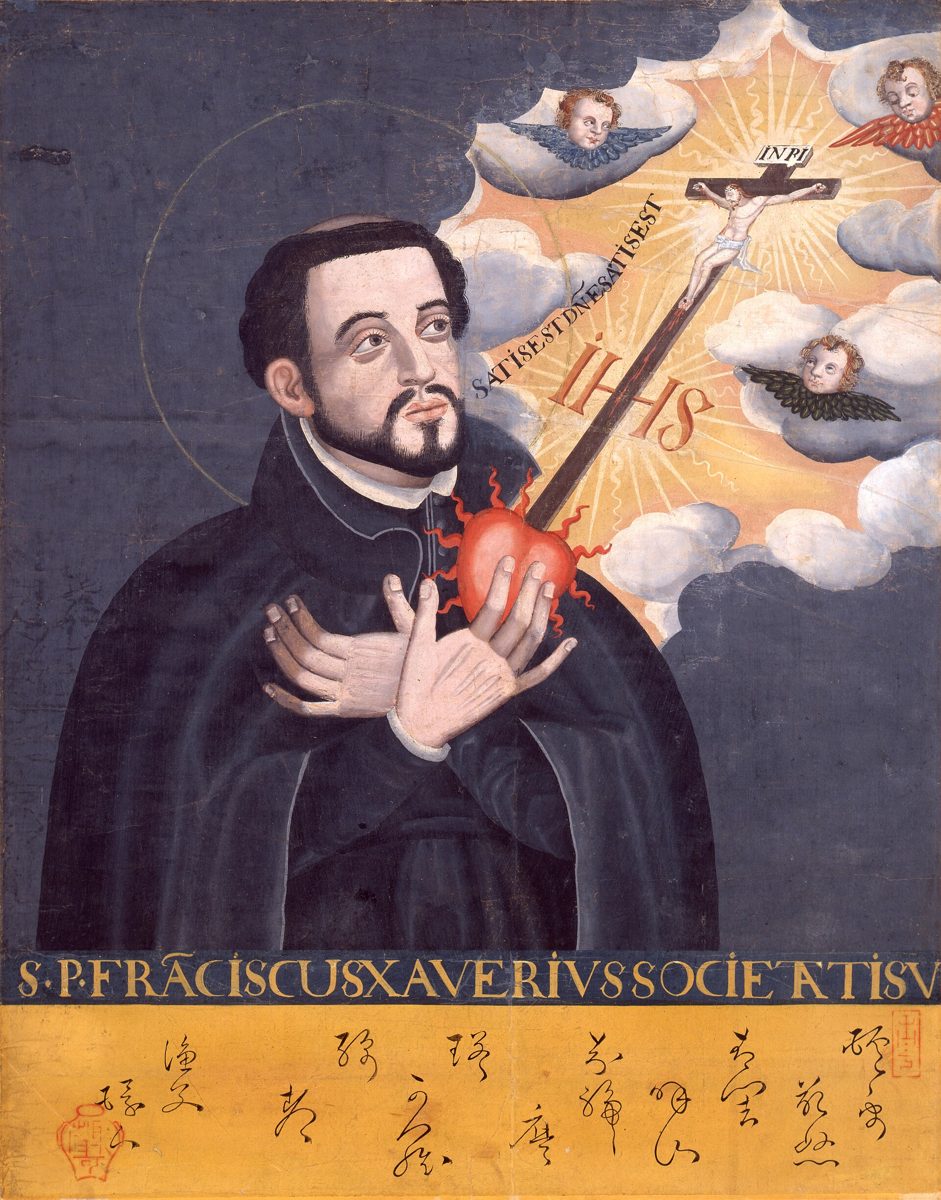
A question in Malacca
In December 1547, in the Portuguese port of Malacca, a priest was officiating at a wedding in the church of Our Lady when a ship's captain he knew, George Alvarez, walked in with a stranger. The stranger was about thirty-five. His name was , and he came from an island the Portuguese had reached only a few years before: Japan.
Anjirō had a past. Wanted for a killing at home, he had fled to a Buddhist monastery and then onto a Portuguese ship.Now he wanted to know about the faith of the foreigners, and the priest, Francis Xavier, wanted to know about Japan.
Xavier asked him a direct question. If he went to Japan, would the Japanese become Christians? Anjirō's answer, as Xavier's biographer Georg Schurhammer tells it from the letters, was careful:
"Not at once. First they will question you about many things, and they will consider what you answer and what you know, and above all they will observe whether you live up to your teachings."If they were satisfied on both points, he said, then within half a year the lord and all reasonable people would follow, "for the inhabitants of Japan follow reason as their guide."
The second half of that prediction proved far too hopeful. The first half proved exactly right. Xavier's two years in Japan were a long test of whether he lived up to what he taught, and of whether he could learn. This page is about the man who took that test.
From Navarre to the Indies
Francis was born on 7 April 1506, Tuesday of Holy Week, at Xavier Castle in the kingdom of Navarre, the last of six children of the lord of the castle.As a student in Paris he became one of the first companions of Ignatius of Loyola, and on the feast of the Assumption, 15 August 1534, he took vows with them at Montmartre, the beginning of what became the Society of Jesus.
In 1541 he sailed from Lisbon for the East. From in India he worked as far as the Moluccas.That is where Japan found him.
Anjirō was instructed and baptised at Goa, at Pentecost 1548, taking the name Pablo (Paulo) de Santa Fé, "Paul of the Holy Faith." He was, Miyazaki Kentarō notes, the first Japanese Christian.
Kagoshima
Xavier, two Jesuit companions (the priest and the brother ) and three Japanese Christians, Pablo among them, , Pablo's home town at the southern tip of Kyushu.The date was 15 August 1549: the feast of the Assumption, and the fifteenth anniversary of the vow at Montmartre.
Pablo's mother, wife and daughter welcomed them, and his conversion, Schurhammer says, gave no offence.On 29 September, the feast of St Michael, whom Xavier had chosen as patron of Japan, they were received by the lord of Satsuma, , who gave permission to preach.
Xavier liked at once. "They are the best people thus far discovered," he wrote, "and, it appears to me, among infidels none will ever be found to excel the Japanese."He made friends with the abbot of a Zen monastery, Ninshitsu (Schurhammer: "Nenjitsu"), who loved to talk about the faith and was struck by the idea that the soul does not die.With Pablo's help Xavier put together an account of the faith in Japanese, written in Latin letters, and read from it twice a day.About a hundred people were baptised, and fifteen more at the castle of Ichiku.
Xavier also left the believers of Kagoshima a church calendar, so that they could keep the feasts without a priest.(A later calendar, dated 1634 and attributed to the catechist , was kept by the of and ; that tradition is separate: see Bastian.)
But there was a deeper problem, and Xavier did not yet see it.
The wrong word
Pablo had to translate Christian ideas into Japanese, and the only religious vocabulary at hand was Buddhist. Paradise became "the Pure Land." For God, the single creator, he borrowed Dainichi, the cosmic Buddha of the Shingon school.For months, as Miyazaki puts it, Xavier "thought he was urging people to worship the Christian God," but "in reality he was preaching the Buddha of Buddhism."Shingon monks, Schurhammer adds, were at first pleased to hear what sounded like their own teaching.
By the end of September 1550, the lord of Satsuma had turned against the mission under pressure from the Buddhist clergy, and conversions were forbidden. Xavier left Kagoshima, and Pablo stayed behind to look after the little community.
The road to the capital
Xavier went first to , where Portuguese ships called, and baptised about a hundred people in a few days. Then he set out for the capital, (Kyoto), to ask the emperor for leave to preach in all Japan.He left Torres at Hirado.
On the way he stopped in , the rich seat of the lord Ōuchi Yoshitaka. The audience went badly: when Xavier's companion read out a passage condemning sodomy, the lord was offended.
Eight days before Christmas 1550, Xavier, Fernández and a Japanese companion, Bernardo, left Yamaguchi by land, in deep snow. Schurhammer, drawing on the companions' accounts, writes that Xavier walked barefoot on the frozen roads until his feet swelled, split and bled, and waded icy streams.
Kyoto was a disappointment. The city was half ruined by civil war; there was no way to see the emperor, who in any case had little power, and no way in to the great monastery on Mount Hiei.After eleven days they left. As the city faded from view, Schurhammer says, Xavier recited the psalm of the Exodus: "When Israel went out of Egypt."
Learning
What he did next shows the man. He had walked to Kyoto as a barefoot pilgrim, and it had won him nothing. So he changed.
Back in Yamaguchi in 1551, he presented himself to Ōuchi Yoshitaka as an envoy, in good clothes, with official letters from Goa, including one from the Bishop of Goa, and thirteen gifts: a clock that struck the hours, a pair of spectacles, a mirror, Portuguese wine, pictures and books, "remarkable things that had never before been seen in Yamaguchi."This time he received permission to preach and an empty temple to live in.
He also fixed the word. Once he understood what Dainichi meant, he went through the streets with Fernández crying, "Do not pray to Dainichi!" From then on he used the Latin Deus.It cost him his Shingon friends, and his opponents punned on the new word: Deusu sounded like dai-uso, "the great lie."
In two months, Schurhammer says, about five hundred people were baptised in Yamaguchi, mostly courtiers and officials.One was a half-blind wandering minstrel, given the name (Lawrence) at baptism, who would become one of the great Japanese preachers of the mission.
Bungo, and departure
In September 1551 a message came that a Portuguese ship had arrived in Bungo, on the east coast of Kyushu. Xavier went, and was received at by the young lord Ōtomo Yoshishige, later known as , then about twenty.While he was there, news came that Ōuchi Yoshitaka had been overthrown and had killed himself; a brother of Ōtomo became the new lord of Yamaguchi.
In November 1551 Xavier sailed from Bungo, meaning to return to India, with two Japanese companions, Bernardo and Mateus.He had been in Japan a little over two years.
Shangchuan
His mind had turned to China. In 1552 he reached the island of Shangchuan (Sancian) off the coast of Guangdong, hoping to find passage to the mainland, and there he fell ill, lying in a rough hut.
His companion, a young Chinese named Antonio, kept the last watch. Schurhammer, following Antonio's account, writes that Xavier died "the name of Jesus on his lips," two hours after midnight on Saturday 3 December 1552.He was forty-six.
He was beatified in 1619 and canonised in 1622, together with Ignatius.
What he left
Measured by numbers, Xavier's own harvest in Japan was small: by Schurhammer's counts about a hundred at Kagoshima, about a hundred at Hirado and some five hundred at Yamaguchi, and Miyazaki notes that he never mastered the language.But the seed grew. Ten years after his landing there were about 6,000 Christians; thirty years after, about 130,000.
But he set the course. His view of the Japanese as a people of high culture, to be met with reason and respect, "were to become the basic line for future missionary work in Japan."And the test Anjirō set him in Malacca, whether he lived up to what he taught, is the reason his name is still honoured in Kagoshima, Hirado and Yamaguchi.
