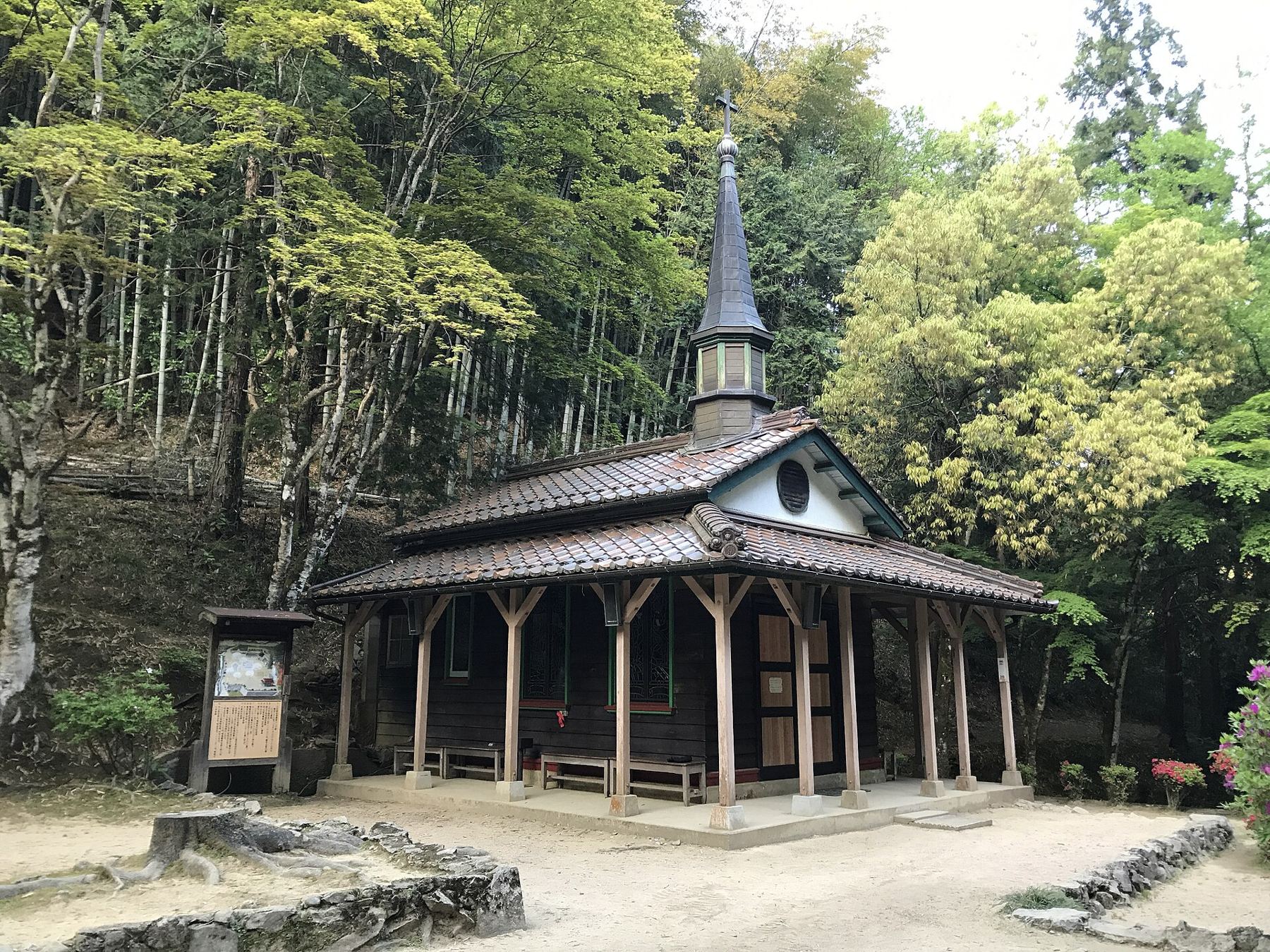
The pond in the snow
On a Thursday morning, the 26th day of the eleventh month, at six o'clock, two farmers from were called out of their prison at , in the mountains of western Honshu.It had been snowing for thirty days. The bamboo and pine branches were bent to the ground, and the snow lay two or three feet deep. In front of the magistrate's room was a pond, perhaps eight metres across, covered with thick ice.
The guards stripped and , cut the paper cords from their topknots, walked them to the edge and pushed them in. The ice broke. The water was too deep to stand except at one shallow place in the middle, where Jinzaburō stood with the water at his chin.
He wrote it down years later. He looked up, put his hands together, and asked Santa Maria to carry his prayer; Sen'emon said the Our Father. "Sen'emon, Jinzaburō," an officer jeered, "can you see your Tenshu? Well?" They threw water in the men's faces until they could hardly breathe. Sen'emon said, "Jinzaburō, are you ready? I can't see. The world is spinning. Please watch over me." When the guards finally shouted at them to come out, Jinzaburō answered: "I am climbing a mountain of treasure now. I can't come out of this pond."They hooked his hair with a bamboo pole and dragged him out.
How did a village of farmers outside come to be standing in an icy pond in Shimane? And why, offered their houses and land back if they would only give way, did so many of them refuse?
The funerals that broke the silence
The trouble began, as it often had in Urakami, with a death.
Under the Tokugawa system every household belonged to a Buddhist temple, and when someone died the temple priest had to come, chant the sutra and watch the body placed in the coffin. Urakami's temple was the Shōtokuji.For generations the had gone along with this on the outside. But after the discovery at in March 1865, the missionaries taught that this outward Buddhism could not go on.
In April 1867 families began burying their dead themselves, without calling the priest.Then most of the villagers went to the headman's house, the , and said: we were Buddhists only on the surface; we are really Christians, and we want to cut our tie with the Shōtokuji.Ten representatives of the four hamlets of Urakami Yamazato went to the headman, and more than 400 households submitted papers refusing the temple-registration system.The parish history calls this "a bombshell of resistance" to a law the shogunate had enforced for two and a half centuries.The headman could not ignore it and reported to the .
Spies were already in the village, mapping the .Since 1865 the villagers had built four: the Chapel of Holy Mary of the Epiphany at Hara in Motohara, the Chapel of Saint Joseph at Tsuji in Motohara, the Santa Clara chapel at Kawakami in Ieno, and the Chapel of Saint on the Nagayo road in Nakano. The priests from Ōura came at night in disguise to teach, baptise and say Mass.
The night raid
The magistrate's men struck in the early hours of 15 July 1867 (Keiō 3), at all four chapels at once.The parish history says the main target, the Saint Francis Xavier chapel in Nakano, was hit at one in the morning; the archbishop's 2018 homily gives about three o'clock for the raids as a whole ().
Three young men were sleeping in the Xavier chapel. Matsuda Kisuke was tied up. The boy Sanada Zennosuke slipped out through a window. Moriyama Jinzaburō, as if the officers were not there, took down the holy pictures, stacked them neatly, knelt in front of the officers, put his hands behind his back and said, "Please tie me." The parish history says he was so calm that the officers, half believing he had some Christian magic, hesitated to touch him.
Sixty-eight men and women were taken to the prison at Sakuramachi.The number held eventually reached eighty-three. Under severe torture, all but Takagi Sen'emon renounced their faith, though, the archbishop adds, after they went home they took it back.
Urakami had been through this before. There had been crackdowns in 1790, 1839 and 1856. This, the fourth, the yonban , was the one that turned Urakami into red earth.
Protests, and a new government
The foreign consuls protested. The Prussian and French consuls went to the magistrate, and a few days later the American minister, Van Valkenburgh, came to Nagasaki, protested too, and visited the prisoners.The parish history notes how much it surprised the magistrate that the representative of a great power should go out of his way to comfort farmers.
But the shogunate fell before it settled the case. In 1868 the new Meiji government declared a return to the unity of rites and rule, with Shinto as the basis of the state, and posted new : "The evil sect of is strictly prohibited."On 25 April 1868 a council before the emperor, with Sanjō Sanetomi and Kido Takayoshi present and Ōkuma Shigenobu called up from Nagasaki, adopted Kido's plan. The leaders were to be punished severely in Nagasaki and the remaining 3,000 or so were to be sent to domains of 100,000 koku or more west of Owari, whose lords would hold power of life and death over them.The British minister, Harry Parkes, and other envoys argued that a law crushing freedom of belief was an unjust law. The government answered that this was a domestic matter.
The American historian Thomas Burkman, working from the diplomatic records, adds two details. Kido's first proposal on 25 April was harsher still: that the Christian leaders be beheaded. It was the Shinto scholar who persuaded the Dajōkan that exile alone should be used.The decree that followed, on 8 June 1868, spoke of some 4,010 Christians to be sent to thirty three western domains, "rigidly excluded from social intercourse until it shall have been proved that their hearts are purified," set to work in mines and forests, with one ration a day allowed to the lord for three years. In the event only about 120 were sent under that first order.
It is worth being fair to the officials. The parish history itself offers two explanations: the new state wanted religious uniformity built on Shinto, and its leaders still carried the 250-year-old belief that Christianity was a subversive sect. A whole village of Christians, they feared, might rise up as Shimabara had.Burkman notes that even some foreign diplomats thought the government was not wholly without reason: Harry Parkes found it understandable that Japan should resist what it saw as the political side of Catholic teaching, and while the first exiles were boarding their steamer at Nagasaki, was quietly putting ten Japanese youths aboard another ship for Shanghai, to study for the priesthood.
Leaving home
The first group went in July 1868: 114 of the leading figures, 66 to Hagi, 28 to Tsuwano and the rest to Fukuyama.The archbishop describes the day. They left Urakami at five in the morning, stood all day at the gate of the Nishi Yakusho and at evening were sentenced, as "ignorant peasants" spared harsher punishment by great mercy, to be "entrusted to other domains." They walked down to the Ōhato pier between ranks of riflemen. As their steamer passed below the Ōura church, they turned toward its cross, joined their hands and said the Our Father together.Sen'emon remembered seeing the fathers watching from the church, and the group prayed all the way to Onomichi.
The rest of the village followed in the snow of January 1870. Burkman, from the British and American records, says the heads of 700 Christian families were brought before the governor, and that Parkes, who was in Nagasaki at the time, could not stop the order from Tokyo; the reasons given were that foreign missionaries were working outside Nagasaki and that the villagers would not follow local customs. To the dismay of the Protestant missionaries who watched, American and European ships were used to carry the exiles.On 5 January the male household heads were made to stand all day in the yard of the Tateyama office and put on ships at evening. From the next day the women, children and old people were gathered at the headman's house, under flags marked north, south, east and west, and called out one by one.Some sailed from Nagasaki; others walked to Togitsu, crossed Ōmura Bay and boarded ships elsewhere, partly, the parish history says, so as not to alarm the foreign consuls.
Watchers lined the road. Many of the exiles wore the white cloth they had worn at baptism, which they called "the veil of the soul." Mothers carried babies and led small children; boys and girls told their rosaries, red-cheeked in the falling snow.In total 3,394 people left, and Urakami became an empty village.The archbishop gives about 3,380 people, sent to twenty domains at twenty-two places; the parish history speaks of twenty-one domains.These figures are in detail.
The journey
The government told the foreign envoys that families would be kept together, housed and given work.On 9 February 1870 four of the treaty powers even offered to keep their missionaries inside the foreign settlements if the exiles were sent home. The offer was not accepted, but from then on, Burkman says, the government began sending home those who recanted, and made no further arrests.A Foreign Ministry instruction of 1870 set rations of five gō of brown rice a day.The parish history says that in most domains these rules were not followed.
, aged thirty, was sent to Wakayama with her four daughters. She remembered praying the rosary aloud through the streets of Nagasaki, and being stripped and searched before she was put in a stable, where her rosary and her picture of Mary were taken. Fever spread; about nine people died. With no light at night, she said, "we could not tell if a dying person was still breathing. We felt with our fingertips and listened for breath, and did the last prayers in the dark."Food was a small bowl of red-rice gruel and one pickled plum. "Many parents gave in," she said, "because they could not bear hearing their children say 'water' and 'I'm hungry'."
At Tsuwano thirty-seven of the exiles died. The parish of Tsuwano names them all, from the record the domain filed in 1871, from Jinzaburō's own notes and from the monument at Kaburazaka.They include Moriyama Yūjirō, fourteen, who told his sister that after eight days of beatings he saw a sparrow on a roof bringing a grain of rice to its chick, and thought that if God cared for sparrows he would care for him; and Iwanaga Mori, six, who refused the sweets an officer offered if she would say she hated Christ: "If I take the sweets I can't go to Paradise. In Paradise there are sweets and everything."
Many gave way. Others gave way and later took it back.Of the 3,394 who left, the parish history counts 613 deaths and 1,011 who renounced their faith, most of whom later returned to it.(Miyazaki gives 664 deaths, and other sources about 660 or 662: .)
The way home
Foreign pressure did not let up. In 1871 the government sent Kusumoto Masataka and Nakano Takeaki to inspect the exiles' treatment, and conditions began to improve.On 24 February 1873 the government removed the public notice boards that banned Christianity, while Iwakura Tomomi's mission was in Europe meeting protests over the persecution.The exiles were sent home: on 14 March an order released the 1,938 Christians still in exile, and by July they had been brought back. By British calculation, seventeen percent of the original deportees had died in exile.
The first fifty-three arrived from Wakayama on 7 April 1873; the last six came from Kōchi on 7 August. About 1,900 returned to Urakami.Of them, 736 had no house to go to; homes had been sold, torn down or stripped of doors, mats and tools.They built shacks from timber in the government forest at Takenokubo, ate insect-ridden dried sweet potato from , and planted beans with potsherds because they had no hoes."But it was not hard," Sada remembered. "It was far better than the journey. We could work freely, and we could pray aloud."On Sundays she walked eight kilometres to Mass at Ōura.
In 1880 the returned Christians bought the house of the Takaya headman, where their families had trodden on the every New Year, and turned it into their church.The cathedral that stands there today rose from that ground.
