Every month, on set days, a French priest walked the lanes of Urakami with a satchel over his shoulder. Children ran ahead of him shouting that the priest was coming. Families came out with 5 or 10 sen, and he wrote each gift in a little book.
His name was Pierre-Théodore , of the Paris Foreign Missions Society, the son of a family of stonemasons and carpenters. He had arrived in Nagasaki in 1873, the year the exiles came home, and in 1888 he became their parish priest. He was collecting for a cathedral. When the bishop saw his plans and asked where the money would come from, Fraineau, by the parish's account, answered calmly: "It will come down from heaven." Tradition
It came down in copper coins from farmers who, fifteen years earlier, had come home from exile to find their houses gone.
Freedom within limits
On February 24, 1873, the government took down the notice boards that had banned Christianity since 1614. It did not proclaim religious freedom; it simply stopped saying the old ban out loud. In Nagasaki, Bishop Bernard Petitjean, the priest of the discovery, had spent the exile years writing to Rome. On May 29, 1873 Blessed Pius IX wrote to him in the brief Dum asperrimam to share his joy at the end of the persecution. "From this moment," the archive of the Paris Foreign Missions Society says, "the Japanese government showed itself disposed to tolerance," and Petitjean began to organize his vicariate. The returned exiles of Urakami came home to burned fields and empty house lots, and 736 had no house at all.
Missionaries counted about 15,000 Catholics attached to the restored Church in 1873, with thousands more still outside its organization.By the end of the year Japan had three churches, twenty-seven oratories and two seminaries with seventy pupils.The Nagasaki seminary opened in 1873, while twenty young men in Yokohama were taught lithography to print religious books.
Then disease came. In July 1874 dysentery broke out on Iōjima and spread to Urakami, followed by smallpox. Father Marc nursed the sick, helped by young returnees such as Iwanaga Maki; the community they formed raised orphans and became the Urakami .
In 1876 the government made Sunday an official day of rest, chiefly for administrative convenience rather than religious reasons.By March 1879 the Catholic mission counted 20,146 believers, church buildings in six cities and fifty-five chapels or oratories.Japan's Catholic population grew to 23,909 in 1880.
The headman's house
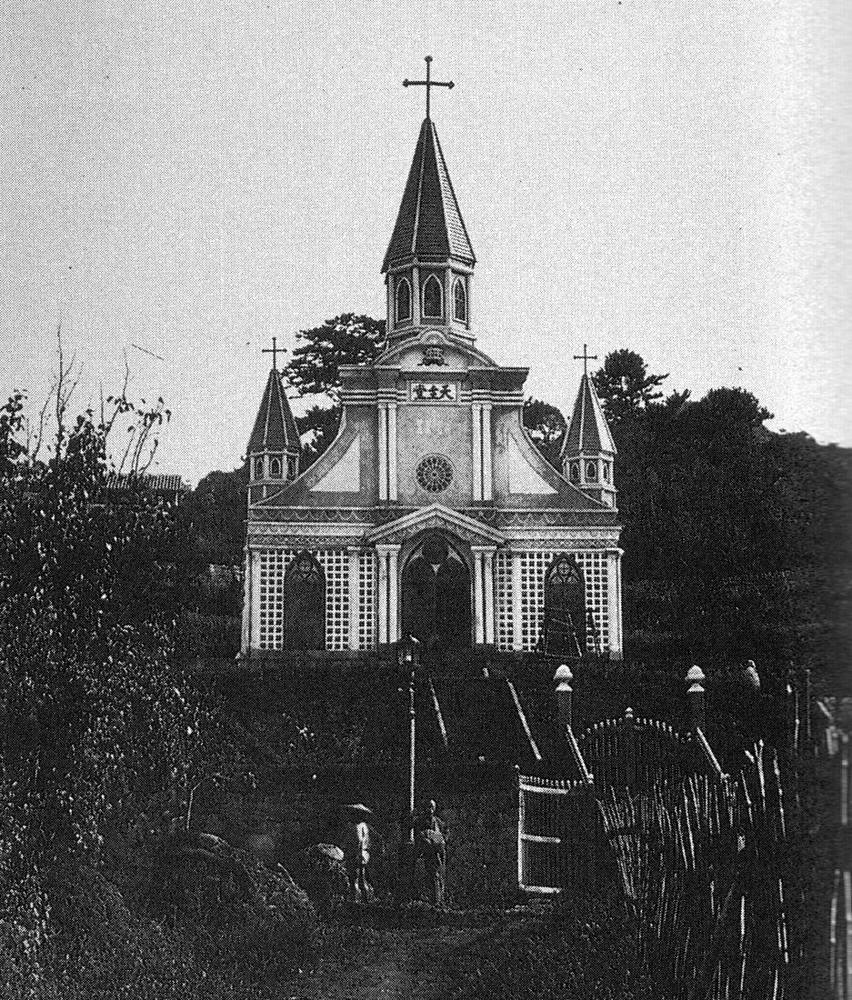
The returnees wanted a church of their own. In 1880 the estate of the , the village headmen, came up for sale. It was the house where their families had been made to tread on the fumi-e every New Year, and where the exile had been announced. On June 4, 1880, the Urakami Catholics bought it for 1,600 yen and made it a temporary church. They held their first Mass there on August 15, the feast of the Assumption.
By the late 1880s more than 5,000 believers were spilling out of its doors at Sunday Mass.
Much of the Church's growth still depended on ordinary lay workers.Catechists, often married men who could move among their neighbors more freely than foreign priests, taught the faith, while communities of sisters trained women catechists.
Churches in the villages
The end of the ban changed the landscape of western Kyushu. The communities that rejoined the Church began building in the very hamlets where they had hidden, simple at first and then grander, as priest-builders such as de Rotz in Sotome and Urakami and Father Pelu in the Gotō Islands trained Japanese craftsmen. Ōura itself was rebuilt in brick in 1879 and blessed by Petitjean, by then a bishop, on May 22, 1879.
The Church also established a national hierarchy in 1891, with an archbishop in Tokyo and dioceses at Nagasaki, Osaka and Hakodate.By 1895 Japan had twenty Japanese priests alongside eighty-eight European missionaries and 169 churches and chapels.
Marc de Rotz, a member of the Paris Foreign Missions Society, landed in Nagasaki in 1868 and printed catechisms by lithograph at Ōura. From 1879 he was parish priest of Sotome, on the coast north of Nagasaki, among the descendants of the hidden Christians. He designed Shitsu Church himself and built it in 1882. In 1883 he added a workshop to help the village women support themselves, with a macaroni factory and a sardine-net works; he imported tools and taught people to use them with drawings. In 1893 he built a small chapel at Ōno for the 26 Christian households there, of local stone set in a mortar of red earth and lime, a technique now called the de Rotz wall. The villages of Shitsu and Ōno are now one of the twelve components of the UNESCO property "Hidden Christian Sites in the Nagasaki Region".
One of the craftsmen trained in this way was , a master carpenter from the upper Gotō Islands. He learned church building from Father de Rotz and Father Pelu, and was a Buddhist who came to understand the Christian spirit through his friendship with the priests. He went on to design and build more than thirty churches.
In 1908 he built the brick church of Nokubi on Nozaki Island, laid in English bond under a roof of Japanese tiles, with a ribbed vault inside. It is the work of Japanese carpenters, taught directly by European missionaries, joining Western and Japanese techniques.
At Ōso on Nakadōri Island, finished in 1916, he banded the brick walls with courses of dark over-fired brick and crowned the bell tower with an octagonal dome.
For the altar at Egami he drew ears of wheat and a fruiting vine, for the bread and the wine, with roses for Mary; the drawing, found in 2005, is dated June 21, 1917.
About thirty of his drawings survive. They were found when his old house at Maruo was demolished, conserved in 2016, and are now shown at the Geihinkan Museum in Arikawa.
The most remarkable of his churches stands on , a small island off the Gotō coast. Work began in 1910, and the families of a small hamlet put all their strength into it for ten years until it was finished in 1919. It is built of cut local sandstone, with an octagonal dome on its bell tower, and Nagasaki Prefecture calls it outstanding among the island churches. It was designated an Important Cultural Property on November 14, 2001.
Across the water the pattern repeated. Kuroshima, an island off Sasebo, had been settled in the 18th century partly by hidden Christians from Sotome. After 1873 the whole community rejoined the Church. In 1902 they finished one of the largest brick churches in Japan, designed by Father Joseph Marmand. On Fukue, in the Gotō Islands, Marmand had built a small wooden church at Dozaki in 1880. His successor, Father Pelu, planned a brick one, which the builder Nohara Yokichi completed in 1908.
The mission's work extended beyond church construction.By 1895 religious sisters operated ten orphanages caring for about 1,500 girls, and eight Japanese communities of women religious worked in education and charity in the south.Schools and lay catechists provided much of the Church's contact with communities far from its main churches.
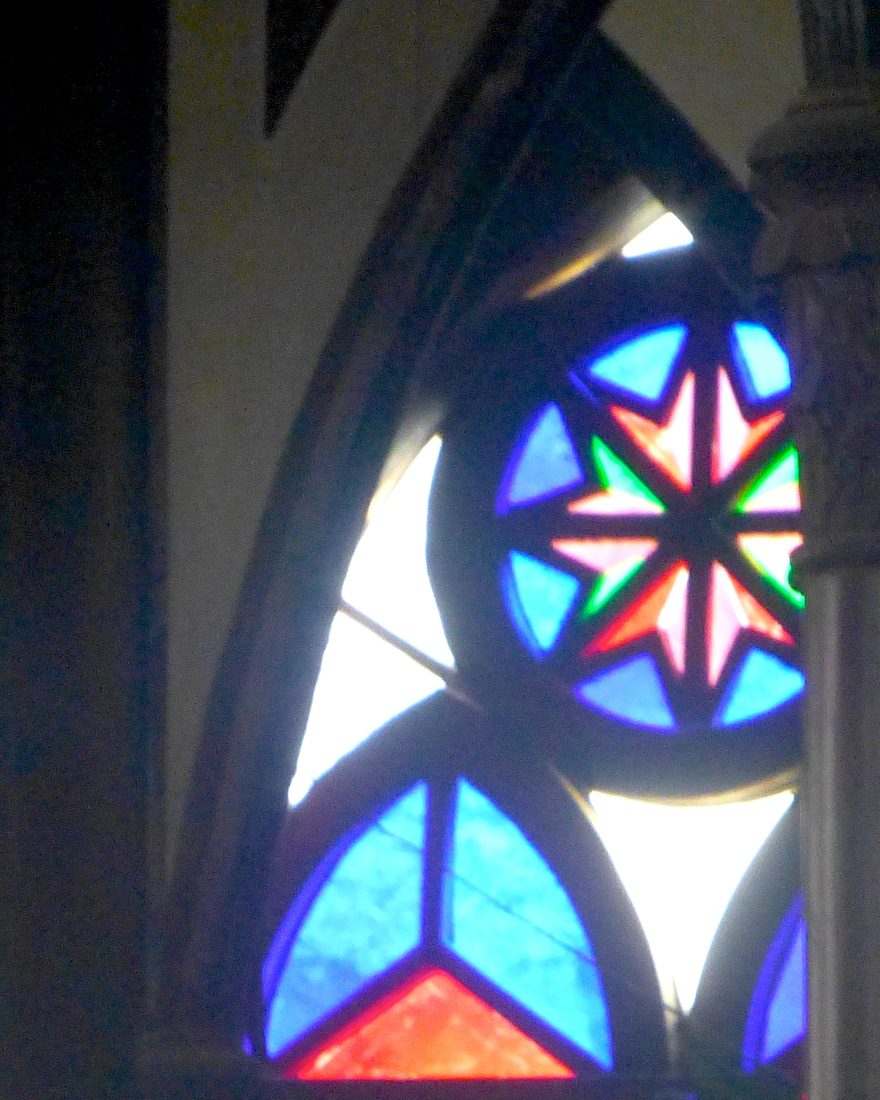
The light inside those churches changed too. Stained glass made in Japan begins with Unosawa Tatsuo, who trained in Berlin and made his first Japanese work, for the Tokyo Prefectural Office, in 1894. At Egami on Naru Island, finished in 1918, there is no true stained glass at all: believers painted cherry blossoms by hand on clear window glass.
A farmers' cathedral
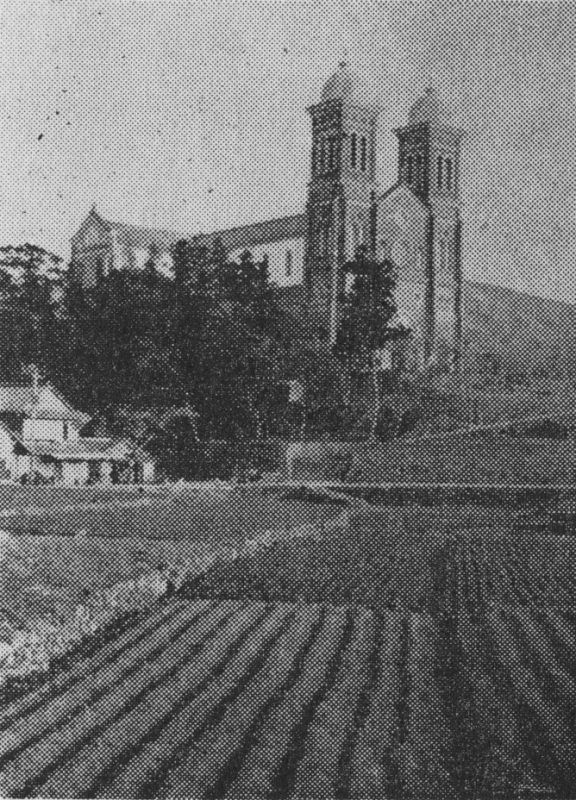
Fraineau's cathedral was begun in 1895, to his own design: a Romanesque church of stone and brick. Inflation after two wars slowed it. Fraineau gave his own money, lived in great poverty, and died of overwork on January 24, 1911, after 38 years in Japan, with the walls half built. When stone and brick were landed at the pier, believers competed to carry them up Takaya hill.
His successor, the Belgian Father Raguet, simplified the plan to finish faster. The church was dedicated to the Immaculate Conception. (sources differ) Nagasaki City and the hypocenter park plaque give 1914 for the dedication; the parish history gives March 18, 1915, the day after the 50th anniversary of the Discovery. The twin bell towers were finished in 1925, thirty years after the first stone, with bells from France.
People called it the largest church in the East. It stood on the ground of the headman's house, where the fumi-e had been trodden.
>
Catholic numbers grew from 42,378 in 1890 to 50,302 in 1895, then more slowly to 54,602 in 1900 and 59,437 in 1905.Anti-Western feeling and shrinking mission finances made evangelization harder, and rising costs led some priests to dismiss their catechists.
In September 1905, during the Hibiya riots after the Russo-Japanese peace treaty, rioters burned one Catholic church and two Protestant churches in Tokyo.Shinto, Buddhist and Christian groups then contributed to a fund for the damaged churches, distributing more than 13,000 yen in December 1906.In the Tōhoku famine of 1905, a relief committee including a Catholic missionary and five Protestant missionaries raised and spent about 100,000 yen.
A Japanese bishop
The Church in Japan was becoming Japanese. In 1927 the Diocese of Nagasaki was placed under Japanese leadership, and on October 30 that year Pope Pius XI consecrated in Rome as the first Japanese bishop.
The Japanese hierarchy had been established in 1891, and by 1908 the Church counted thirty-three Japanese priests, twenty-six of them in the Nagasaki diocese.The country had 217 churches and chapels that year, including 122 in the Nagasaki diocese.
Sixty students at Yasukuni
But the conditions written into Article 28 were tightening. The government promoted shrine Shinto as a patriotic duty and called it civic rather than religious. On May 5, 1932 Colonel Kitahara Hitomi, the army officer assigned to , the Jesuit university in Tokyo, marched about sixty preparatory students to , the shrine to Japan's war dead. When the command came to salute the war dead, two students, perhaps three, did not present arms.
The army made it a test. In June the Ministry of Education was told that the army was recalling its officer, because "the spirit of Sophia University did not fall in line with the principles of Japanese education." Archbishop Chambon of Tokyo asked the ministry what the bow meant. On September 30 the vice minister replied that it had "no other purpose than that of manifesting the sentiments of patriotism and loyalty."
The shrine question had occupied the missions well before the Sophia incident: in 1917 Rome sent the apostolic delegate from Manila to Japan to help address it.The 1924 provincial synod in Tokyo also planned a major seminary and regular meetings of the country's bishops.
Under watch
Elsewhere the pressure was harsher. On Amami Ōshima a local campaign in the 1930s closed the Catholic girls' school, drove out the Church's workers and forced most believers to renounce their faith. The Religious Organizations Law of 1939 placed every religion under state control. It required each religious body to submit its doctrines to the Ministry of Education for approval, so that religion could be mobilized for the national cause.
The pressure on religious bodies intensified after the Manchurian incident of 1931 and the government's campaign to define the national polity in 1935.Catholic schools and welfare institutions continued to operate, but the Church generally avoided political activity.
The ministry at first demanded that Catholics cut their tie with the Pope, then backed down after protests. Western bishops were replaced by Japanese ones, Western heads of Catholic schools gave way to Japanese, and in May 1941 the Church was reorganized as a single body, the Nippon Tenshu Kōkyō Kyōdan, under Archbishop Doi Tatsuo of Tokyo. The historian Hamish Ion judges that Doi, like some Protestant leaders, became a mouthpiece for wartime propaganda, while groups that would not conform, above all the Holiness churches, saw pastors jailed.
By the outbreak of the Pacific War in 1941, ordinary missionary activity had effectively ceased and the Catholic missionary journal Actio Missionaria stopped appearing.Some wartime advocates of a distinctively Japanese Christianity attempted to interpret Christianity through imperial and Shinto concepts.
New Catholics came from outside the old communities, too. Nagai Takashi, born in Shimane in 1908, graduated from Nagasaki Medical College in 1932; an ear infection ended his plan to practice internal medicine, and he turned to radiology. In June 1934 he was baptized with the name Paul, and in August he married Moriyama Midori, from an Urakami Christian family. In July 1937 he went to China as an army doctor and came home in 1940 to head his department. In June 1945 he learned he had leukemia and was given three years to live.
The farmers' cathedral was still standing on Takaya hill. On the morning of August 9, 1945, a priest sat in its confessional hearing confessions before the feast of the Assumption.