Two priests and a carpenter
On 22 January 1863 Father Louis Furet of the Paris Foreign Missions Society arrived in Nagasaki to build a church. Finding land was hard: merchants had already filled the foreign settlement. With help from the Nagasaki magistrate, he secured a plot beside the Ōura Minamiyamate settlement and began raising money and levelling the ground. 1
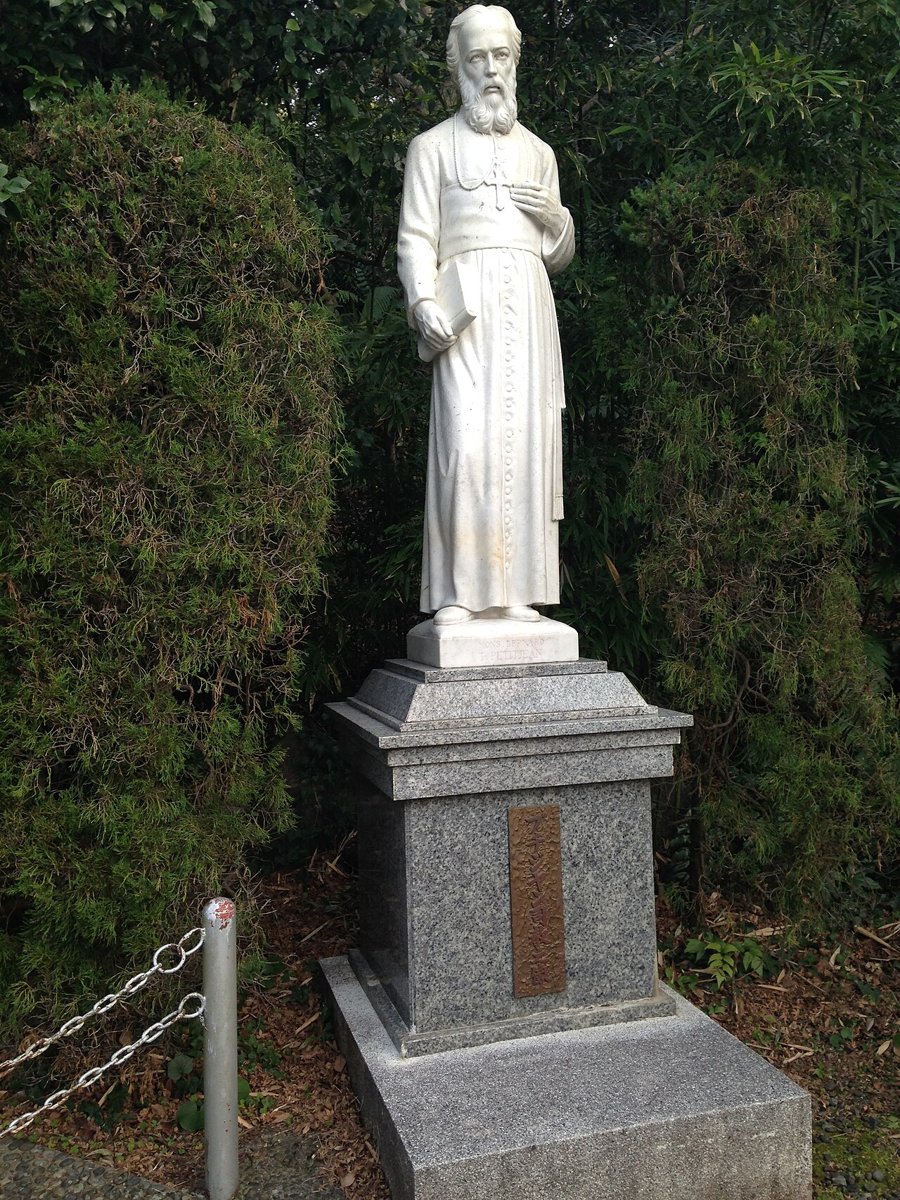
Father Bernard Petitjean arrived in early August. His heart was elsewhere: he wanted to find the place where the 26 Martyrs had died in 1597, and to find the descendants of Japan's first Christians. Still, about two months later the design was almost complete. 1 Nagasaki City's cultural property record names the two priests as the design directors (設計指導). 2
The builder was a Japanese master carpenter. Around January 1864 Father Prudence Girard, head of the mission, came from Yokohama and signed a contract with 小山秀之進 (Koyama Hidenoshin), master carpenter, and his elder brother 小山良輔 (Koyama Ryōsuke), both from Amakusa in Kumamoto. 1 The city record gives the builder's name as 小山秀 (Koyama Hide), the name he used later. 2
A building race
The Koyama family were also contracted to expand the foreign settlement at the same time, and the church stalled while Petitjean struggled to pay. The magistrate's office then asked Petitjean to teach French at its language school. He said he was too busy with the church. The office answered by sending more craftsmen, and the work sped up. 1
The church was completed on 29 December 1864. On 19 February 1865 Girard dedicated it to the newly canonized 26 Martyrs of Japan. Captains of French, British, Dutch and Russian ships attended with their men and fired salutes. The magistrate, invited by the French consul, sent a deputy. The crowds of curious townspeople who had watched the building go up were absent, probably because the magistrate's office had forbidden visits. 1
What it looked like
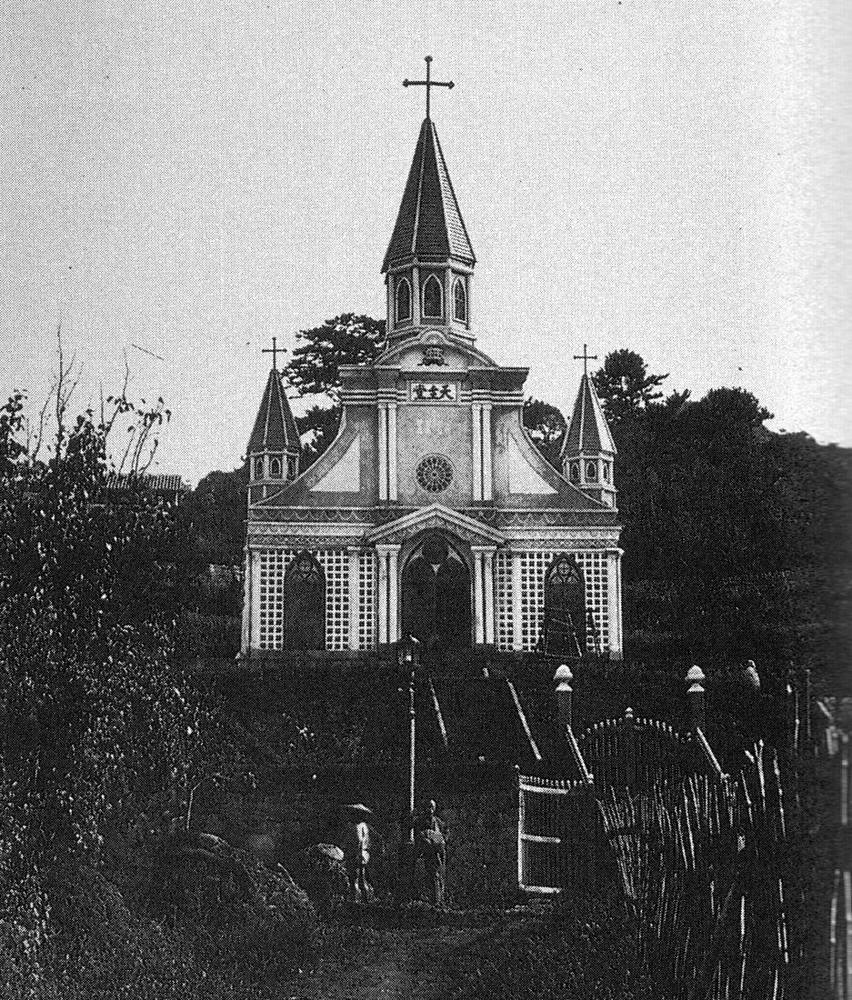
The photograph in slide 7, labelled on Commons as "創建当時の大浦天主堂" (Ōura Church at its founding), shows that first building. 7 The prefecture's description lists what you can see: a small church of three aisles, with a Gothic pointed roof, two smaller towers and one larger, each topped with a golden cross. 3 Church Trust calls the original a mix of classical, Gothic and Japanese styles. 1 Its outer walls were wood. 2
It did not last long in that form. Strong winds soon brought down the two side towers. 3 The church was also too small for the believers who now came openly. 1
The rebuilding of 1875 and 1879
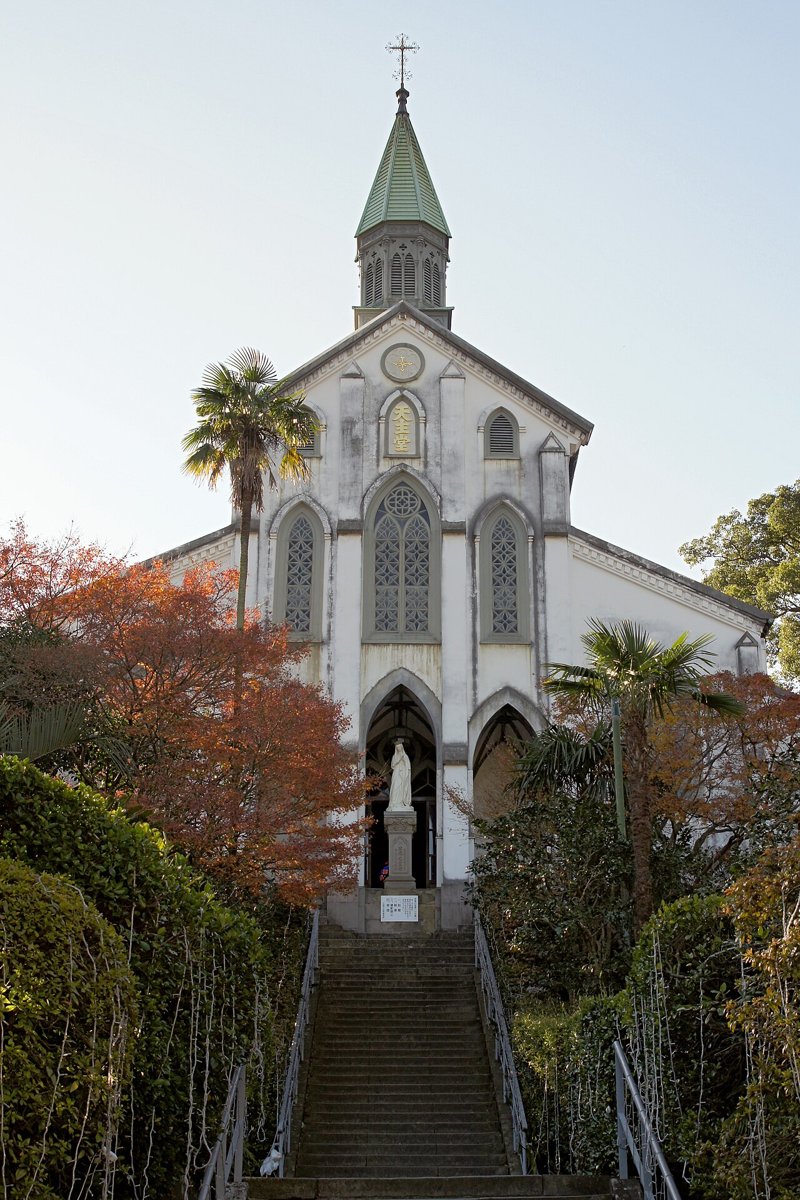
Ōura was enlarged in 1875 and again in 1879, and its plan and exterior changed; the outer walls went from wood to brick. 2 Church Trust describes the 1879 work, led under Fathers Poirier and de Rotz by the Urakami master carpenter 溝口市蔵 (Mizoguchi Ichizō) and the Amakusa carpenter 丸山佐吉 (Maruyama Sakichi). The walls were taken down and the church extended by about 6 m at the front, 2 m on each side and 3.6 m at the back, doubling its area. The new walls were brick finished in white plaster, and the whole building became uniformly Gothic. Petitjean, by then a bishop based in Osaka, blessed it on 22 May 1879. 1 Ōura is the only five-aisled church in Nagasaki Prefecture, with its distinctive octagonal spire at the center of the front. 3
Yet the heart of the first church survived. Nagasaki City notes that the main interior space keeps its original form, 2 and Church Trust records that the nave roof stayed at its original height. 1
Why it matters
Nagasaki City's record sets it in context. After the treaties of the 1850s opened Japan's ports, a foreign settlement was laid out at Nagasaki, and Ōura was built inside it for resident foreigners, dedicated to the 26 Martyrs who had only just been canonized. A few weeks later it became the stage of what the city calls the dramatic Discovery of the Christians, without parallel in the religious history of the world. 2 Notethat last phrase is the city's own praise, not a measured claim.
Church Trust calls Ōura the oldest surviving church building in Japan. The Yokohama church built by Girard in 1862 came first, but it was moved and rebuilt in 1906. 1 Ōura became a National Treasure in 1933 and, after repairs to bomb damage, was re-designated on 31 March 1953. 1,2 It served as the bishop's church for Nagasaki until the cathedra moved to Urakami in 1962, and a new parish church was built beside it in 1975. 1
The small wooden church of slide 7 is the room where the question "Where is the statue of Santa Maria?" was asked. 1