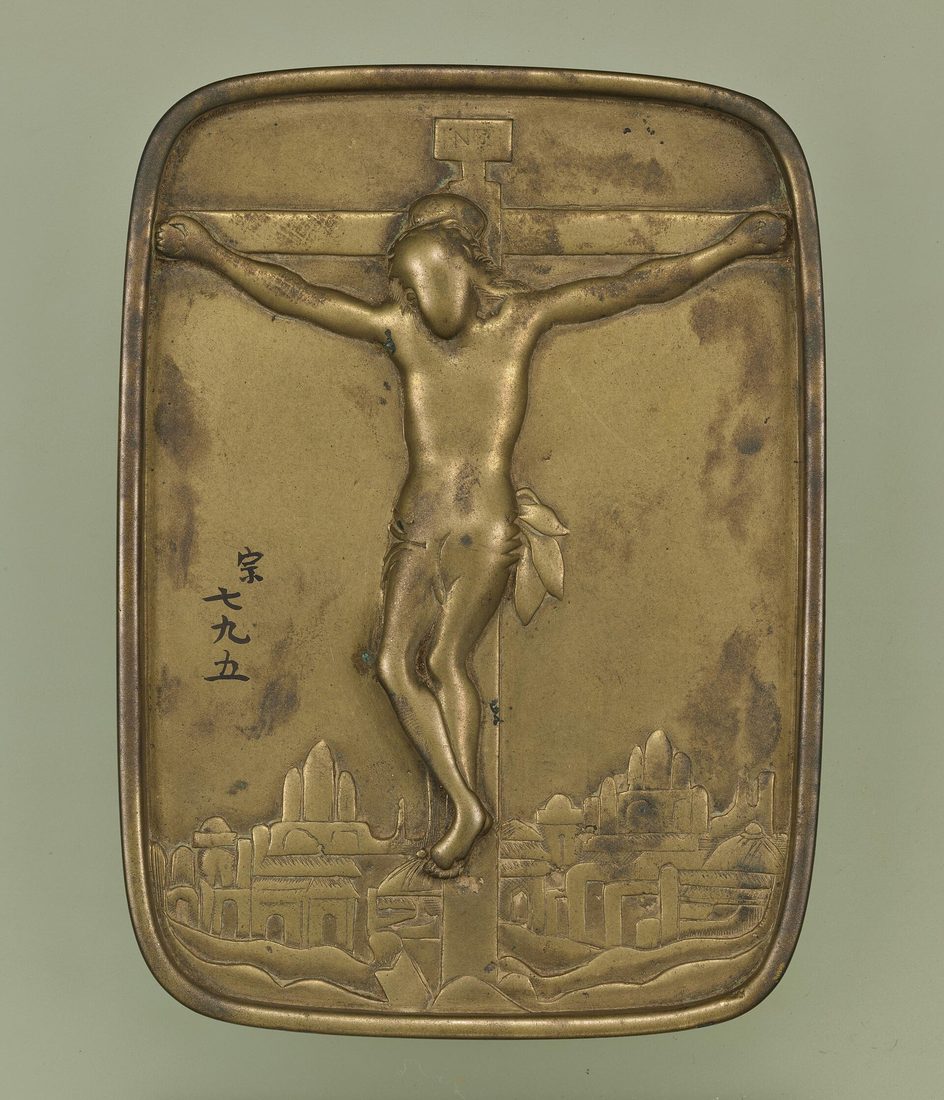
Every New Year, the villagers of , a farming valley just north of Nagasaki, were summoned to the house of the village headman, the . There, one by one, they stepped on an image of Christ or Mary. Many did it while silently praying the , a prayer of sorrow for sin. They trod on the face they loved and asked forgiveness in the same moment.
Miyazaki Kentarō thinks that yearly wound changed the faith itself. After the treading, believers repeated the prayer of contrition, and over time their devotion moved away from God as a strict father and judge toward Mary, mother and forgiver.
How did a faith live like that, not for a year or two, but for more than two hundred? The answer has two halves: a state that built a net over every household in Japan, and laypeople who found a way to live inside it.
The great persecution
The began what Miyazaki calls a savage persecution. Missionaries and believers who were caught and would not renounce their faith were killed. Forty-four died in Arima in 1614; fifty-two were burned in Kyoto in 1619; fifty-five died at Nishizaka in Nagasaki in 1622; sixteen were killed in the boiling springs of Unzen in 1627.
The first executions, beheading, crucifixion and burning, moved the onlookers and made the martyrs admired rather than feared, so the authorities turned to torture designed to break people. The worst was the pit: the victim was hung upside down in a hole in the ground, kept dark to frighten the mind as well as the body. In 1633 the Jesuit Cristóvão , the highest-ranking Jesuit in Japan, renounced his faith while hanging in the pit at Nishizaka. He was given a Japanese name and wife and made to help interrogate Christians. The news shocked the whole country.
The count of martyrs whose names, places and circumstances are known reached 4,045. Those of whom nothing is known may have numbered as many as forty thousand, and at Nishizaka alone 660 died. Note: the forty thousand is an estimate quoted by Miyazaki, not a count. In 1644 the last priest still in Japan, the Jesuit Mantio Konishi, was killed. From then on, Miyazaki writes, "the faithful had to maintain their faith on their own, while outwardly pretending to be Buddhists."
Shimabara and the closed country
In 1637 farmers in Shimabara and Amakusa rose against crushing land taxes. These had been the domains of the Christian lords Arima Harunobu and Konishi Yukinaga, and most of the people were Christian. Led by the young Amakusa Shirō, more than twenty thousand people held out in the ruined castle at until the next year, when the siege ended in their destruction.
The shogunate drew its own lesson. In 1639 it banned Portuguese ships from landing, and in 1641 it moved the Dutch trading post from Hirado to Dejima, a small artificial island in Nagasaki harbour. From then on Japan traded through Nagasaki with Holland and China alone.
A net over every household
The third shogun, Tokugawa Iemitsu, built the system that would outlast him by two centuries. Miyazaki lists its parts.
- Rewards for informers, introduced in Nagasaki in 1619 and later nationwide. The notice board of 1682 offered 500 pieces of silver for a priest and 100 for an ordinary believer.
- The five-household group, combined with the reward system in 1642 so that finding Christians became a collective duty. If a neighbour from another group exposed a Christian among you, the whole group could be punished.
- Temple registration (), from 1635: every family had to be vouched for by a Buddhist temple.
- The . From 1628 people were made to tread on an image of Christ or Mary. some sources give 1629. In 1669 the Nagasaki magistrate had twenty brass plaques cast for the purpose; nineteen survive at the Tokyo National Museum. In Nagasaki the treading became a New Year event, done street by street.
Miyazaki points out that these tools controlled ordinary people, not only Christians, and that they lasted until the end of the shogunate. The notice boards stayed up until 1873.
The keepers
So how did anything survive? The answer begins before the ban. In the Christian century the missionaries had organised lay confraternities, starting with a misericordia in Yamaguchi in 1554, each with its own officers. When the priests were gone, these groups became the means of passing on the prayers and the rites.
In , Urakami and the Gotō Islands, each hidden community had a , who kept the church calendar and led most rites; a , who baptised; and elders. Baptism was what kept the community going from one generation to the next, so the baptiser's office counted as the highest and carried the most taboos.
They kept prayers, the (from Latin oratio), passed on by mouth for some 230 years, because a written copy could cost a life. Some are in Latin; many Japanese prayers are full of Latin and Portuguese words. On Island one sung prayer, Gururiyōza, carries the words and tune of the Marian hymn O gloriosa Domina as printed in Spain in 1553.
They kept a calendar. In Nagasaki, Sotome and Gotō the hidden Christians kept the feasts by a church calendar for the year 1634, converted to the lunar calendar, which opened each year with the Annunciation. : it was handed down by , a Japanese catechist of Sotome, and is called "Bastian's calendar". Remember Xavier's calendar of 1550 in Chapter I: the idea of a priestless year of feasts had come with the first mission.
They kept hope. Tradition says that Bastian left prophecies before he was martyred: after seven generations a confessor would come on a great black ship, and Christians would be able to sing their prayers aloud anywhere.
And they kept their teachers. At Karematsu, a hilltop in Sotome, the Kurosaki hidden Christians gathered in secret to pass on the orashio. In the Meiji era they built a small shrine there to San Jiwan, the foreign teacher of Bastian, surrounded by Christian graves with flat stones laid face down. Nagasaki City notes that Shinto shrines to Christians are rare anywhere in Japan. San Jiwan's identity and story are handed down in the community.
Mary in the guise of Kannon
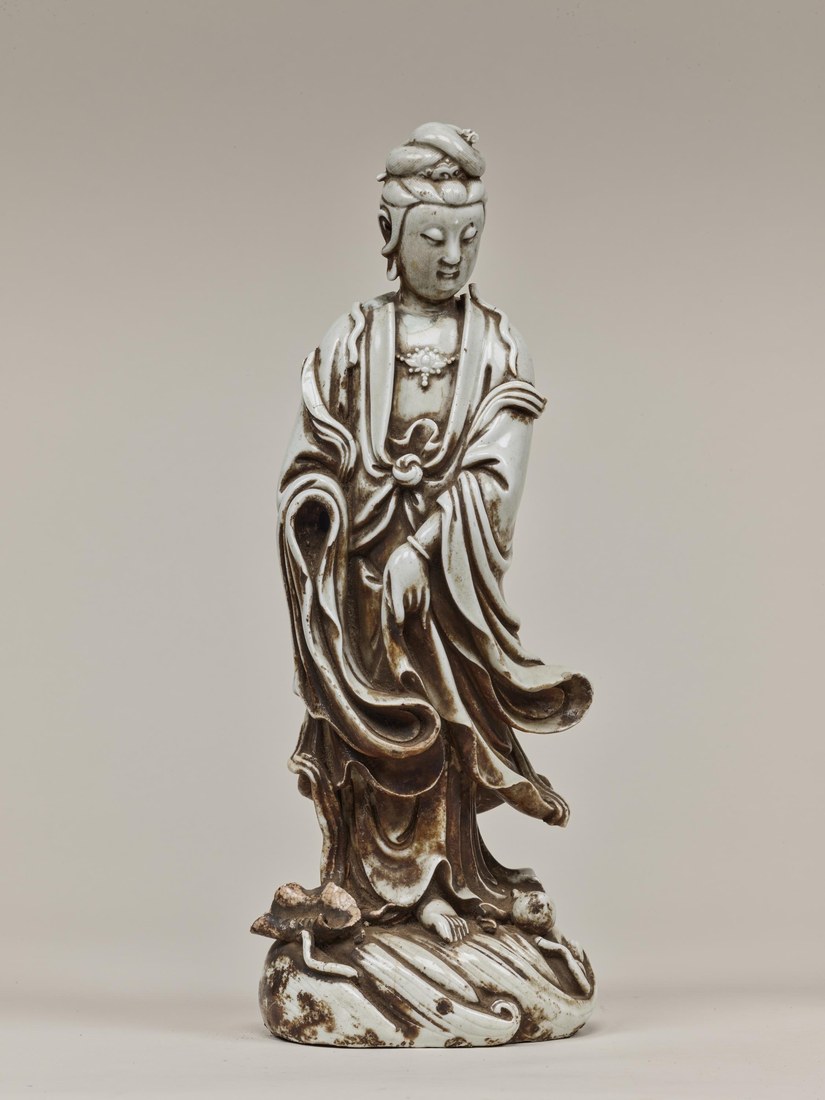
Owning a statue of Mary was dangerous, so families prayed before white or blue Chinese porcelain figures of Kannon, the Buddhist bodhisattva of mercy. To them she was Mary. When Urakami was questioned late in the Edo period, believers named "", Santa Maria, as their principal image.
One such figure can still be seen. In the Tokyo National Museum is a standing white porcelain Kannon, Dehua ware from 17th-century China, that belonged to , a leader of the hidden Christians of Urakami, and was seized in 1856. The museum's note says it is believed to correspond to the "Hantamaruya" named in the arrest record. Note: that identification is the museum's careful "believed", not a certainty.
Kuzure: when the net closed
Hiding did not always work. From time to time came what were called , "collapses", the discovery of a whole hidden community. In 1657 at Kōri village in Ōmura domain, 608 people were arrested. Miyazaki's two chapters in the same handbook give the number beheaded as forty-one and as 411. In Ōmura, graves were dug up and bones thrown into the sea.
By the end of the shogunate the response had changed. In Amakusa in 1804 hidden Christians were discovered at Sakitsu and three nearby villages, because people had been seen killing cattle and offering the meat at their Buddhist altars, and worshipping images unlike any Buddha. In 1805 more were found at Takahama, and 5,205 people in the four villages were taken up; at Sakitsu alone, 1,709 of 2,401 villagers. Instead of torture they were told to throw their devotional objects into a box set up in the grounds of Sakitsu's Suwa Shrine. The domain, after consulting the shogunate, ruled that they had followed an "alien sect" in error rather than Christianity, and on 12 September 1806 the ruling was read out to the villagers: they had repented, so they would be treated leniently, but any future error would be punished severely.
Urakami was raided in 1790, again around 1839 to 1842, and again in 1856. After the 1856 raid, a man named was the only baptiser left. One man held the sacrament for a whole valley.
Black ships
In 1858 the shogunate signed trade treaties with five Western powers, and the next year it opened the ports of Hakodate, Yokohama and Nagasaki. French priests of the Paris Foreign Missions Society came with them. In 1863 Louis Furet and Bernard Petitjean reached Nagasaki, and on the hill at Ōura, facing Nishizaka where the martyrs had died, they built a church dedicated to the .
It was finished at the end of 1864. A few months later, a group of farmers from Urakami would walk through its door. Seven generations, as the prophecy counted them, had passed. That story is Chapter III.