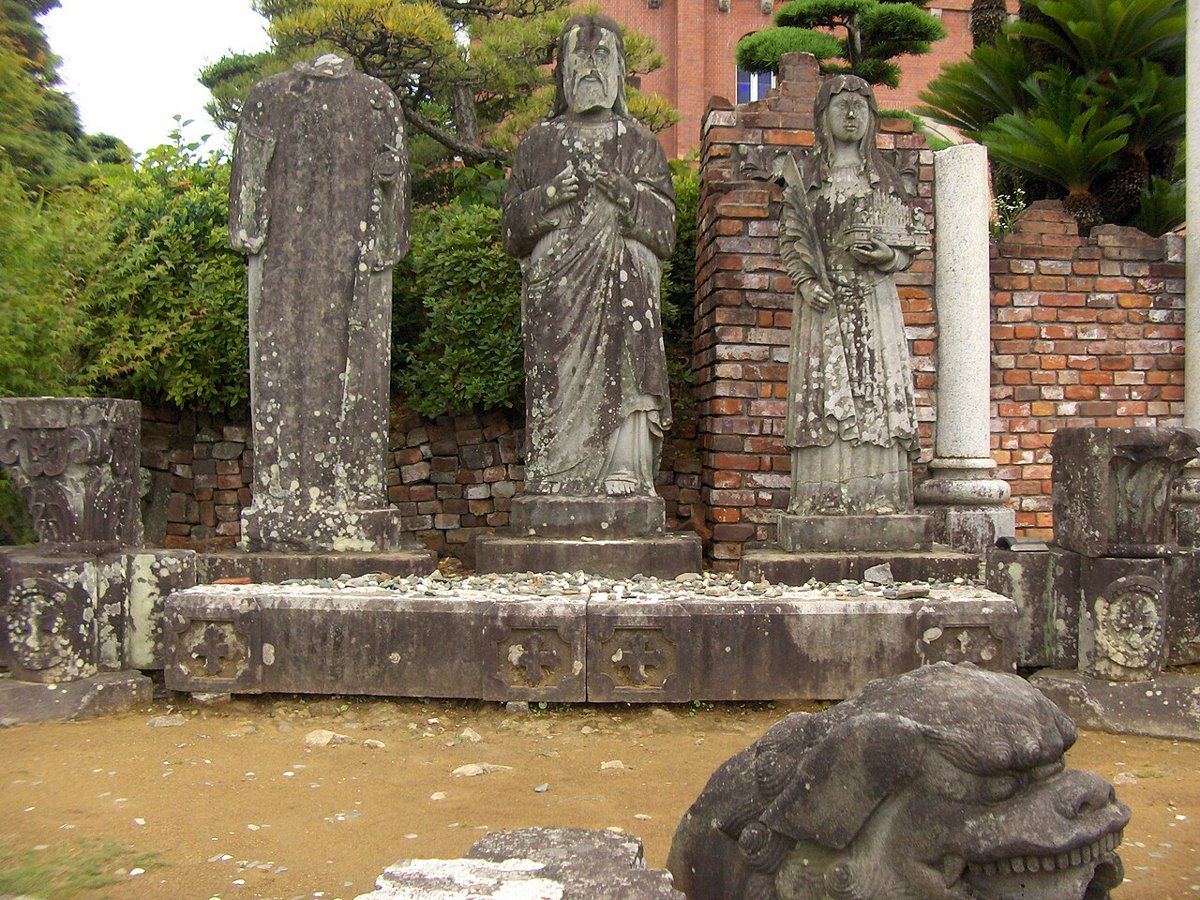
A prayer on a stone
In October 1945, a newly demobilized soldier walked up the hill to what was left of Urakami Cathedral. He was a priest, a Trappist monk from Hokkaido named 野口嘉右ェ門 (Noguchi Kaemon), born in Urakami. Before going back north to his monastery he wanted something, anything, from the church where he had grown up. He searched the area around the altar and the confessionals for about an hour and a half and found not even a piece of glass. 1
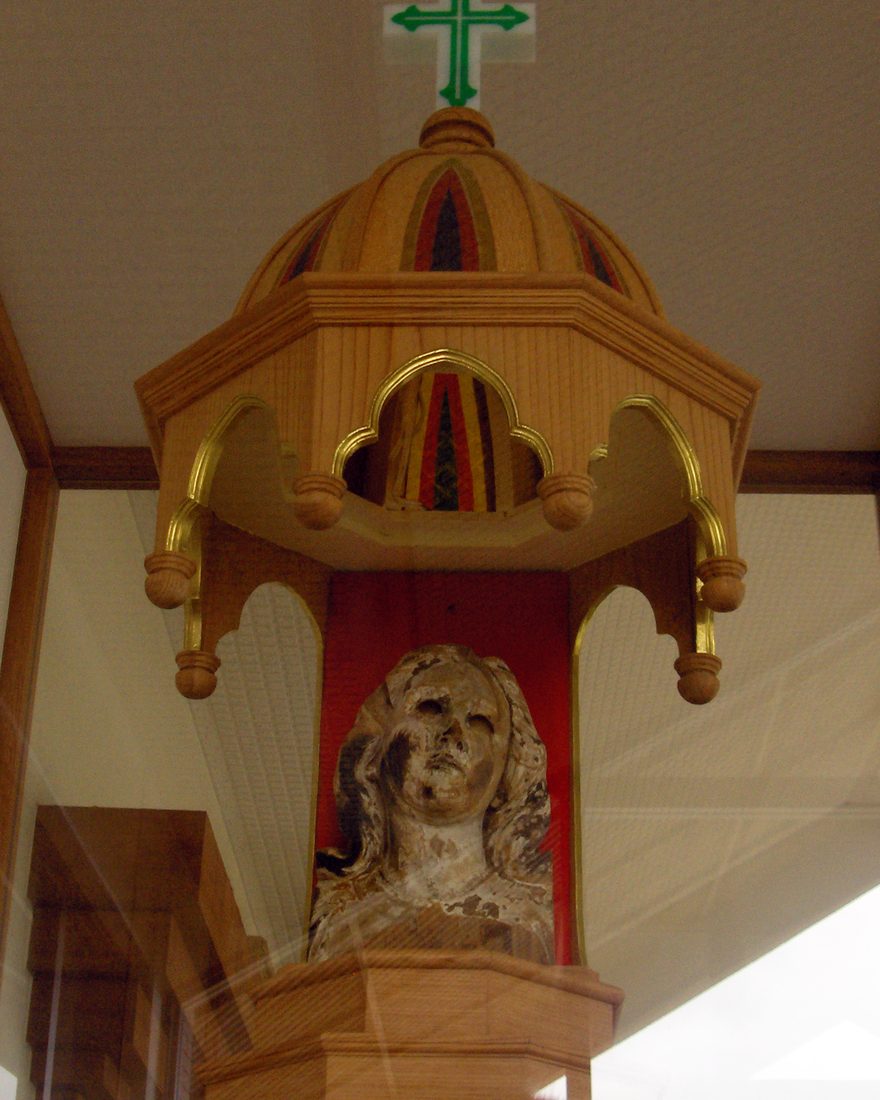
He sat down on a stone and repeated the prayer he had said when he left for the monastery as a young man: wherever I am, protect and help me. Then he asked for one small thing. In his own words, written decades later: "I prayed in silence for a while. When I opened my eyes, the face of Our Lady, burned completely black, was looking at me with sad, fond eyes." He cried out for joy and ran home holding it. 1
That head is the object in slide 10.
The statue before the bomb
Noguchi remembered the statue arriving when he was twelve or thirteen: a figure of Mary sent from Italy, placed high above the altar near the ceiling. He was so drawn to it that, before leaving for the Trappist monastery in 1929, he knelt before it to say goodbye. 1 By the time he came back as a soldier in 1943-45 the altar had been rebuilt and the statue stood at its center. 1
Disputedthe parish history describes the Immaculate Conception above the main altar as a wooden statue from Spain, not Italy. 2 Both sources agree it was wooden and stood above the main altar. 1,2
Thirty years on a desk
His mother, seeing it, told him in Nagasaki dialect that this was a great grace from Mary and that he must take it to the monastery and pray hard. Later, when Bishop Urakawa of Sendai visited the Trappists and saw it, he told Noguchi he had found the greatest treasure: had he not, it would probably have been thrown out with the rubbish. 1 Father Kawazoe added that some other altar objects seem to have been taken home by American soldiers. 1
Noguchi took the head back to the Trappist monastery in Hokkaido. For about thirty years it sat on the desk in his room, and he prayed before it. 1 Around 1975, a Hokkaido newspaper made the story known. He brought the head to Nagasaki for the 30th anniversary events at Urakami and entrusted it to a teacher named Kataoka, asking that it be returned to the church. 1
The Nagasaki Shimbun fills in what followed. From 1975 the Junshin women's junior college (now Nagasaki Junshin Catholic University) kept it. In 1985 it was shown at an atomic bomb exhibition at the Vatican, where Pope John Paul II saw it. In 1990 it went back to Urakami Cathedral, where at first it sat among other bombed objects in the believers' hall. 3 Unverifiedwe assume Noguchi's "Kataoka" is Kataoka Chizuko, later president of Junshin, whom the paper quotes; neither source says so.
From storeroom to symbol
For years few people paid attention. The turn came in 1998, when the painter Hirayama Ikuo included the bombed Mary in a book of paintings and essays, and it made the front page of a national paper. 3 In 2000 it was shown in Belarus, a country hit by Chernobyl. 3
For the 60th anniversary of the bombing in 2005, an existing small chapel on the south side of the cathedral was renovated as the Hibaku Maria chapel. At the believers' suggestion, its altar and ceiling recreate the prewar cathedral. The parish priest who proposed it, Father Hirano Isamu, said that when he arrived the head was being kept in the priests' house, and he wanted it out in public. 3 The chapel window, designed by Sister 佐藤ヒロ子 (Satō Hiroko), shows lilies and the ruined old church, with half-melted kiln-fired glass for its bricks; it was made by Ikuta Glass of Osaka during Father Hirano's time. 4
In April 2010 a pilgrimage carried the head to Guernica, beside a Basque statue of Mary that had also lost all but its head to bombing. In May 2010 Archbishop Takami took it to New York during the Non-Proliferation Treaty review conference, the first time it had been to the country that dropped the bomb. 3
Why this image matters
The question in slide 1 was "Where is the statue of Santa Maria?" In October 1945 it was in the ashes of the church the Urakami believers had built. One of their own sons found her face. 1