A street full of strangers
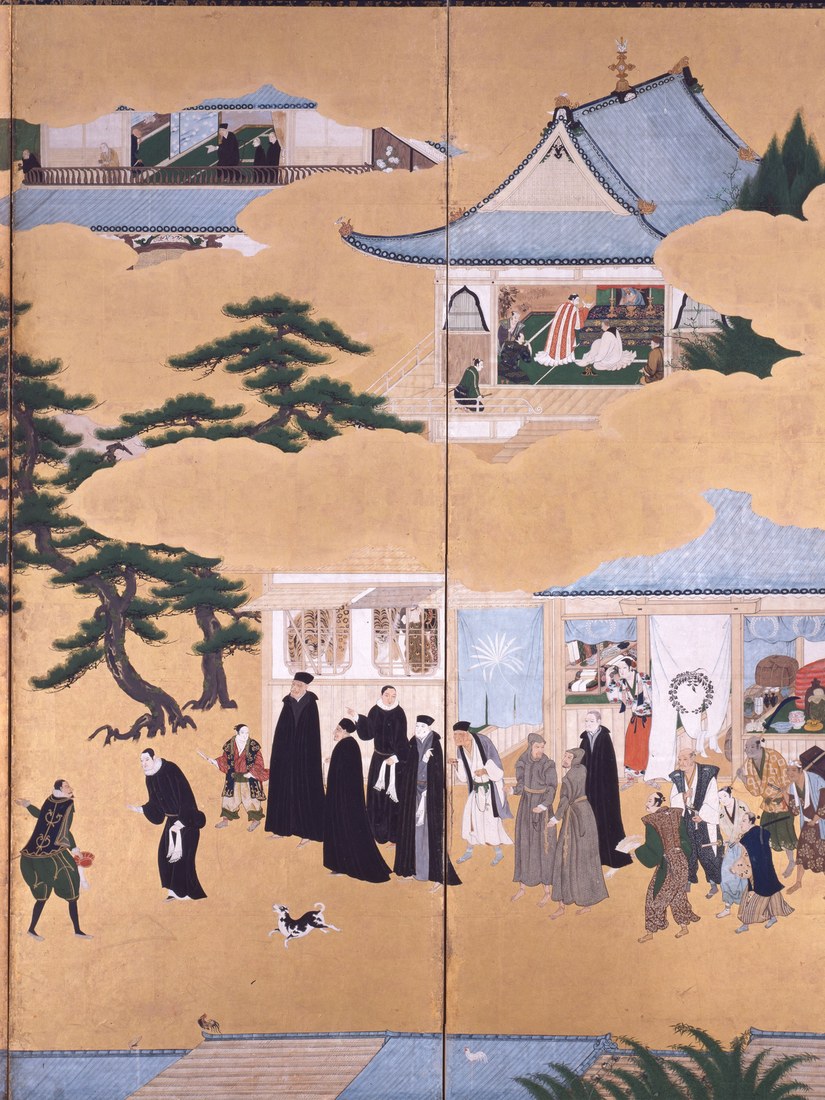
The slide shows the right-hand end of a gold screen. Black-robed men in wide hats stand in a knot in front of the shops. Others in grey habits and rope belts walk among them, and a Japanese crowd presses in from the right. Above the gold clouds rises a building with a curved Japanese roof, and inside it figures gather before an altar. 1,3
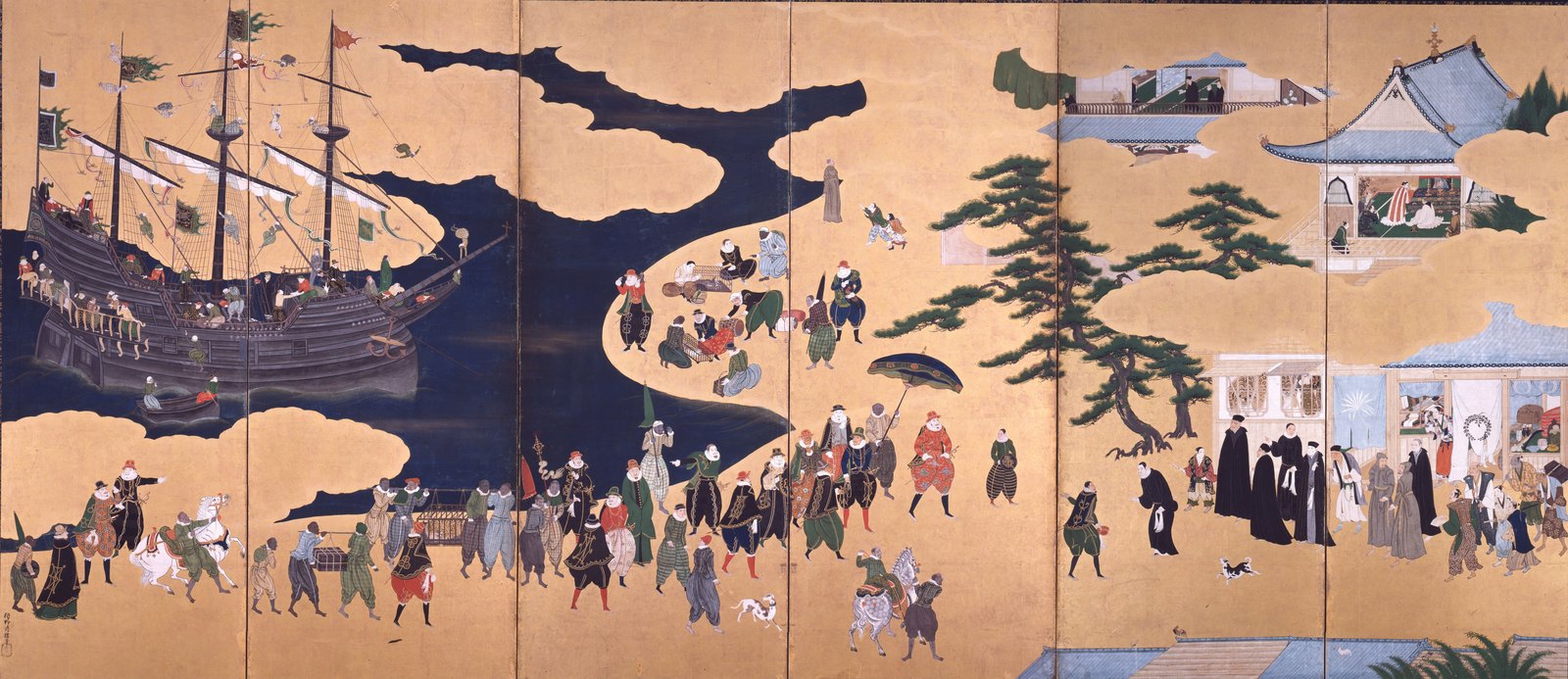
Kobe City Museum describes exactly these people. On the right-hand screen a Nanban ship has arrived at a Japanese port after its voyage. Goods are being unloaded, the captain's party has landed, and they are met by Jesuit missionaries, Franciscan friars and Japanese believers. 1 Unverifiedwe read the figures in black as the Jesuits and those in grey habits as the Franciscans; the museum names both orders but does not say which figures are which.
What "Nanban" meant
"Nanban" first meant "southern barbarians" in Chinese, a word for foreign lands to the south. In Japan it came to mean the foreigners who arrived by ship from the southern seas, and once the Portuguese began coming in earnest in the mid 16th century, Europeans were the people it described. 5,3 Screens showing their voyages, their trade and their faith are called Nanban screens, and more than 90 are known worldwide. 1,5 Kobe City Museum thinks they began to be painted in earnest after Toyotomi Hideyoshi's conquest of Kyushu. 5
The trade they show was concrete and local. The first Portuguese ship reached Nagasaki in 1571, and in 1580 the Christian lord Ōmura Sumitada ceded Nagasaki to the Jesuits. 6 Unverifiedthe screen does not name its port, and we have found no source that identifies it as Nagasaki.
Trade and faith in one picture
The museum points to the shop behind the captain's party, a karamonoya selling imported goods: tiger and leopard skins, silk cloth and ceramics. Behind that shop stands the Nanbanji, the "southern barbarian temple", where a rite is under way before an altar bearing an image of the Saviour. 1 The national designation text is more specific: in the Christian building at the right of the right-hand screen, a priest holds up the host toward an altar adorned with a sacred image. It is a Mass. 2
That placement is the point of the picture. The museum says the screens show the real nature of the Nanban trade, which was mostly carrying trade between other ports, and in which commerce and mission were bound together. 1 The same ship that brought silk brought priests, and the church sits in the same street as the shop.
The painter
Most Nanban screens are unsigned, so even the school of the painter is usually unknown. 2 This pair is different. Each screen carries the signature "Kanō Naizen hitsu" (painted by Kanō Naizen) and a seal reading "Naizen". 1,2 Five Nanban screens with Naizen's signature are known. 1
Kanō Naizen (1570 to 1616) was the son of a retainer of Araki Murashige, lord of Itami Castle in Settsu. When Oda Nobunaga destroyed the Araki house, the boy entered the service of the painter Kanō Shōei, became a painter, and was allowed to use the Kanō name. He later worked as an official painter to the Toyotomi family and painted the Hōkoku Festival screens, now an Important Cultural Property at Toyokuni Shrine in Kyoto. 1
Disputedthe exact date. The designation text explains that the screens must date from between Naizen's adoption of that name and his death in 1616. Comparing them with the Hōkoku Festival screens, dedicated in 1606 and somewhat older in style, it places them in the later Keichō years, while stressing that a precise date cannot be known. 2 Google Arts and Culture gives 1598 to 1615, and the Commons file title says "c1600". 3,4
How they were painted
The designation text praises the craft. Among Nanban screens, most of which show European ships inaccurately, this ship is considered relatively accurate. Thick foreign clothing is built up in raised pigment, and glossy ink is used to suggest velvet. The same almost craft-like precision runs through the architecture. 2 Kobe City Museum adds the exotic animals, among them an elephant, Arabian horses and greyhound-type dogs, and calls the pair outstanding among all Nanban screens for its detail, lively figures and bright colour. 1
The left-hand screen, not shown in the slide, imagines the foreign port the ship sails from: Chinese-looking buildings with auspicious clouds, dragons, jewels and domes. The museum thinks Naizen combined many earlier images of foreign lands to paint a port he had never seen. 1
From Nara to Kobe
The museum records the chain of owners: Uemura Kōsaku of Nara; bought in 1932 by the collector Ikenaga Hajime; from 1951 the Kobe Municipal Art Museum; from 1965 the Municipal Museum of Namban Art; and from 1982 Kobe City Museum. 1 It was designated an Important Cultural Property on 15 June 1995. 2 Ikenaga also bought the Kobe portrait of Francis Xavier, in 1935, and both now hang in the same museum. 1,7
Why this image belongs here
The Xavier portrait in slide 3 shows how the mission began. This screen shows what it looked like at its height: open, commercial, and in plain sight, with a church in the middle of a harbour street. 1,2 Within a few years of Naizen's death, that open church would be gone; the shogunate banned Christianity across Japan in 1614 and tore down the churches. 6