A chest that was never opened
In the hills of Sendaiji, in what is now Ibaraki City, Osaka, the Higashi family kept a chest that nobody opened. Its name says it all: the akezu no hitsu, "the chest that must not be opened". It was found tied to a roof beam of the main house. In September 1920 it was opened at last. 1
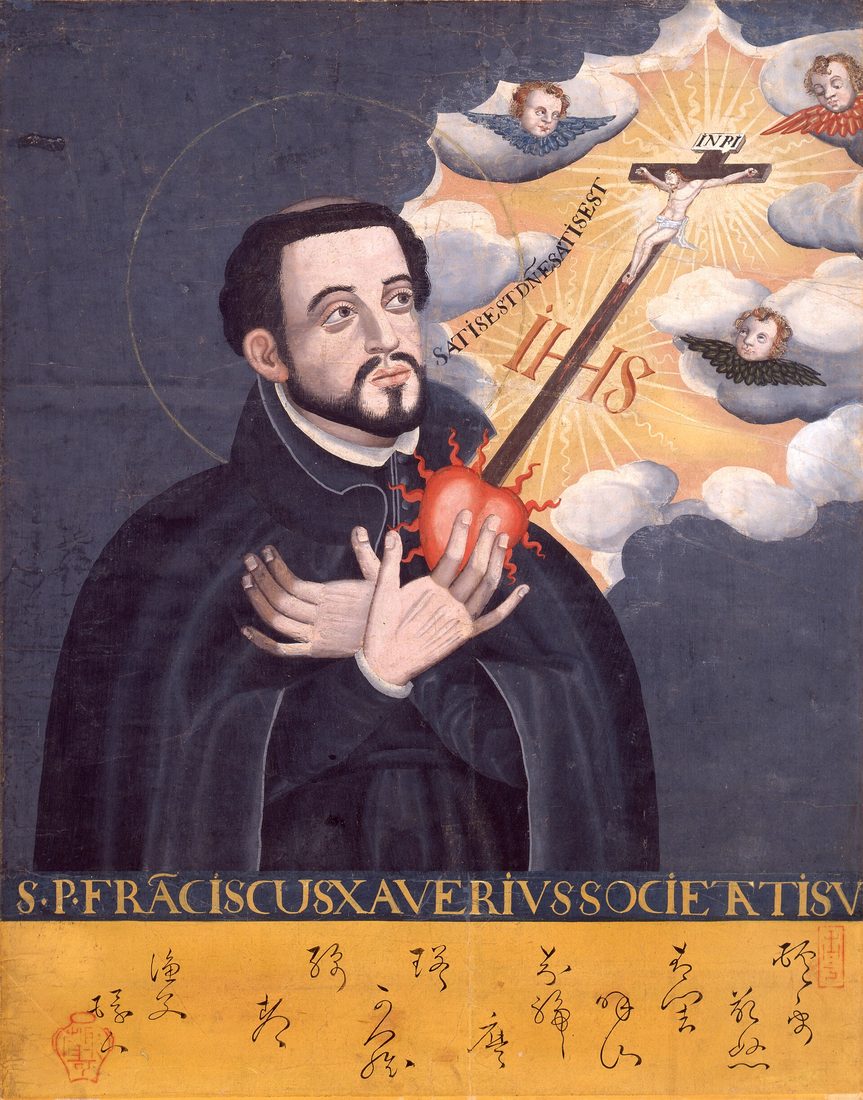
Inside lay a painted portrait of a man with his eyes raised, hands crossed over a burning heart, and words floating from his lips. It was Francis Xavier, the Jesuit who first brought Christianity to Japan in 1549. The same chest held a painting of the Fifteen Mysteries of the Rosary and other Christian objects that had been kept secretly since the ban. 1,2 This is the picture in slide 3.
The man in the picture
Francis Xavier (1506-1552) was one of the founding members of the Society of Jesus. He reached Goa in India in 1542 as a papal envoy, worked across South Asia, and landed at Kagoshima in 1549. 2 The national designation text notes that he spent two years and three months in Japan, travelling across western Japan and as far as Kyoto and Sakai, before leaving for China, where he died on Shangchuan island off Guangdong in December 1552. 3,2 His stay was short, but, as the same text puts it, he laid the foundation of Christianity in Japan and stirred missionary zeal in Europe. 3
Who painted it, and when
Nobody knows the painter's name. Kobe City Museum lists the work as "artist unknown", ink and color on paper, 61.0 by 48.7 cm, early 17th century. 2 The national designation text explains that it is not a true oil painting: it mostly uses Japanese painting materials, yet with a glossy surface, and X-rays show Western-style modelling, dark tones laid first and light over them, on the faces of Xavier and the angels. Where it looks gold, the painter used lead white mixed with yellow ochre rather than gold leaf, a Western technique. 3
The likely date comes from history. Xavier was canonized in 1622, and missionary letters show that devotion to him grew in Japan around 1620, even as persecution tightened. The designation text tentatively dates the painting to around 1623, when news of the canonization reached Japan. 3 This is a scholarly estimate, not a recorded date.
What the picture says
The words from Xavier's mouth are "SATIS EST DÑE SATIS EST", "It is enough, Lord, it is enough". The museum explains the source: Orazio Torsellino's Life of Xavier, published in the late 16th century, tells how Xavier, praying in a garden in Goa, was so overwhelmed by the love of God that he opened his robe over his burning chest and cried out these words. 2 Copperplate portraits printed in that book spread across Europe, and the Kobe painting belongs to that line. 2
Torsellino's story is precise: early one morning, praying in the garden of a church in Goa, Xavier was touched by the love of God in meditation and lost consciousness; coming to himself, he opened his coat over a burning, swollen chest and repeated the words again and again. When Pope Gregory XV canonized him in 1622, the bull of canonization gave the story official weight. 2
Two details are not in the printed portraits: the flaming heart and the crucifix. The museum reads the heart as the swollen chest of the Goa story, and the crucifix as the contemplation of the cross that Jesuit prayer stressed. It suggests both may have been added by the Japanese painter and the missionaries around him. 2 Below the portrait is a Latin line naming "S. P. Franciscus Xaverius Societatis" and a block of Japanese written in man'yōgana phonetic characters, read as "the sacrament of Saint Francis Xavier", with an IHS seal. 2,3 Disputedreadings of the final phrase 漁父環人 differ; one view takes it to mean the Pope, and the designation text says there is no settled interpretation. 2,3
From a farmhouse to a museum
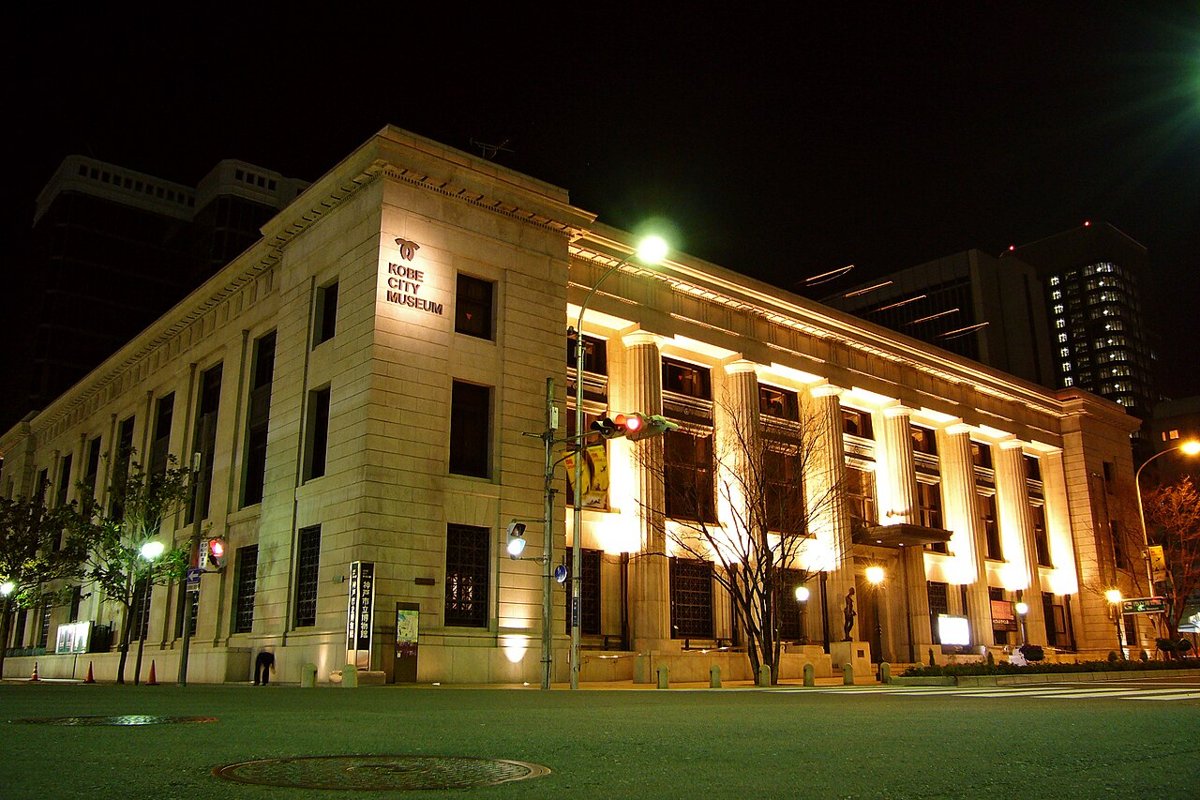
The museum records the chain of owners: Higashi Tōjirō; bought in 1935 by the collector Ikenaga Hajime; from 1951 the Kobe Municipal Art Museum; from 1965 the Municipal Museum of Namban Art; and from 1982 Kobe City Museum. 2 It was designated an Important Cultural Property on 27 June 2000, as 紙本著色フランシスコ・ザビエル像. 3 The chest's contents as a set are kept in memory by Ibaraki City as the "Christian relics in the akezu no hitsu". 1
Why this image belongs here
The portrait is the face most Japanese students know for Xavier. Its real story is about the people who hid it: a family that kept a chest shut for generations so that an image would survive. It belongs beside the hidden Mary of slide 6 and the trampled Christ of slide 5. 1,3 The museum calls it one of the very few early Edo Western-style paintings to survive, out of the many holy pictures destroyed under the ban. 2 The collector who bought it, Ikenaga Hajime, had bought the Nanban screens of slide 4 three years earlier. 2