At the Twenty-Six Martyrs Museum
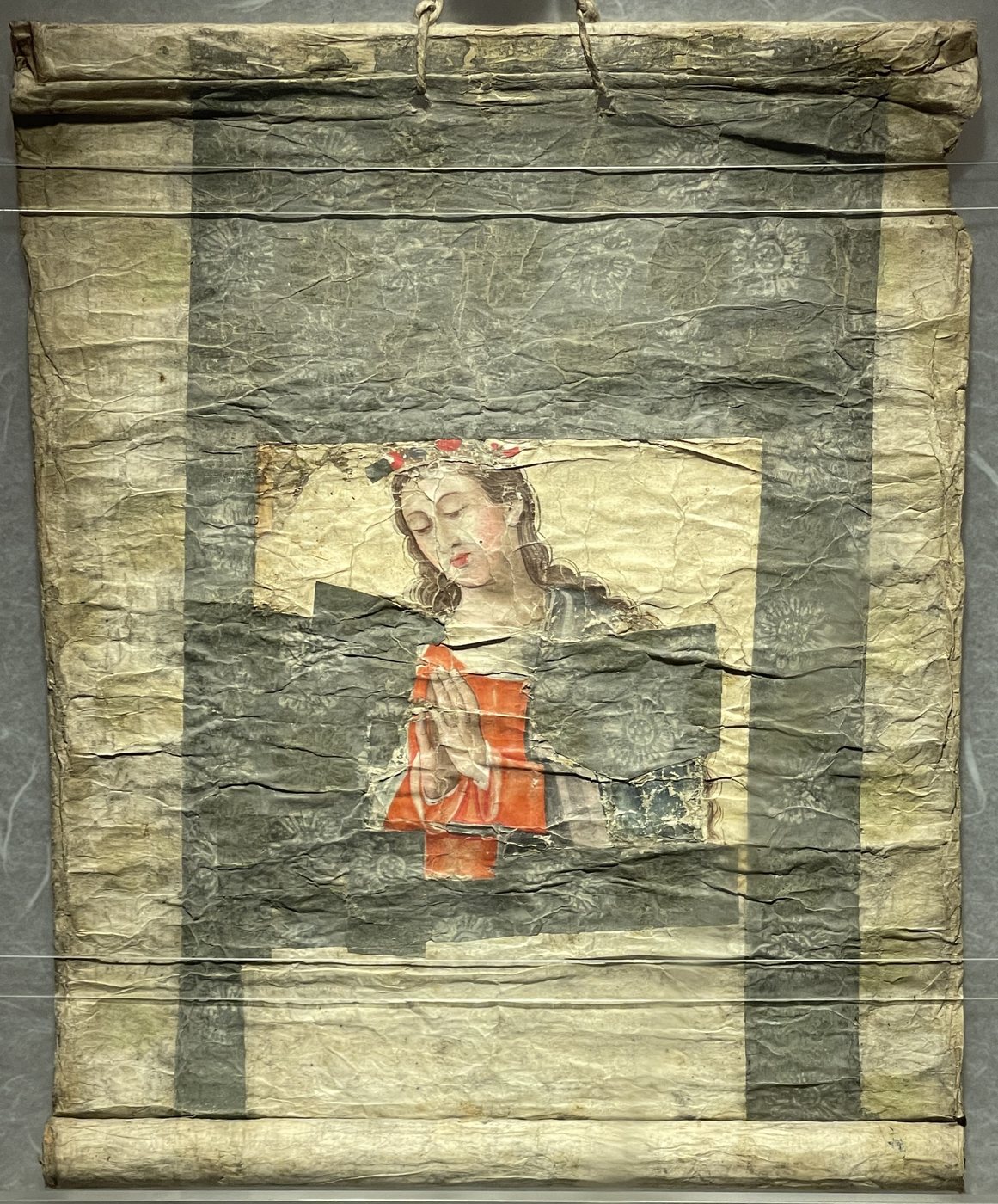
Among the treasures of the Jesuit-run museum is a painting of the Virgin known as Our Lady of the Snows, thought to have been made in Nagasaki between 1600 and 1614 Unverified.4 The museum also keeps relics of the three Japanese Jesuits, Paul Miki, James Kisai and John of Gotō.4 Its other treasures include a letter of 1546 from Francis Xavier to King John III of Portugal and a letter of 1621 by Julian Nakaura.4
The museum opened in 1962, a hundred years after the canonization of the Twenty-Six Martyrs, and was designed, like the Church of St Philip beside it, by the architect Imai Kenji.4
A Western Mary on Japanese paper
The museum's label gives the title as 「雪のサンタ・マリア」, "Santa Maria of the Snows", and heads it "artist and date unknown".1 Its Japanese text calls the scroll the work of a Nanban painter of 1600 to 1614, probably painted in Nagasaki under the direction of Brother Nicolao (イルマン・ニコラオ).1 The English text hedges the whole account: "We don't have precise data, but it was probably made in Nagasaki by some of the Christian painters under the painter Nicolao, S.J., between 1600 and 1614."1
Unverified The date, the place and the workshop rest on the museum's own label and an official summary that repeats it, and both say "probably" or "thought to".1,4
The label describes a Western-style Mary painted on Japanese paper, with Japanese pigments and Japanese drawing techniques.1 It says the figure resembles the Virgin of the Assumption in the Kirishitan-era pictures of the Fifteen Mysteries of the Rosary (ロザリオの十五玄義).1 Damaged as it is, the label adds, it shows the mingling of Western and Japanese art reached early in the seventeenth century; there were probably many paintings like it, but only a few remain.1
Snow in summer
The title comes from a Roman feast. Tradition As the label tells the legend, at the end of the fourth century snow fell in Rome at the hottest time of summer to show where a church should be built for the Virgin.1
A neighboring label in the same case explains that the image of Mary at the basilica of Santa Maria Maggiore in Rome, the Salus Populi Romani, to which Pope Francis was devoted, was also called "St Luke's Lady" and "Our Lady of the Snows", and that it was popular with Japan's Kirishitan.3 Its feast is August 5, and a liturgical calendar made in Japan in 1594 already lists it, on the nineteenth day of the sixth month of the old calendar; the label shows the calendar page.3 Pope Francis came to Nishizaka in 2019.4
The scroll's label notes that the Bastian calendar (バスチャン暦), handed down among the hidden Christians of Sotome (外海), marks "August 5, feast of Snow Santa Maria".1 A hidden Christian book, 「天地はじまり」 (Tenchi hajimari, "The Beginning of Heaven and Earth"), tells the snow story with Mary herself working the miracle. Tradition In the passage the label quotes, she prays to heaven, and "though it was the sixth month, in the summer heat, wondrous to tell, the sky suddenly clouded over, snow began to fall, and soon it lay several feet deep" (translated).1 Afterwards she rises to heaven, where the Lord of Heaven (天帝), greatly pleased, names her 雪のさんた丸や, Snow Santa Maria.1
Kept, then restored
The label ends on the scroll's survival. It says the picture shows the love of the faithful who guarded it at the risk of their lives through 250 years of persecution, and the comfort they drew from it, and that faith, art, legend and history meet in this torn scroll.1 Note The label does not say who kept the scroll, where, or how it reached the museum.
In fiscal 2018 (Heisei 30) the scroll was restored with a grant from the Idemitsu Cultural and Welfare Foundation (出光文化福祉財団), as a sign below it records.2