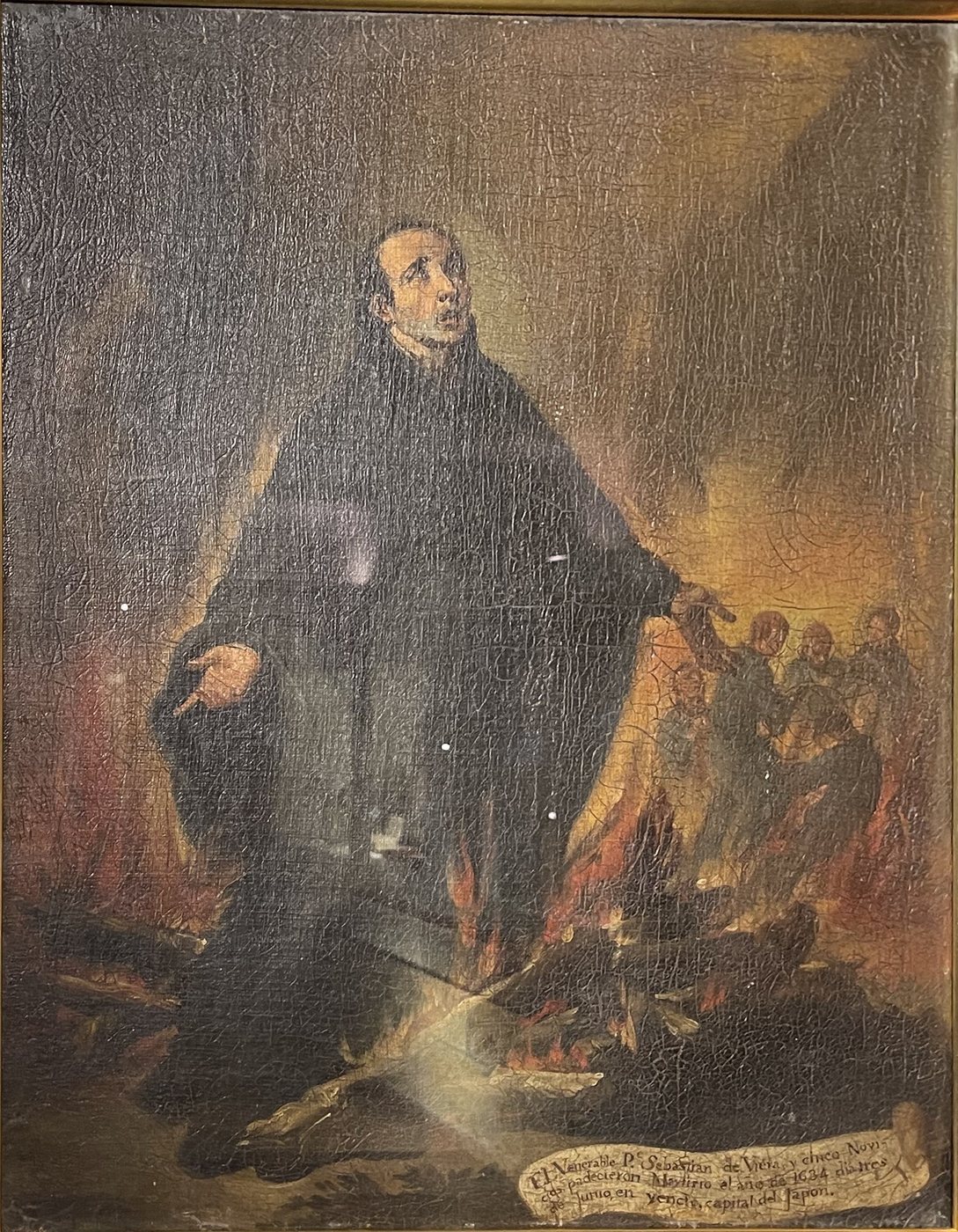
A painting from Seville
The museum label is short. In Japanese it gives the title ヴィエイラ神父の殉教, "the martyrdom of Father Vieira", and describes an oil painting, Spain, 17th century.1 In English it gives the title "Martyrs in Edo (Tokyo)", names Seville as the place of origin, and states that Father Sebastião Vieira SJ and five novices died in "the pit" between June 6 and 9, 1634.1 The label names no artist.1
The painting shows the priest in a black cassock standing in the flames, with a group of figures behind him at the right. A painted scroll at the foot carries a Spanish inscription, which reads in our photograph: "El Venerable P.e Sebastian de Viera, y cinco Novicios padecieron Martirio el año de 1634 dia tres de Junio, en Yendo, capital del Japon", that is, the Venerable Father Sebastián de Viera and five novices suffered martyrdom in 1634, on the third of June, in Edo, capital of Japan (translated).28 Note The inscription's June 3 differs from the June 6 to 9 of the label and the histories below. The reading is ours, from a photograph.
The painting hangs in the Jesuit-run museum at Nishizaka, which opened in 1962 on the hill where the Twenty-Six Martyrs were executed in 1597.2 Note The label does not say when or how the painting came to Japan.
The procurator who came back
Vieira was born about 1571 at Castro Daire in Portugal and entered the Society of Jesus at Coimbra on February 3, 1591.3 By 1617 he was the Jesuit superior in Japan, living hidden at Nagasaki.4,5 In December 1623 the Jesuits at Macao chose him as their procurator to Rome, and in 1626 he pleaded the cause of the persecuted Japanese Church before Pope Urban VIII.6,7,8 Sending him back, the Pope is reported to have said: "Go, and if you suffer death, I promise to declare you a martyr of the Church of God" (translated).9
He landed in Japan again on August 12, 1632, after leaving Manila disguised as a Chinese sailor.10,11 For sixteen months he lived on the move, often in a small boat, helping Christians along the coast and reconciling those who had given up the faith.10,11,12 He was captured off Osaka (大坂), held at Ōmura (大村), and then ordered to the shogun's court at Edo (江戸).13,14,15 There, told to set down his teaching, he wrote a treatise on the faith that was sent to the shogun Iemitsu (家光).16,17,18
His life: Sebastião Vieira SJ: The Procurator Who Came Back.
The pit at Edo
In prison at Edo, Vieira received his five Japanese catechists into the Society as novices.19,20 On June 6, 1634, Sebastião Vieira was taken to the pit at Edo with his five Japanese novices, the Franciscan Luis Gómez, a man in his eighties, and Gómez's Japanese servant Francisco, whom the friar had received as a brother.19,21,22 All were hung in the pit, and the companions died first.19,23,24
The old Jesuit was still alive after several days.19,24,18 The guards piled up wood and burned him alive in the pit.19,3,24 His ashes were scattered in the sea.19 He was 63 years old.3,25
Note The day of his death varies: Profillet, Murdoch and Pagès say he was burned on June 9, after three days in the pit; Charlevoix and Boero give June 6; Caddell says four days, head down. The museum label's "June 6 to 9" covers the span.19,18,21,26,25,27,1