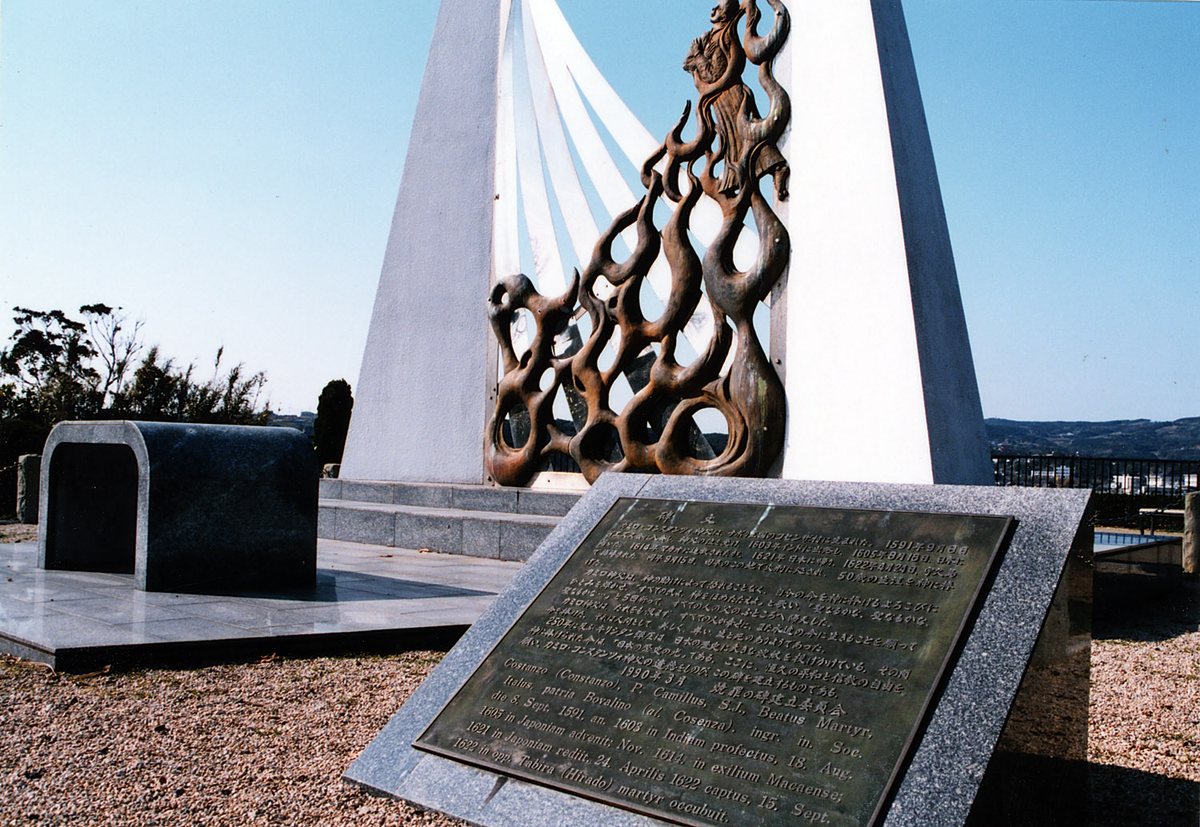
From Calabria to the Society of Jesus
Camillo Costanzo was born into a leading family of Motta Bovalino, in Calabria.As a young man he went to Naples to study civil law.On a carnival night, dissolute companions sent a courtesan to his room; the law student drove her out and prayed before a crucifix, and he struck the servant who had been part of the plot.Before he became a religious, he served for some years as a soldier in the army of Archduke Albert at the siege of Ostend.
Costanzo entered the Society of Jesus at Naples, at about the age of twenty.He asked for the China mission, and at thirty he was sent east at his own request.He left Italy in March 1602 and travelled by way of Goa and Malacca to Macao.The Portuguese there were determined not to let Italians enter China, so the Jesuit went on to Japan instead.
Missionary in Buzen and Sakai
Costanzo reached Nagasaki (長崎) on August 17, 1605, after a two-day typhoon during which he heard confessions, baptized a Chinese passenger and led the travellers in psalms.After a year spent learning Japanese, he worked first in the province of Buzen (豊前) and at Kokura (小倉).He then spent six years at Sakai (堺), one of the four principal cities of Japan, where he baptized more than 800 people, most of whom later died for the faith.In April 1609 he was at the bedside of the aged missionary Organtino, and he sent the news of his death to Europe.
The expulsion edict of 1614 ended this work.Costanzo had asked leave to go to Ezo (蝦夷), but he was well known, and his name stood near the top of the list of those to be expelled.Officials of Ieyasu (家康) had registered him, and he was forced to return to Macao.
Seven years of study in Macao
In exile at Macao from 1614 to 1621, Costanzo turned to study and writing.He perfected his Japanese and spent five full years studying the Buddhist scriptures, the Buppo, with teachers and old commentaries.He then wrote, in elegant Japanese, a refutation in fifteen books, which was examined and approved in Japan.Further works defended the faith, among them two books called the Difference and the Disillusionment, which argued that God, the angels and the soul in Buddhist teaching were not those of Christianity.In 1616, at Macao, he made his solemn profession of four vows.
On December 25, 1618, the exile wrote to the Jesuit General urging that Ricci's word Tienchu for God be replaced with Latin names in the Chinese mission.As a warning, he recalled an old mistake in Japan: "It is told in Japan of Blessed Father Francis Xavier that he went at night through the squares saying: 'Dainichi uo uogami are!'" (translated).According to the letter, that word carried a hidden sexual meaning, which is why it had been dropped as a name for God.When Longobardi asked him to go to China, he refused and chose to return to Japan.
Back in disguise, 1621
In 1621 Costanzo returned secretly to Japan, disguised as a soldier and wearing a sword.He and a companion posed as fugitives on a ship coming back from Cochinchina, but sailors recognised the bald priest even after seven years away.The Christian captain held the two men for the governor of Nagasaki until the Brothers of the Congregation of St Ignatius, warned by two passengers from Sakai, persuaded him to let them go.Hunted by a constable, the missionary escaped by boat to the lands of the lord of Arima (有馬), where the Jesuit Provincial was staying.
He then served the Christians of Fudoiama in Hizen (肥前) and of Karatsu (唐津), on the border of Chikuzen (筑前).Finally he was sent to Hirado (平戸), and he spoke of his bond with the Christians there as a holy marriage.For three months he toured the island of Ikitsuki (生月).
Several families who sheltered him later paid with their lives.One host, Lucas Mori Heibyoe, was beheaded in Hirado on March 3, 1624, at the age of 76.
Betrayal and arrest at Uku
Costanzo was betrayed in 1622 through a Christian woman of Ikitsuki who hoped to win her husband to the faith.She had just made her confession to the priest, and she told her husband, a non-Christian justice officer named Monami Soiemon, about him.The officer drew out every detail and informed the authorities, who sent three armed ships in pursuit.Meanwhile the Jesuit had set out in a small two-oared boat with his host, the catechist Gaspar Koteda and Agustín Ota, bound for the islet of Nojima in the Hirado domain.
On April 24, 1622, the pursuers found him in port at Uku (宇久).The island belonged to the lord of Gotō (五島), not to Hirado, but its revenue collector, a man named Sansi, let them take him.Once they knew who he was, the captors bound his companions and the boatman but did not dare to touch him.At Nojima they treated the priest with great reverence and invited him to a lavish supper.He declined the meal but, out of courtesy, accepted a drink of their sake.The next day they took him, with Agustín and Gaspar, five leagues on to the town where he would be tried.
Trial at Hirado and prison on Iki
At Hirado, Costanzo was examined by two judges, as he later told the Jesuit rector at Nagasaki in a letter.He handed them a written defence of the faith and told them that Christians must obey their rulers except where they command what is contrary to God, as the shogun's ban on preaching did.One judge declared that he deserved death, and a halter was thrown round his neck.When the prisoner called himself happy, the judges "said that my brain was unhinged" (translated).
That same night he was sent to the island of Iki (壱岐), twelve leagues out to sea, where only ships waiting for a wind to Korea called.His prison had no stockade but was closely guarded, and he shared it with two friars, the Augustinian Pedro de Zúñiga and the Dominican Luis Flores.The guards accepted his preaching and said they would become Christians if the shogun did not forbid it.Costanzo wrote that he was waiting for the reply from the shogun's court at Edo (江戸), and with it his death.His letters called his life there happy, and he bowed deeply whenever he passed near Suzuta (鈴田) prison, where Carlo Spinola was held.
Of the many letters the Provincial, Francisco Pacheco, sent to the prisoners, only one reached Costanzo.It gave him authority to receive his catechist Agustín Ota into the Society of Jesus.Born at Ojika (小値賀) in the Gotō islands, the catechist had been raised among Buddhist monks before his baptism and had kept a church before joining the priest.Ota took his first vows before the priest, with Zúñiga and Flores present.On August 10, 1622, the new Jesuit brother was beheaded on the beach near the prison, in sight of his three fellow prisoners.
Gaspar Koteda, the other catechist, was moved to another prison before he could take vows, and he was beheaded at Nagasaki on September 11, 1622, aged 21.The host John and the boatman Damian had already been beheaded on the island of Nakaenoshima (中江ノ島) on May 27, 1622.
Burned alive at Tabira
The order to burn Costanzo alive came from Edo, while his companions were to be beheaded.Following Japanese custom, the condemned priest sent the Provincial a parting gift: a reliquary holding the formula of his profession of four vows, which Pacheco made a treasure of the province.He was taken by boat to Hirado and met by six servants of the lord and an officer from Nagasaki standing in for Hasegawa Gonroku (長谷川権六).
The stake stood not on the island itself but opposite the town, at Tabira (田平), on the Kyushu (九州) shore across the channel.On the open beach a wooden post rose from a great pyre inside a fence of woven bamboo.A huge crowd watched, including English and Dutch Protestants from a fleet of thirteen ships.At the gate of the enclosure, Costanzo announced in a loud voice, in the Japanese manner: "I am Camillo Costanzo, Italian, religious of the Society of Jesus" (translated).He was tied to the stake with ropes of beaten, twisted cane smeared with mud, so they would last longer in the fire.
From the stake the martyr preached in good Japanese on Christ's words not to fear those who kill the body.As the flames rose, he declared that the sects of the Buddhist monks were vain and that salvation lay only in the law of Jesus Christ.He sang the psalm Laudate Dominum omnes gentes with the Gloria Patri, mixed Latin words into his Japanese, and three times cried out in Japanese with words of delight.After crying Sanctus for the fifth time, he bowed his head and died.
It was September 15, 1622, and he was about fifty, with some thirty years in the Society and seventeen in Japan.His remains were thrown into a fast current toward Hirado and never found, though the Jesuit rector of Nagasaki, Giovanni Battista Baeza, had the coasts searched.Even the Protestant onlookers admitted that his virtue was beyond words.In the brief of beatification of July 7, 1867, Pius IX named Costanzo among six Jesuits singled out as the most eminent of the 205 martyrs beatified.
What is uncertain
Where the sources disagree
- The year of the arrest. the 1868 English-language Spinola volume gives April 24, 1623, which cannot be right since he died in September 1622; Boero, Solier and the other accounts give April 24, 1622.
- The day of death. Boero's 1867 Italian text prints September 13, 1622 at one point, probably a misprint, against September 15 in the same book and in all other sources.
- His age at death. Boero gives fifty, Solier about fifty, Charlevoix his fifty-first year, and Profillet and Pagès a little over fifty.
- His age on entering the Society. most sources say twenty, but Charlevoix says he entered the novitiate at Naples at twenty-one.
- His arrival at Macao. Profillet and Solier put it in 1603, Bartoli and Boero in March 1604.
- The distance from Motta Bovalino to Gerace. twelve miles in Boero and Bartoli, twelve leagues in Profillet.
- His companions on the 1621 voyage. Bartoli names Fr Antonio de Sosa, while Pagès says he came with Frs Gaspar de Castro and Manoel Borges.
- Laures's Kirishitan Bunko says he worked as a scholar in China after 1614, but Bartoli says he refused requests to go to China and stayed in Macao until 1621.
- Where he worked in 1621 and 1622. Boero's 1867 text says Hizen, Chikugo and Hirado; the 1869 Spanish edition says Hizen, Chikuzen and Hirado; Bartoli names Fudoiama in Hizen and Karatsu on the Chikuzen border.
- The betrayal. Boero says the husband informed the Hirado officials, Profillet that he denounced the priest to the lord of Gotō; Charlevoix and Solier describe the informer as a man who pretended to want baptism.
- Where the catechists were taken. most accounts say at Uku with Costanzo, but Solier says Ota and Koteda were seized at Nojima, and the 1869 Spanish edition of Boero glosses the place of capture as Ikitsuki.
- The prison island. most sources place the prison on Iki, but one rendering of Luis Flores's letter of May 24, 1622 glosses it as Ikitsuki.
- How he was tied. Boero and Bartoli say very tightly with mud-coated cane, Profillet says loosely with reeds.
- The languages of his last sermon. Profillet and Pagès say Japanese, Portuguese and Flemish; Boero, Bartoli and Charlevoix speak of Japanese mixed with Latin.
- The execution site. Boero and Bartoli place Tabira on the Kyushu shore across the channel; Charlevoix calls the place Tobira, between the town and the fortress of Hirado, and Solier puts it beside a strait between the town and the citadel.
- The host John's name. Sakamoto in Anesaki and Charlevoix, Tenkamoto in Profillet and Delplace, with the second name also spelled Saemon and Zaiemon.
- Ezo. an index to Bartoli calls him the first founder of the Christianity of Ezo, yet the same index says Girolamo de Angelis was the first to cross there, and Charlevoix says Costanzo asked to go but was expelled instead.
- His later writings. Boero counts two works in defence of the faith besides the fifteen books, while Bartoli describes three.
