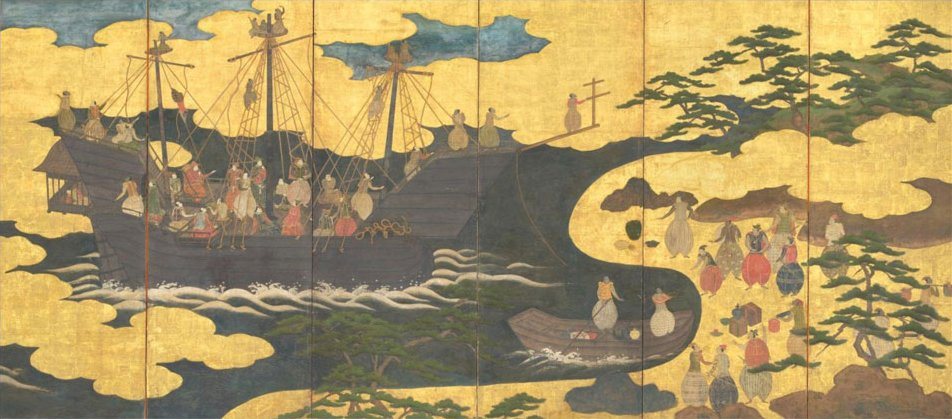
From Évora to the see of Japan
Luís de Cerqueira was born in 1552 at Alvito, a town in the archdiocese of Évora in Portugal.He entered the Society of Jesus as a novice at Évora in 1566, when he was little more than fourteen years old.There he took a doctorate in theology and was at once made a professor in its Faculty of Theology.
In the early 1590s Cerqueira was chosen to stand ready as successor to Pedro Martins, the Jesuit named bishop of Funai, the diocese of Japan.Alessandro Valignano, the Jesuit Visitor, had urged that a younger man be sent as coadjutor to the bishop.The professor was teaching theology at Évora when the choice fell on him, and he was raised to the episcopate against his will.In November 1593 he was consecrated titular Bishop of Tiberias, with the right to succeed to the see of Japan.He left for the Indies in 1594, reached Macao the next year, and waited there because of Hideyoshi's persecution.
In February 1598 Bishop Martins sailed for India, and he died at sea before reaching Malacca.The coadjutor, still at Macao, automatically became his successor.
A quiet arrival in a persecuted Church
On August 5, 1598, Cerqueira landed at Nagasaki with Valignano and a small group of Jesuits, after 22 days at sea on Nuno de Mendonça's ship.The bishop came ashore quietly by night, without any public welcome, on the advice of Christian lords.He had been ordered to come without any sign of his episcopal rank.Hideyoshi was gravely ill at that moment and died later that year, which brought the Church some relief.A few days after the landing, another ship brought news of Martins's death, which the new bishop had not yet heard.
What he found dismayed him: churches pulled down, pastors scattered and the faithful afraid.Terazawa Hirotaka, Hideyoshi's governor in Shimo, had burned more than 130 churches.For about two years the bishop kept his real authority hidden from the governor.
The stand against the slave trade
The first matter Cerqueira took up as bishop was the buying and export of Japanese and Korean slaves by Portuguese merchants.On September 4, 1598, he met fifteen Jesuits at the Jesuit house of Nagasaki, among them Valignano and Organtino.The meeting concluded that most Japanese sold as slaves had been kidnapped or tricked, and that Koreans taken in Hideyoshi's war were captives of an unjust war.In the words of its ruling, "most of the young men and women that are sold are stolen, tricked, and bought, thus having no proof of legitimate captivity."With the consent of all the fathers, the bishop renewed his predecessor's excommunication of slave buyers and refused any licence to take purchased youths out of Japan, whether as slaves or under years of service.
He held to this line strictly and refused a licence to everyone, even the captain-major of the voyage.Valignano wrote that the ban angered the Portuguese merchants but won over the Japanese, who said the bishop had done in a few days what another could not do in many years.Cerqueira also wrote to the king, asking that King Sebastian's law on the freedom of the Japanese be published again.Philip III put the 1570 law into effect on March 13, 1603, and in 1604 ordered the captains of the Japan voyage to support the bishop.The bishop also urged the Christians of Nagasaki to buy Korean slaves in order to set them free.The record is not entirely simple: the memorandum he left at his death named his cook, António Rebelo, as a slave legitimately held.
From Amakusa to Nagasaki
In early 1599, to keep him out of sight of the Nagasaki governor, Cerqueira moved to the lands of Konishi Yukinaga in Amakusa.Valignano reported that the bishop, then forty-seven, took up Japanese with great enthusiasm.He spent about thirteen months at Shiki, where Christians came from twenty leagues around to be confirmed.On Holy Thursday 1600 he blessed the holy oils in solemn rite, the first time this was seen in Japan, and publicly washed the feet of twelve poor men.Even so, he never became very fluent, and he later reached his seminarians through Latin.
In 1600 Cerqueira settled for good in Nagasaki, judging a city under central control safer than a daimyo's domain.He lived in the Jesuit college near the harbour, and the Church of the Assumption, built the next year, served as his cathedral.He bought land beside the college and in 1607 moved into a house of his own there, with an inner door into the college.He so tempered his authority that the Japanese lords never suspected a foreigner of acting as a prince in their land.
He gave the young Church much of its public worship.In 1601 he confirmed more than 8,000 people at Nagasaki and said he had never found a people who received the sacrament with such reverence.In 1605 he had the feast of Corpus Christi celebrated in Japan for the first time, carrying the Blessed Sacrament through the streets himself.Because pagans were offended when Christians kept away from the New Year rites, Cerqueira set up a feast of Our Lady of Protection at the start of the lunar year.He also fitted holy-day calendars to how long each district had been Christian, and adapted adult baptism out of respect for Japanese modesty.In January 1603 he counted about 200,000 Christians gathered in churches with priests.
The first Japanese priests
The bishop believed that the Church in Japan could not be cared for without priests born there.Early in 1599 he held a conference of experienced Jesuits, which he called a sort of diocesan synod, and they urged him to open a diocesan seminary.In his 1603 report to the Pope he wrote that "the Japanese are well suited for the priesthood".In September 1601 he ordained Sebastião Kimura at Nagasaki, the first Japanese priest.Cerqueira kept candidates in his own house to study theology and taught seminary classes himself.For them he wrote a Manual of Cases of Conscience, printed in Japanese translation but now lost.By the end of his life he had ordained seven Japanese priests and placed three of Nagasaki's five parishes in Japanese hands.
Money was a constant worry: his royal stipend of 2,000 crusados a year had still not been paid in 1603.In 1606 he wrote, "I am deeply in debt and get daily deeper into debt".
Friars, a shogun and martyrs
Cerqueira opposed the coming of friars from Manila to Japan.He held that a papal brief barred missionaries from entering by way of the Philippines, and he feared that their coming fed Japanese suspicion of a Spanish conquest.In 1603 he courteously but firmly refused the Franciscan commissary Diego Bermeo leave to minister.In November 1604 he published Clement VIII's brief, which ordered friars who had come via the Philippines to leave and return by the Portuguese route.The bishop complained that he was suspected of partiality to the Jesuits, as if, being chosen as pastor, he did not owe more to his flock than to his order.
In 1606 he travelled to the court of Tokugawa Ieyasu, introduced by Ogasawara Ichian, a former governor of Nagasaki.The retired shogun received him in ceremonial robes and let his litter be carried into the palace, a privilege of the greatest lords.He came as head of the Church in Japan, not as an envoy of the viceroy of India.On the way home Hosokawa Tadaoki met him at Kokura and asked to be counted among his Christian subjects, though he was not baptized.
He took great care over the martyrs.In 1603 he sent letters of comfort to the condemned Christians of Higo and had a summary of their deaths sent to the Pope and to Philip III.After eight nobles were burned alive at Arima on October 7, 1613, the bishop held a formal process and declared them martyrs as far as his tribunal could judge.
Death and burial
After three months of illness, Cerqueira said his last Mass on February 2, 1614.He died at Nagasaki on Sunday, February 16, 1614, aged 62, probably of cancer.His death came probably in the same week that the text of Ieyasu's prohibition reached the city.Remembered for humility and gentleness, the bishop was mourned by Christians and pagans alike.He was buried among the Jesuits, near the eight martyrs of Arima, and Franciscans, Dominicans and Augustinians attended his funeral.When the Jesuit compound was demolished later that year, his remains were moved to the Misericórdia cemetery.In 1619 Hasegawa Gonroku had the Christian cemeteries emptied, and the Jesuits moved the bishop's body with those of other Jesuits.
He died without a successor, although he had urged Rome in 1612 to name a coadjutor.Before his death he commended his Church to Valentim Carvalho, the Jesuit provincial.There was no cathedral chapter, so the seven Japanese secular priests elected the provincial vicar general.A bitter dispute over that office followed, just as the great persecution began.
What is uncertain
Where the sources disagree
- Arrival date. most sources give August 5, 1598.Profillet and Oliveira e Costa give August 15, and Ávila Girón's notes allow August 4 or 5.
- Consecration. Roggendorf says he was consecrated by the Archbishop of Évora in November 1593;Cooper places the consecration at Lisbon in November 1593;Profillet has Lisbon in 1594.Ehalt says he was named successor-designate in 1592,Roggendorf in 1593.
- Companions in 1598. Roggendorf and Solier speak of four other Jesuits with Valignano;Boero speaks of ten.
- Return to Nagasaki. Tronu dates his settling there to summer 1600, before Sekigahara;Roggendorf says only after Ieyasu's victory in 1600.
- Move to Amakusa. Tronu gives February 1599,Pagès March 1599.
- His own house. Tronu says it was finished in 1606;Roggendorf says it was still being built in 1606 and he moved in during 1607.
- The 1606 audience. Cooper, Solier and Pagès place it at Fushimi;Wilberforce and Anesaki say Kyoto (Miyako).Murdoch notes that missionary writers admit Ieyasu received him because of his credit with the Portuguese merchants.Hesselink thinks Ogasawara Ichian's part in it exposed his alliance with the Jesuits and helped bring about his fall.
- Date of death. February 16, 1614 is given by Roggendorf, Bartoli, Solier, Hesselink and the Nagasaki Portuguese memorial.Profillet, Delplace, Cary, Laures, Murdoch and Pagès's history give February 20.Jennes gives both 1615 and February 1614, and Ehalt once says 1612 in error.
- Cause of death. Roggendorf says probably cancer;Charlevoix and Caddell report that he was said to have died of grief at the ruin of his Church.
- Burial. Delplace, Bartoli and Pagès say he was buried in the Jesuit church;Hesselink says the Misericórdia cemetery.
- Start of his government. Anesaki dates him as bishop of Japan from 1605, though he succeeded on Martins's death in 1598.
- Succession. Charlevoix says Carvalho took over by apostolic brief;Solier says the clergy elected him without knowing that Rome had already ruled the Jesuit superior should govern.
