From Ávila to the Franciscans
Pedro Bautista was born in the village of San Esteban del Valle, in the diocese of Ávila in Spain, to noble parents.His family name was Blásquez, and he was born in the 1540s.He studied at Ávila and at Salamanca.As a young man he took the habit of the Discalced Franciscans of the province of San José, at the convent of Arenas.
In the order he became a preacher and a teacher of philosophy and theology, and several times a guardian.He was guardian of the convent at Mérida when he was sent overseas.
Mexico and the Philippines
Around 1580 Pedro Bautista was sent to Mexico, where he worked among the Chichimeca.He fell ill there and stayed to preach, laying the foundations of a Discalced custody that later became the province of San Diego.In the mid-1580s he sailed from Acapulco for the Philippines.
In Manila he founded the house of San Francisco del Monte, was elected provincial, and founded convents along the bay and in Camarines.He walked barefoot through the islands.His days were given to teaching, preaching and visiting hospitals, and his nights to prayer.Later he asked to be relieved of office so that he could live in contemplation.
He was one of the first Franciscans named bishop of the new see of Camarines, but he declined.The call to Japan came instead.
The embassy of 1593
In 1593 the governor of the Philippines, Gómez Pérez Dasmariñas, sent Pedro Bautista to Japan as his ambassador.Hideyoshi had demanded the submission of the Philippines, and the governor gave the friar authority to agree peace and friendship until King Philip II sent orders.The governor chose a Franciscan because a memorial from the Japanese merchant Harada said that the ruler would like to see friars of that rule.He was also to be commissary of the Franciscans in Japan.
Four Franciscans left Manila in May 1593: Pedro Bautista, Bartolomé Ruiz, Francisco de San Miguel and Gonzalo García.They reached Japan in June and were the first religious of any order other than the Jesuits to come there.The Jesuits received them kindly and gave them a Japanese grammar, a dictionary and a confession manual.The commissary visited the Jesuit vice-provincial, Pedro Gómez, and told his friars to follow Jesuit directions and use Jesuit terms.
At Nagoya in Hizen the friars refused the horses offered to them and walked through the mud.They presented the governor's gifts, twelve swords, twelve daggers, a cup and two vases.Hideyoshi served them refreshments with his own hands, gave each a silk robe, and said that a sunbeam had marked him at birth to rule the world.The ambassador answered that the friars had come for friendship, not tribute, because "the King of Spain did not recognise subordination to anyone but to God".He offered that he and his friars stay as hostages until the King of Spain could reply.The ruler let them stay on condition that they did not speak of religion to the Japanese.
Founding the mission
Pedro Bautista asked to see the wonders of the capital, and the friars were allowed to go to Kyoto (Miyako).There they were lodged at first by a treasury official, Hasegawa, who kept watch on them.They were given a fine site at Myōmanji, where they built a church, a convent and a hospital for lepers.From October 1594 they said Mass in the presence of Japanese Christians.In time the Franciscans founded houses at Osaka, where their convent was named Bethlehem (Belén), and at Nagasaki.In May 1595 they set up a residence and church in Cruzmachi, Nagasaki.
The commissary arrived at Nagasaki on December 18, 1594, with Fr Jerónimo de Jesús, seriously ill, and the Jesuits nursed him.He was remembered as a father to the poor lepers.In 1596 he wrote that although he knew little Japanese he heard confessions and preached in Lent, and that people wept for joy at his first sermon.It is said that on a Pentecost day he healed a Japanese girl of leprosy, and that tongues of fire appeared over those present.
He ruled that the Christians of Japan were bound to keep the feasts and fasts of the Church, as in New Spain and the Philippines, until the bishop of Japan came.He also held that the newly baptized should wait at least a year before receiving Communion.He disapproved of Jesuit customs such as the tea kettle he found in a village church near Kyoto.In his letters he trusted the ruler, writing, "We have nothing to fear while Hideyoshi is alive."
Arrest in Kyoto
When the Spanish galleon San Felipe reached Japan, its general told its envoys to go straight to the commissary in Kyoto and to say nothing to the Jesuits.Pedro Bautista then wrote that the ruler had seized everything on the ship, and that because it carried artillery and arquebuses it was said the Spaniards meant to take Japan with the help of the Christians.With guards around the Kyoto convent, he wrote that he would rather give his life for Christ than be sent back to the Philippines.
While guarded, he and another friar heard confessions all night, and before dawn he said Mass and gave Communion to the friars and fifty Christians.He left Fr Jerónimo hidden in Osaka to console the Christians.When a judge asked why so many Christians wanted martyrdom, he answered: "Because it is so easy a way to go to heaven, and so cheap a price to buy the eternal goods".During the parade through Kyoto he preached to the crowd as well as he could in Japanese and encouraged his brothers in Spanish.He gave the crucifix from his neck, stained with blood from his cut ear, to Cosmas Shoya.
Letters from the road
Pedro Bautista's letters from prison and from the road speak of death for Christ as a gift.Before Christmas 1596 he wrote that he and the brothers would like to celebrate the feast in heaven.On January 1, 1597, he called death for Christ God's greatest gift and wrote, "What a wonderful way to begin the year".In mid-January he reported that twenty-four condemned prisoners had left Kyoto for crucifixion at Nagasaki, and he asked that they might receive Communion before they died.His last letter was dated on the road on February 2, 1597.
Resting by the road near Sonogi, the commissary began to weep, and the guards mocked him for fearing the cross.Through Brother Gonzalo, who knew Japanese, he told them he wept because he had come hoping to found his order in Japan and had not done so.At Sonogi he knelt before the Jesuit João Rodrigues and asked pardon for any trouble the Franciscans had caused, and the Jesuit knelt and asked pardon in turn.The two men embraced in tears.
Last of the twenty-six
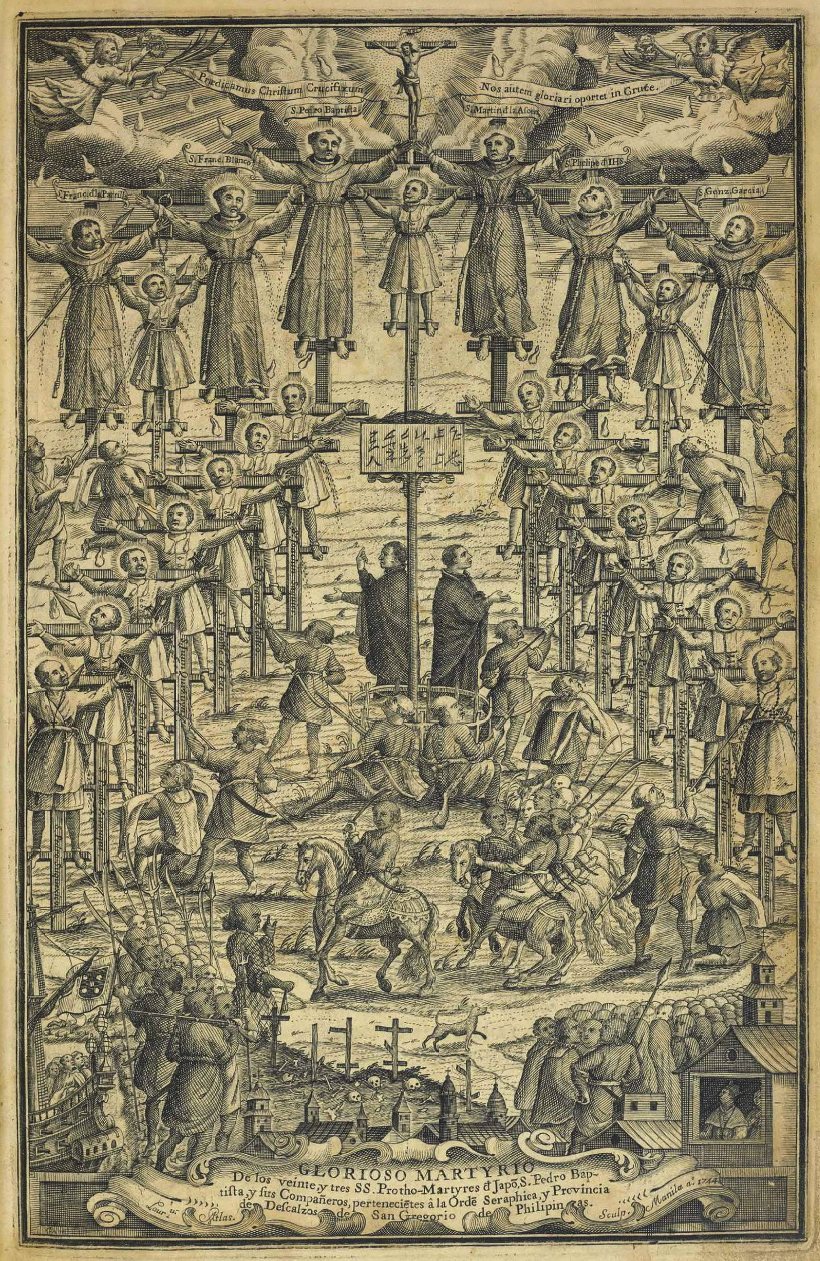
At Nagasaki on February 5, 1597, Pedro Bautista was crucified with twenty-five companions.Not content with the iron ring, he pointed to his palm and asked the executioner, "Brother, nail me here."The executioners refused, saying they had no such order.His cross stood in the middle of the line.
On the cross he began the Benedictus, and the others took it up.Then he stayed silent and still, his eyes fixed on heaven.The boys asked him to sing the Laudate pueri with them, but he was lost in prayer and did not hear.Having seen all his companions die, he was the last to be speared.
A Spanish eyewitness wrote that on Good Friday, April 18, 1597, blood flowed from the lance wounds of the commissary's body, which he saw white and whole.Others said the body vanished from the cross for a few hours, or that he was seen saying Mass after his death.In Manila his habit and his right hand, fixed in the gesture of blessing, were venerated.His letters were collected and printed in Madrid in 1916.
What is uncertain
Where the sources disagree
- Birth year and age at death. Hesselink gives 1542, Miyazaki 1545.Ages at death are given as 48 (Solier, Yuuki), 50 (Yuki, Rigaud), 52 (Profillet) and about 54 (Hesselink makes him fifty-four by 1595).
- Age on entering the order. 21 in 1566 (Profillet), 22 (Ribadeneira, Cooper) or 24 (Hesselink).Ribadeneira also adds studies of Latin and music at Ávila and Oropesa and a post teaching arts at Peñaranda.
- Dates for Mexico and the Philippines. Profillet says he went to Mexico in 1580 and the Philippines in 1583; Hesselink says he left Seville in 1581 and reached the Philippines in 1584; Boero's translator says he stayed three years in Mexico and sailed from Acapulco in 1585; Ribadeneira says two years.
- The bishopric. Medina says he was one of three Franciscans named bishop of Camarines who all declined; Boero's translator says his appointment as commissary for Japan prevented it; Kenners says he was compelled to accept but left before consecration, which other accounts do not support.
- Year and day of sailing. most sources give May 1593 (Bartoli May 20, Kenners May 21), but Ribadeneira says 1592, and Medina also dates the embassy to 1592.Cooper records a council of friars in Manila ruling on May 28, 1593, that the journey was lawful.Boero's translator wrongly gives 1596.
- Hostages. Charlevoix, Profillet and Cary say Hideyoshi accepted the offer to stay as hostages; Bartoli says he refused it, and Murdoch says he refused unless they swore the Philippines would submit.
- The papal briefs. some clergy in Manila objected that the journey broke a decree of Gregory XIII. Kenners says the archbishop and chapter of Manila ruled that a concession of Sixtus V limited this, and Murdoch says the friars evaded the bull by coming as ambassadors.Caddell and Miyazaki say the friars preached openly against the conditions set, and Caddell calls him a man of "every virtue except prudence".Bouix rejects the charge that he caused the persecution, and Perez wrote a defence of him in 1925.
- Why he wept near Sonogi. most accounts say he grieved at not founding his order in Japan; Yuuki says he was recalling that the bishop had raised the papal briefs against him.
- His January 1597 letter. Boero dates it at "Catacabe" on January 16, Solier at "Catabe" on January 19.
- Position of his cross. Solier and Yuuki put him eleventh; Medina sixteenth.
- Relics. Ribadeneira says his right hand was kept at San Francisco in Manila, but the 1947 editor says Ribadeneira later gave the head and right hand to the Concepcionist nuns of Toro.
- The crucifix. a crucifix in the hermitage at San Esteban del Valle is said to be the one he gave Cosmas Shoya.
- Reported wonders after death rest on testimony, including the oath of the Dominican Martín de León and depositions in the Mexican process.
