十Christian Japan
Place guide · Nagasaki · Martyrdom site

Twenty-Six Martyrs Monument, Nishizaka

On a hill above Nagasaki station, twenty-six bronze figures stand shoulder to shoulder, facing the harbour. What happened on this hill in 1597, and why does the monument look towards Ōura?

3 min read9 sources6 pinsVisitingTap any name, place or term to learn moreTimeline

The ground the Tokugawa called unclean became a place of pilgrimage. The hill where twenty-six Christians were crucified gave its name to the church at Ōura, and in 1962 a monument, a museum and a church were built on it.

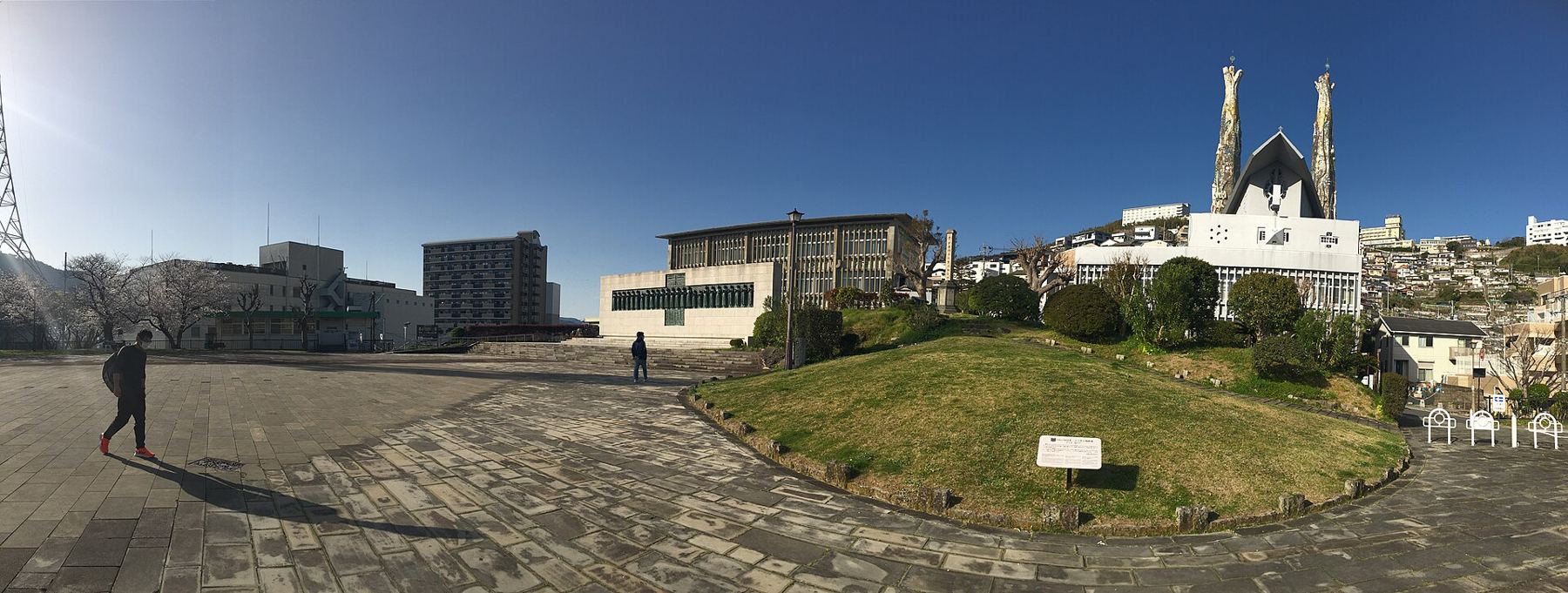
The bronze relief of the Twenty-Six Martyrs at Nishizaka
The bronze relief of the Twenty-Six Martyrs at Nishizaka.Twenty-Six Martyrs Museum and Monument, 27 March 2022. Nesnad, CC BY 4.0. Commons

In 60 seconds

The place in 7 steps. Each line is footnoted.

  1. 5 Feb 1597Twenty-six Christians are crucified on Nishizaka on Toyotomi Hideyoshi's orders.
  2. After 1597Hundreds more are martyred on the same ground.
  3. 1862The twenty-six are canonised.
  4. 1865The church at Ōura is built and dedicated to them.
  5. 1950Pius XII makes Nishizaka an official place of pilgrimage.
  6. 1956The site becomes a prefectural historic site.
  7. 1961 to 1962Funakoshi Yasutake's monument, then Imai Kenji's museum and church.

The hill above the harbour

On the morning of 5 February 1597, twenty-six Christians were led up the hill of Nishizaka, overlooking Nagasaki. , the ruler of Japan, had ordered their deaths. They had been arrested in Kyoto and Osaka and made to walk the length of western Japan in midwinter. On the hill they were fixed to crosses one by one and killed with spears.

They were six Franciscan missionaries, three Japanese of the Jesuits, among them , and seventeen lay Christians. Besides the Japanese there were four Spaniards, a Mexican and a Portuguese. The youngest were boys of twelve to fourteen.

On the mapThe last road
Nishizaka Park, Ichijō Modoribashi, Togitsu. Full atlas and pin sources
1597 to 1862

The unclean ground

Under the Tokugawa, the place where they died was called , "the unclean ground of the foreign priests". It went on being used. The prefecture records that hundreds more were martyred here after 1597. In 1637 , the first Filipino martyr and the first Filipino saint, was executed here.

1862 to 1956

Saints

Pope Pius IX canonised the twenty-six in 1862. Three years later the Paris Foreign Missions built their church on the hill and dedicated it to them as the Church of the Twenty-Six Martyrs, today's Ōura Cathedral. It was in that church that the hidden Christians of Urakami made themselves known to Father Petitjean on 17 March 1865.

In 1950 Pope Pius XII declared Nishizaka an official place of Catholic pilgrimage. Nagasaki Prefecture made the martyrdom site a historic site on 6 April 1956.

On the mapNishizaka and Ōura
Nishizaka Park, Twenty-Six Martyrs Museum and St Philip's Church, Ōura Cathedral. Full atlas and pin sources
1961 to 1962

A monument, a museum and a church

For the centenary of the canonisation the sculptor , a convert in his late thirties, made a great bronze high relief of the twenty-six, life size. The prefecture dates the monument to 1961 and the museum and the church to 1962; the Japan Tourism Agency says the complex opened in 1962. The relief faces Ōura Cathedral.

The museum and the Church of St Philip beside it were designed by , another convert, who as a young man had seen Antoni Gaudí's work in Spain. Gaudí's influence shows in the twin towers of St Philip's, covered in coloured ceramic mosaic, and in a white phoenix on a mosaic of broken crockery on the museum's west wall. The museum's lower wall recalls the stone walls of Nagasaki's temple quarter; above it is a pattern taken from the bamboo fence round the execution ground, and above that, bars like a prison's. The red tops of the coloured tiles stand for the bloodied spears.

Pope John Paul II came here in 1981, Mother Teresa in 1982 and Pope Francis in 2019.

Timeline

The dated story

Every dated event on this page, with its sources. Filter by section.

  1. 3 Jan 1597Ears cut at Ichijō Modoribashi, Kyoto
  2. 5 Feb 1597Twenty-six crucified at Nishizaka (Keichō 1.12.19)
  3. 1637Lorenzo Ruiz executed here
  4. 1862Canonised by Pius IX
  5. 1865Ōura church dedicated to the Twenty-Six
  6. 17 Mar 1865The Discovery at Ōura
  7. 1950Official pilgrimage site
  8. 6 Apr 1956Prefectural historic site
  9. 1961Funakoshi's monument
  10. 1962Museum and St Philip's church open
  11. 1981John Paul II visits
  12. 1982Mother Teresa visits
  13. 2019Pope Francis visits
Atlas

Where it happened

Each pin is a place named on this page. Coordinates come from official prefecture maps, OpenStreetMap or Wikidata, as listed. Rows marked "not yet pinned" have no verified pin.

This placeRelated site
PlaceWhy it matters hereCoordinatesCoordinate source
Nishizaka ParkThe martyrdom site and monument32.7543629, 129.8716442OpenStreetMap way/875993473
Twenty-Six Martyrs Museum and St Philip's ChurchImai Kenji, 196232.754463, 129.8720938OpenStreetMap node/1423804998
Ichijō Modoribashi, KyotoEars cut, 3 Jan 159735.0262703, 135.7519417OpenStreetMap way/497958894
TogitsuNight of 4 Feb 1597 by Ōmura Bay32.8405694, 129.8349207OpenStreetMap relation/4010196, town level
Ōura CathedralChurch of the Twenty-Six Martyrs, facing the monument32.734189, 129.8701625OpenStreetMap way/243003159
Dozaki ChurchRelics of St John of Gotō32.7558714, 128.8372523OpenStreetMap way/734662407
Name cards

People, places and events

Who and what this page touches. Dashed cards are pages still to come.

Visiting

If you go

Practical details change. Check with the operators before you travel. Churches are places of worship: please follow the visitor manners asked of you.

Read next

Where to go from here

Glossary

Words on this page

bateren fujōchi バテレン不浄地
"Unclean ground of the foreign priests", the Tokugawa name for the execution hill.
Sources

Footnotes

Translations from Japanese sources are ours.

  1. Nagasaki Prefecture, Cultural Properties Database, "日本二十六聖人殉教地," source link (checked 19 Oct 2026)
  2. Japan Tourism Agency, Multilingual Commentary Database, "Twenty-Six Martyrs Museum and Monument" (R2-00468, 2020), source link
  3. Japan Tourism Agency, Multilingual Commentary Database, "日本二十六聖人上陸記念碑" (PDF 001556586), source link
  4. Society of St Paul (Pauline Fathers), "「カトリック入門」第59回 日本26聖人殉教者," 23 Dec 2021, source link
  5. Our event page "The Twenty-Six Martyrs of Nagasaki, 5 February 1597" and person page "Saint Paul Miki".
  6. Ōura Cathedral (Nagasaki Church Trust), "歴史 / History," source link (checked 19 Oct 2026)
  7. Nagasaki Prefecture, おらしょ こころ旅, "日本二十六聖人殉教地(西坂公園)" (column "ローマ教皇ゆかりの地めぐり(2) 西坂の殉教地へ"), source link
  8. Nagasaki Prefecture, おらしょ こころ旅, "日本二十六聖人記念館" (address, hours, fees), source link
  9. Nagasaki Prefecture tourism (ながさき旅ネット), "教会見学時マナーのご案内," source link
The wider story

For the wider story around this place, see Nagasaki: the Christian city.

Images

Image credits