The road to Fuda-no-tsuji
That year the lords of every province had gathered in Edo to celebrate Tokugawa 's appointment as shogun. Iemitsu took the chance to tell them all of the ban on Christianity and ordered that the prisoners be burned as an example. Fifty were led from the Denmachō gaol with ropes on their necks and their hands tied behind them, through Nihonbashi, Shinbashi and Tamachi, in full view of the crowds, to the execution ground at Fuda-no-tsuji. It was the main entrance to Edo from the Tōkaidō, a where the government's orders were posted and many people passed.
The lay Christians were killed first. While they died, the three leaders sat on horseback, bound, and preached to the crowd. Then the Jesuit Girolamo , the Franciscan Francisco and John gave their lives to God in the flames. They were bound to the last three stakes, Hara Mondo nearest the city. As the fire was lit they greeted and encouraged one another, and Father Jerome, as the Jesuit letter calls De Angelis, reminded Mondo how short the pain would be beside the eternity of glory waiting for them. This was the great martyrdom of Edo. Of the fifty, the names of only thirty-seven have come down to us.
Sources: the road to fuda-no-tsuji
Japanese and European sources agree on the date, the 13th day of the 10th month, 4 December 1623. The Jesuit Annual Letter and a Franciscan account both rest on eyewitnesses, and a Japanese record of the day names Hara Mondo among those burned. Hubert Cieslik SJ brought them together in 1954; the Bishops' Conference and the Archdiocese of Tokyo retell the story for the beatification.
Strength in weakness
Hara Mondo was born at Usui castle in Shimōsa. His father had sided with the Hōjō and lost his lands when the Tokugawa won, so the son served the Tokugawa. He was tall and known from youth as a fierce warrior. He was baptised in Osaka in 1600 by Father Morejón, but it was after his exile that his faith grew deep.
In 1612, at Sunpu castle, Ieyasu began his campaign against the Christians and expelled fourteen who served at his court; Mondo, who was away from home, went into hiding. Three years later he was caught in the hills behind Iwatsuki. The tendons of his hands and feet were cut and a cross was branded on his forehead. He lived on, hidden in the hospital that the Franciscans ran for the poor at Torigoe in Edo, and kept helping the missionaries. In 1623 a former retainer of his family, tempted by a reward of three hundred pieces of silver, told the town magistrate where De Angelis, Mondo and others were hiding.
The two priests
Girolamo De Angelis was born at Enna in Sicily in 1568 and entered the Society of Jesus at eighteen. He reached Japan in 1602, worked eight years at Fushimi, and later went north; in 1618 he became the first missionary to cross to Ezo, where he found about fifteen Catholics. In Edo in 1623 a betrayer led the governor to his hiding place. He slipped away, but his host was pressed to give him up. To spare the other Christians, De Angelis decided to present himself to the governor the next day. His friends begged him not to; his old companion, the catechist Simon Empo, begged to go with him, and at last he let him. He spent his last night of freedom visiting those accused of sheltering him, and in the morning walked with Simon to the governor. In prison Simon asked to be received into the Society of Jesus and made his profession there.
The Franciscan Francisco Gálvez had worked in Sendai and Dewa. He was in Kamakura when the persecution began; his host, Hilary Magozaemon of the Franciscan Third Order, hired a boat to carry him to safety, but the boatman ran off with the money, and the priest was taken on the beach. In the Denmachō gaol the two priests heard each other's confessions and prepared their companions for death.
After the burning, Christians carried away the bodies of the two Fathers, and the head of De Angelis was taken to Nagasaki and on to Macao. De Angelis, Simon Empo and Gálvez were beatified by Pope Pius IX on 7 July 1867, with the feast on 4 December. Even in Cieslik's day the Catholic men of Tokyo gathered at the place on the evening of the feast to pray.
The families
Twenty days later the wives and children of the martyrs, twenty-four in all, were paraded through the city in the same way and executed at almost the same place, with thirteen people who had sheltered Christians.
Two stones
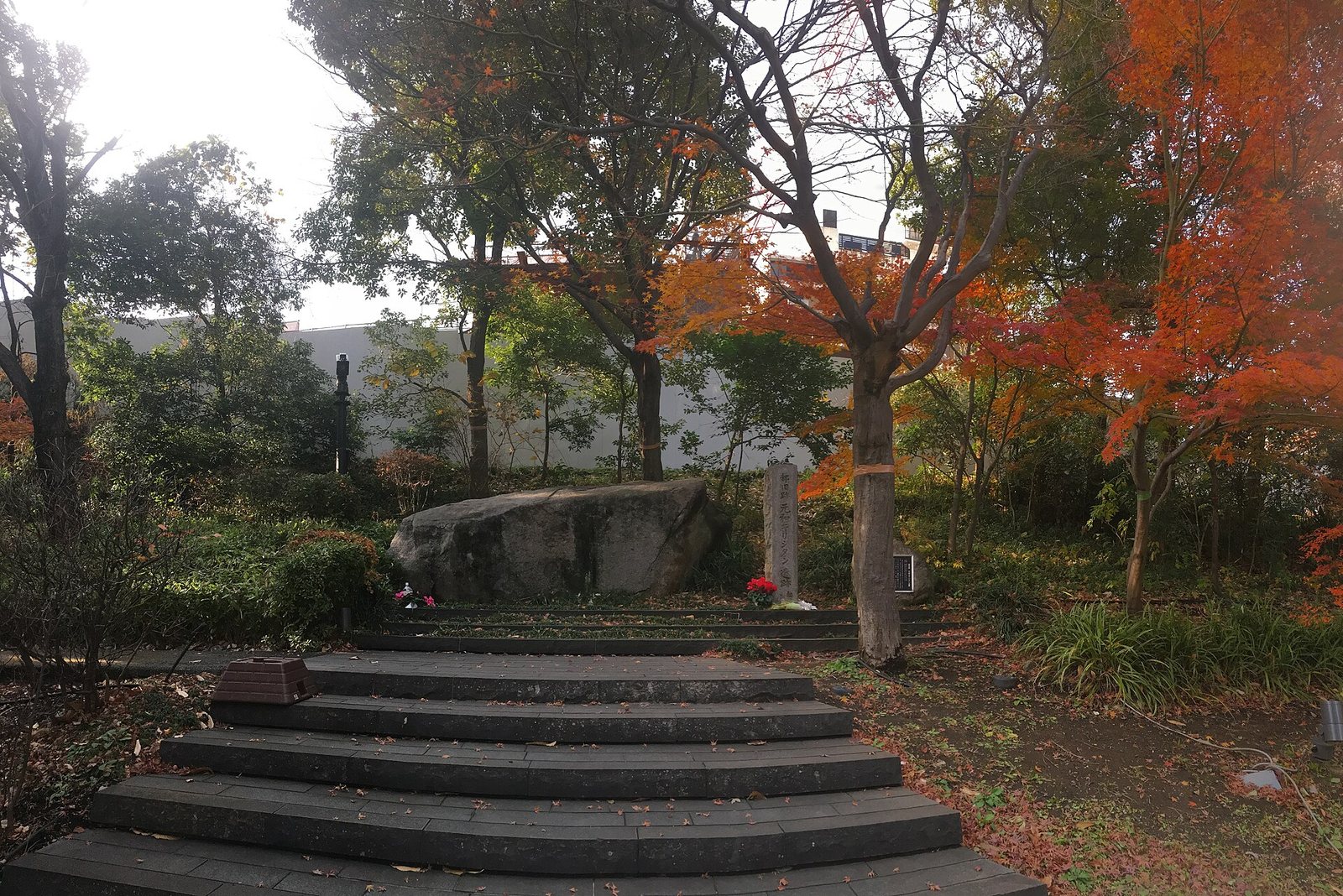
In 1956 Catholics set up a memorial pillar in the grounds of Chifukuji, near the place of martyrdom. When the temple moved away, the pillar went to the Catholic church of Takanawa, where it stands today. In 1960 the Tokyo Board of Education set up its own stone, "都旧跡 元和キリシタン遺跡", "Tokyo historic place: Genna Christian site". The temple later moved after repeated landslides, a hotel stood here, and in 2006 the Sumitomo Fudōsan Mita Twin Building West was built. The Tokyo stone now stands at the top of a broad flight of steps in the building's public open space.
Takanawa church holds a yearly Mass in memory of the Edo martyrs. In front of its crypt hangs an oil painting of the great martyrdom by Ezoe Takayoshi, and its basement archive shows fumie and notice boards of the ban.
