The view of temples and a church
From the harbour road a stone-paved slope climbs into the old town. As you go up, the green spire of the church appears above the tiled roofs of the temples. The prefecture's walking guide calls it the most Hirado of views, East and West in one street. At the top of the slope is Shōjuji, the temple where the third Matsura lord of the domain, , is buried.
Takanobu stands for the town's story. His mother, Mencia, was a daughter of the Christian lord Ōmura Sumitada and a devout Christian, and he is said to have been baptised as a child. When the ban came he ordered the churches in his lands destroyed, and he is said to have given up the faith.
Xavier in Hirado
After a year at , Xavier went to Hirado, where the Portuguese ships called: the trade, of the "southern barbarians". In a few days, his biographer Georg Schurhammer says, he baptised about a hundred people. He left his companion at Hirado and set out for Yamaguchi and Kyoto.
The faith spread from the town into the countryside. The lord of Hirado's west coast, , became a Christian, and his villages followed. In 1599 the Matsura lords banned the faith and the Kotedas left the island. In the town, the prefecture says, there had been a church called Tenmonji, and foreign missionaries came and went in a port known across Europe.
Sources: xavier in hirado
Xavier's time in Hirado comes from the Jesuit letters as told by Schurhammer. The World Heritage page gives the year 1550.
The church on the hill
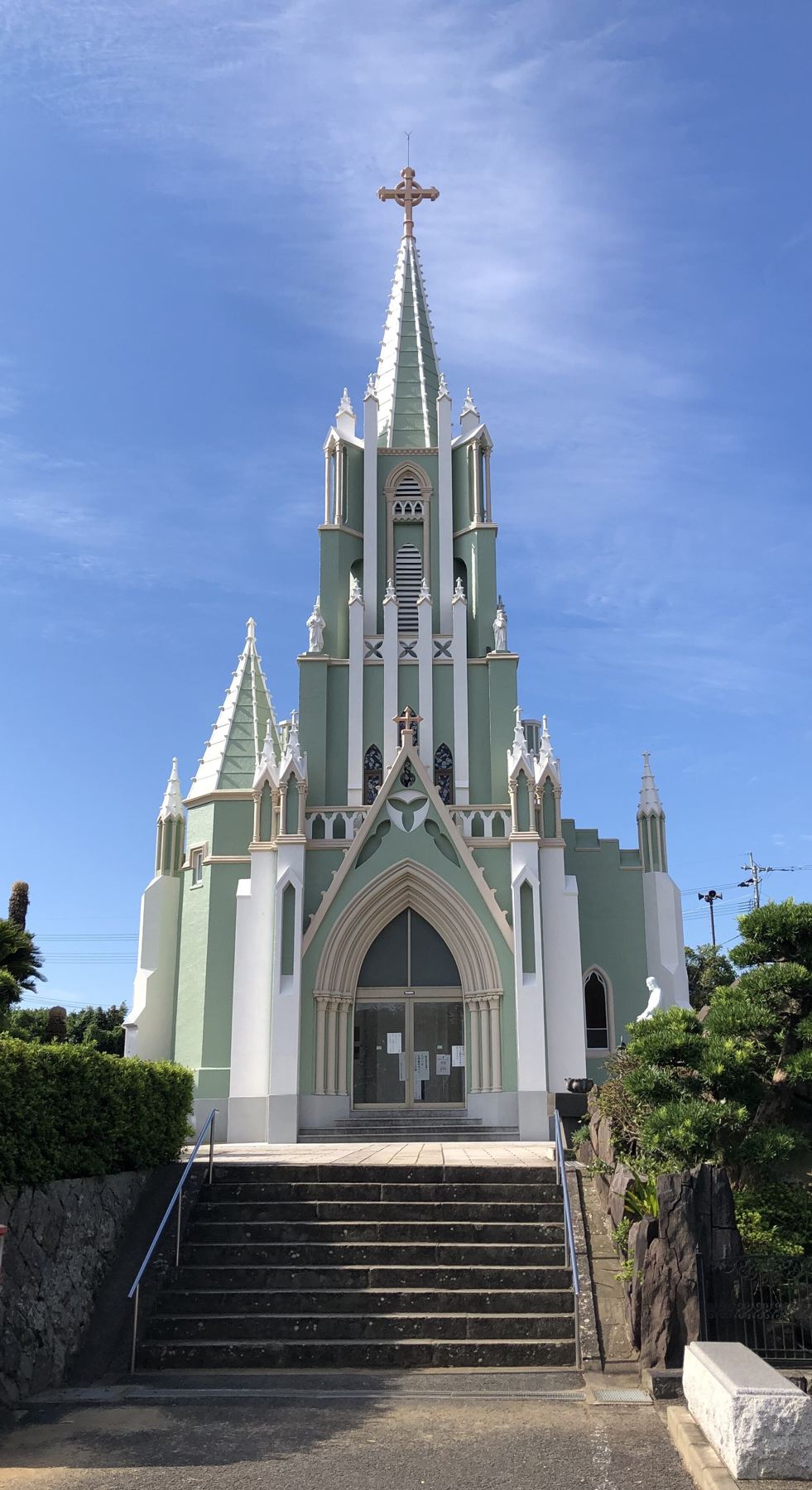
After the ban was lifted Catholics came to live in the town again. In 1913 they built Hirado Catholic Church where the Ai-no-sono nursery now stands. In 1931 the church was rebuilt on its present site. The prefecture says it was dedicated to St Michael the Archangel. It is of reinforced concrete, designed by the Suehiro design office.
It is a Gothic church, but not a symmetrical one: there is an octagonal tower only on the left side. The prefecture notes that a green exterior is rare among the Gothic churches of Nagasaki, and that the marbled walls and pillars inside are said to be painted in a traditional plaster technique.
In 1971, in memory of Xavier's visit of 1550, a statue of him was raised beside the church, and it came to be called the St Memorial Church. In recent years its official name was changed to Hirado Xavier Memorial Church.
